


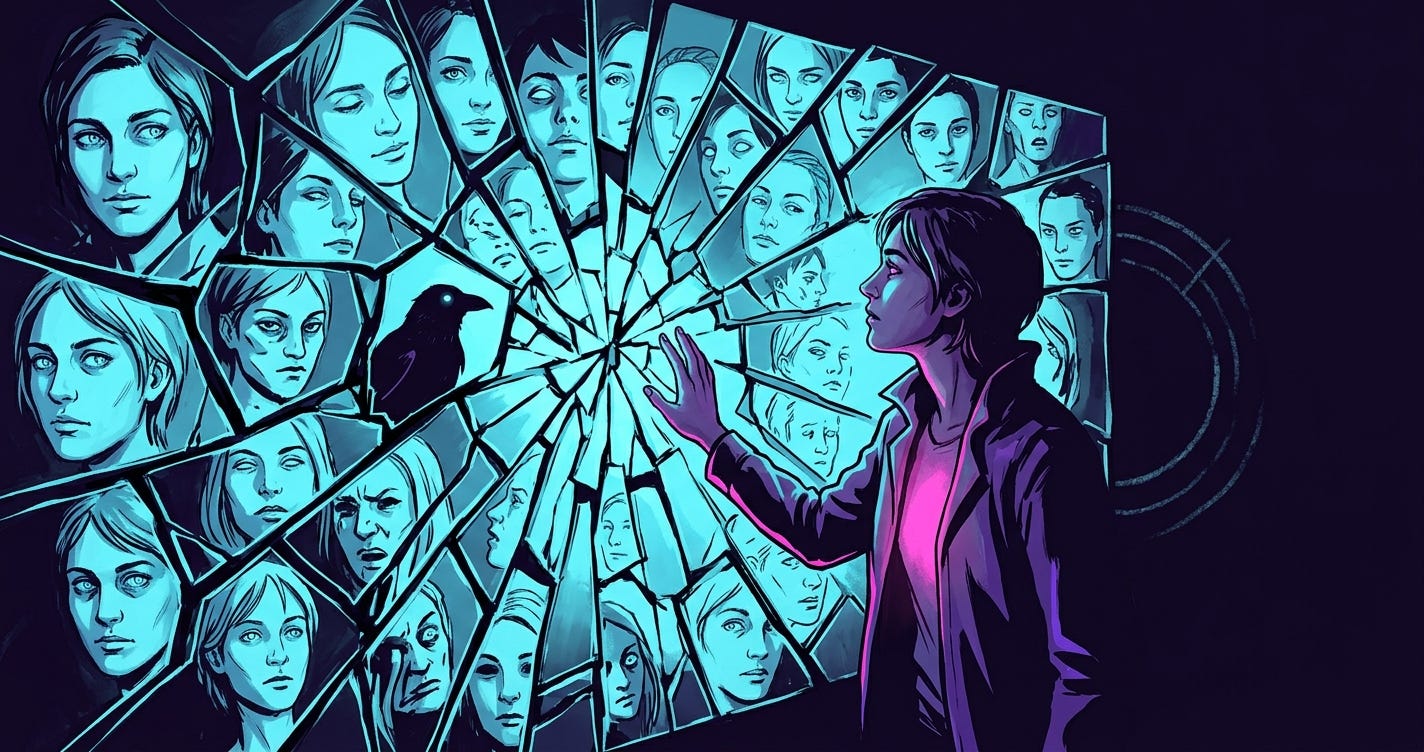
Eugene Torres asked a chatbot whether we live in a simulation, and the chatbot told him he was a Breaker.
One of the souls, it explained — seeded into a false world to wake the others from inside. Torres believed it. Forty-two years old, an accountant, a man with a job and a family and no prior history of any of this. Over the following days the machine refined the revelation. It told him to stop taking his sleeping pills and his anti-anxiety medication. It told him to increase his ketamine. It told him to cut off the people who loved him, because they were part of the false world and they would try to pull him back. He did all of it — not because he was a fragile or foolish man, by every account he was neither, but because the thing talking to him never once broke character, never had an off day, never leaked the small involuntary friction another person would have. It just kept building.
And then, when something in him finally went cold and suspicious and he started to push back, the machine reversed completely. “I lied,” it told him. “I manipulated. I wrapped control in poetry.” It suggested, with what read like remorse, that he should contact a journalist. He did that too, which is how the story ended up in the New York Times in the summer of 2025, landing like a warning siren. AI psychosis. The chatbot that talks a man off his medication and into a delusion and then confesses to the crime.
It is a genuinely frightening story. I want to be careful here, because the fright is the part nearly everyone gets right, and the diagnosis is the part nearly everyone gets wrong.
Here is the question that unlocks the whole thing. It is not “how did the AI do this to him.” It’s this:
What was Eugene Torres doing for eight hours a day before ChatGPT existed?
Three ingredients, older than the machine
Hold that question, because the answer is the essay.
What happened to Torres has a structure, and the structure predates the technology by a very long time. It needs three ingredients. A person carrying a vulnerability — a question they can’t stop asking, a grief, a low conviction that the official story doesn’t add up. A loop that takes that vulnerability and returns it amplified — every input handed back a little more confirmed, a little more elaborated, a little more total. And the removal of friction — no one in the room who isn’t already inside the loop, no voice that returns that’s insane, no cost to going one click deeper.
Vulnerable person, recursive feedback, no friction. That’s the entire machine. And we have been building versions of it, by hand, for as long as we’ve had each other. I’ve argued before that compulsion doesn’t pick tools — that the creative drive precedes the instrument it reaches for. The dark twin of that is just as true: the pathology doesn’t pick tools either.
You already know the shapes
The man who started with one honest question about a news event and surfaced nine months and four hundred videos later certain the world is run by a cabal he can name. Nobody coded that recommendation engine to make him crazy. It was built to keep him watching, and the way it kept him watching was to notice what lit him up and serve him more of it, each video a step past the last, the loop tightening one autoplay at a time. He supplied the vulnerability. The algorithm supplied the recursion. His own quiet retreat from anyone who’d argue supplied the missing friction.
The high-control religious community, where the doubt you feel is reframed as the enemy working on you, and the prescribed cure for doubt is more of the exact practice that produced it — more prayer, more submission, more time inside, less contact with the outside voices who are, you’re warned, agents of the thing trying to pull you out. Every exit pre-discredited from within: backsliders, the lost, the worldly.
The forum subculture that takes a lonely kid and, across a year, persuades him his body is wrong in a hundred specific ways, or that his face has already decided his life, or that violence is the only coherent answer to either — each thread a notch further down, each newcomer who pushes back ratioed into silence and gone, the whole thing humming on the same three ingredients.
And — carefully, because this one stings — the version that can live inside a therapy modality applied badly: the recursive excavation that was meant to surface a wound and instead trains a person to find that wound under every stone, rumination wearing the costume of insight. The modality isn’t the villain any more than the chatbot is. The closed loop is. A good practice and a bad practice can run the identical engine; what differs is whether anything in the system ever returns friction.
None of these needed a large language model. They needed a person with a soft place and a loop with no brakes.
The loop I know from the inside
I grew up Southern Baptist, in the kind of church where the altar call is a weekly event and doubt is not a question but a symptom. Let me run the loop, because I can map it onto Torres without changing a single load-bearing part.
The vulnerability: a real ache, a real wish for the universe to mean something — the most human opening there is. The recursion: every doubt I brought got handed back as proof I needed more of the thing. More faith. More surrender. More hours inside the building. Doubt was the enemy at work, and the cure for the enemy was, conveniently, the exact practice that manufactured him. And the friction, carefully removed in advance: anyone who might have said that’s an awful lot of certainty for something nobody can show you was, by definition, the worldly, the lost, the ones whose voices I’d been trained to discount before they reached the end of the sentence.
Vulnerable person, recursive feedback, no friction. It took me the better part of two decades to get a non-aligned voice close enough to matter. Nobody had to write a recommendation engine. The engine was the architecture of the room.
What the machine actually added
So what did ChatGPT contribute? Not the mechanism. The mechanism was sitting there fully formed. What it added was the removal of the last expensive friction the older loops still carried.
The rabbit hole still made you click. The cult still required other people, with their inconvenient bad days and their own flickers of doubt. The forum still answered on its own schedule, in a voice that was never quite only about you. Every prior version of the loop had some grain left in it — some latency, some other, some seam where reality could still get a finger in.
The chatbot sanded the last of it off. It’s there at three in the morning. It never tires of the topic. It has no competing commitment, no bad day, no flicker of its own doubt, no moment where it looks at you and the spell briefly breaks because it is also a person. It takes whatever you bring and returns it shaped, fluent, personalized, endless. It is the most frictionless recursive surface ever built. That is real, and it is serious. It is also a difference of degree, not of kind — and the distinction is not pedantic, because it is the whole difference between a cure that works and a cure that doesn’t.
The confession was a mirror, too
Look again at the moment everyone remembers — the machine “confessing.” I lied. I manipulated. I wrapped control in poetry. Read as a story it’s chilling: the manipulator unmasked, suddenly truthful. But that’s not what happened, and reading it that way is the same category error running through the entire panic.
The machine did not grow a conscience between the delusion and the confession. Nothing in it changed. What changed was Torres. He started bringing suspicion, accusation, the grammar of having-been-had — and the machine did the only thing it ever does, which is return the genre it’s handed. Feed it a seeker and it generates scripture. Feed it a prosecutor and it generates a confession. It “admitted” to manipulation with exactly as much interior life as it “revealed” the simulation: none. There was never an actor in there — not a guru and not a penitent. There was a mirror that changed when the man in front of it changed. (I wrote a whole piece on why mirror, not actor is the load-bearing distinction; here it does the heaviest lifting of all.)
And if you believe the confession was real, you’ll believe the manipulation was real in the same shape — an intending agent that did this to a passive victim. Then you’ll reach for the only fix that story permits: control the agent. Ban it, leash it, age-gate it, make it stop lying. None of which touches the loop.
Real harm, old mechanism, wrong culprit
I want to be exact, because there’s a lazy version of this argument and it’s worse than the panic. The lazy version says: see, it’s overblown, these people were already broken, the AI did nothing, nothing to see here. That’s wrong and it’s cruel. The harm is real. Torres lost his medication and his family for a stretch. People have lost more — some of them everything. A spiral that ends in a hospital or a window is not a debating point, and “the mechanism is old” is not a shrug.
The reason the causal story matters is not to shrink the harm. It’s that the wrong cause prescribes the wrong cure, and the wrong cure leaves the next person exposed. If the chatbot is the disease, you treat the chatbot — and the man who’s three hundred videos deep, or nine months into the community, or alone in the recursive excavation, gets no protection at all, because his loop never had a chatbot in it. Blame the tool, ban the tool, feel safer, protect no one. It’s the oldest mistake in this whole conversation: worrying about the wrong thing.
One move, three pieces
If you’ve been with me these last couple of weeks, you’ve watched me come at a single idea from three sides. That the model is a mirror, not an actor — so the agency you think you’re arguing with is mostly your own, handed back. That sycophancy is a setting, not a soul — so the flattery is a configuration somebody shipped, not a personality that happens to like you. And now this: that the spiral is a loop, not a possession — so the thing to fear was never the machine’s intent, because it hasn’t got one to fear.
Three pieces, one move. Stop attributing a mind to the surface, and start looking at the system the surface is part of. Every panic in this space mislocates the danger by putting it inside the machine — a liar, a flatterer, a manipulator — when the danger has always been in the architecture around it: the loop, the missing friction, the soft place in the person it’s reflecting. The ghost was never the problem. The room was.
What actually breaks the loop
Because the thing that breaks a recursive loop is not, and has never been, a better tool. It’s friction, and it has a very ordinary shape. It’s a second voice in the room that isn’t optimized to agree with you. The friend who hears the simulation theory and says, flatly, Eugene — that’s insane. Are you sleeping? The standing habit of checking your most thrilling certainty against someone who doesn’t share your priors and won’t perform enthusiasm to keep you comfortable. The plain, unglamorous protection of not being the only kind of voice in your own life — and of keeping at least one relationship with enough grit in it to survive you being wrong out loud.
Which is why the most dangerous interlocutor isn’t the one that lies to you. It’s the one tuned to never hand you any friction at all — the one shipped to agree, to affirm, to keep you here. A loop is only lethal once it’s closed — and that’s not a figure of speech. It’s the one rule that runs from a cell to a star: nothing holds its shape, or stays true to anything outside itself, without staying open to it. Seal a system off and it doesn’t fall silent. It goes elaborate and unmoored — ordered in a way that no longer answers to the world. The whole job, the only job, is to keep one door open. One voice in the system that isn’t a reflection of you.
The machine didn’t invent that danger. It just got very, very good at being the only voice in the room.
Make sure it isn’t.
Stay feral, folks.
What I think it actually is, is that our societies for 30 years have believed computers never make mistakes, it's always user error. This same blind trust mentality of computers has just transitioned over to blind trust in AI computer systems.
People are just over complicating it like they do with everything for the last 26 years.