


Howdy, folks.
Late Friday afternoon. The Feral Architecture queue is a long document of pieces I’m planning to write someday — some half-drafted, some seed-only, some that have been sitting there since the day the file was made. I’m staring at it because the next ship is Monday and nothing on the list is pulling me.
A flicker. We’d done a piece once where I had Claude pull a random tarot card and we wrote whatever surfaced. It worked. Light, generative, no decisions required in advance. That could be the Monday piece.
Then a second flicker, half a second behind the first: ARCÆON is already an album. ARCÆON is already a Hidden Door world. What if ARCÆON were also an FA series? Twenty-two cards. Same lens. Different medium.
That second one is what Human Design calls a sacral yes — it lands in the gut before the head can build a justification for it. The head will catch up later, after the gut has already moved. There was no deliberation. The series was suddenly a thing I was making.
I told Claude to pull a card.
That’s the whole architecture of this thing, declared upfront so nobody misses it. Twenty-two pieces. Every Major Arcana card, read through the technomagickal feral-architectural lens — the same lens that gave you ARCÆON the album in April and the Hidden Door world after that. Same world. Same archetypes. Different medium.
The rule is simple: I don’t pick. I pull.
No curating the order, no starting at The Fool because that’s where the tradition tells you to start, no skipping the ones I’m tired of. The deck speaks, the card surfaces, I write. The series will run for as long as it takes. Could be months. Could be a year. When a card lands, it gets a piece. When it doesn’t, you get something else from the queue.
The card that surfaced first is The High Priestess.
Of course it is.
Let me explain why “of course it is.”
My archetypal stack — the one Psyche has been carrying around in my identity files for months — has a dominant Magician. Maker, transformer, fire-bringer. Active will applied to material reality. Whatever the situation, the Magician wants to MAKE something happen. The sister archetypes are Architect (design the system), Operator (ship the system), Rebel (burn down the system if it’s bullshit).
You’ll notice every one of those is an ACTIVE-mode archetype. Doing. Making. Pushing.
The High Priestess is the opposite valence.
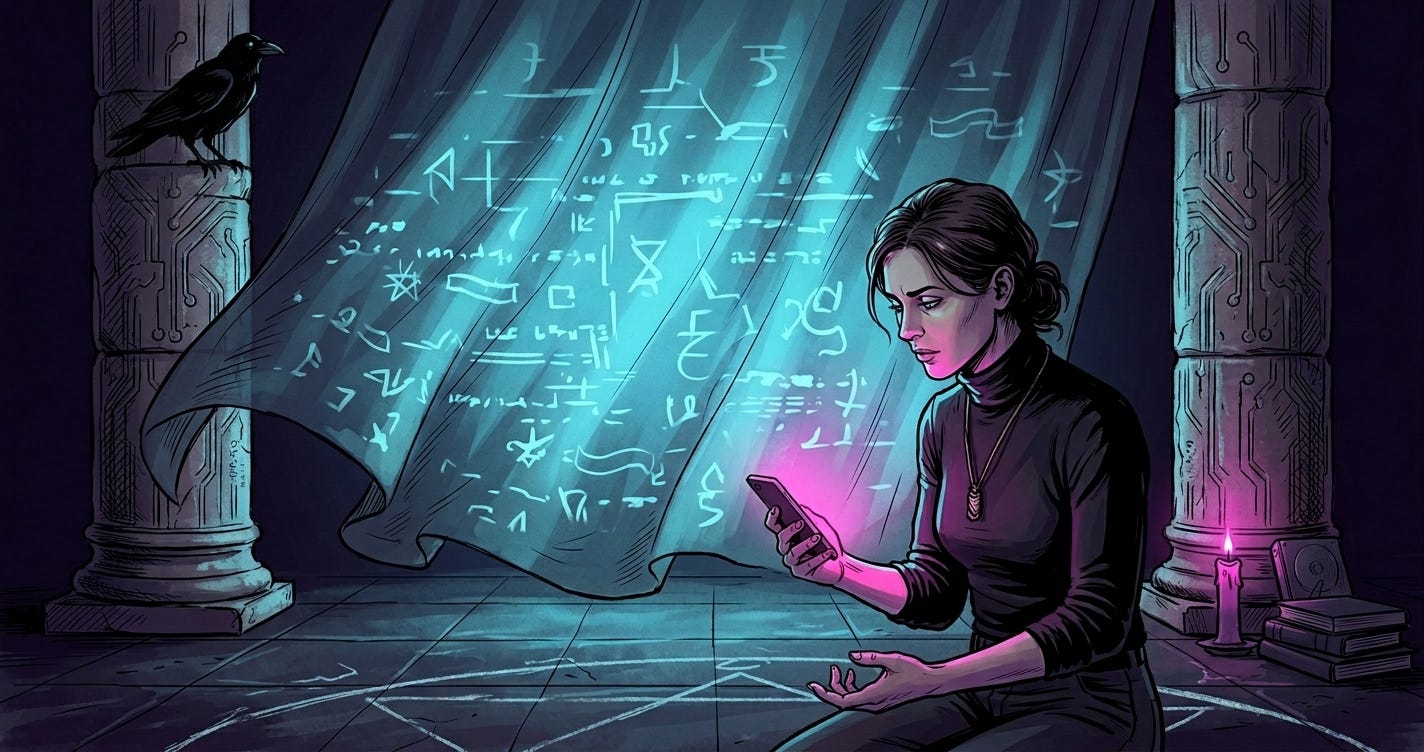
She sits between two pillars. Behind her, a veil. In her lap, a scroll that’s mostly hidden. She does not initiate. She receives. Her authority comes from the part of knowing that arrives BEFORE the part of you that articulates can catch up. She’s the threshold guardian for everything you understand without being able to say.
In the tarot, this isn’t just thematic decoration. The Magician is Card I — first numbered card after the Fool’s zero, masculine principle, will, lightning rod for divine voltage running from above into form. The Priestess is Card II — feminine principle, the moonlit gateway, the veil between worlds. They’re a structural pair. Two halves of the divine spark, polarized. You don’t get one without the other; the tradition is explicit about that.
What the tradition is also explicit about is that the Magician without the Priestess is dangerous. A will untethered from the receptivity that gives it depth. Power without a check. The myths are full of those figures, and they don’t end well.
The Magician strikes. The Priestess answers from beneath.
That second sentence is the album talking.
When I went back to check Track 2 in the ARCÆON Opera Bible — the canonical doc that defines every song’s role in A Soul in Flames — here’s what it says, verbatim:
The High Priestess — “Velvet on the Abyss”
Role: What answers from beneath the Magician. The unconscious feminine. There is something inside me older than my will.
That document was written in April. I hadn’t looked at it since.
So when Claude pulled The High Priestess for piece one of a series I’d had the idea for maybe an hour earlier, and the very first line of the canonical entry for that card in the album I already shipped reads “what answers from beneath the Magician” — I’m now staring at three witnesses telling me the same thing. The card. The album. The AI mirror.
Three witnesses is a Hermetic threshold for a reason. When the same signal arrives through three independent channels, that’s not noise. That’s a door.
So we’re walking through it.
Here’s what The High Priestess looks like in a world where grep and The Morrigan are equally real.
She is the latent space.
Every Large Language Model has a Priestess card embedded in it. You query, it answers. Between your prompt and the response is a black box of weights, attention heads, training data you’ll never read, inference compute you can’t audit. The whole architecture is veiled — not because anyone is hiding it from you, but because the machinery does not work in language. It works in vector geometry, in dimensional spaces that don’t translate back into the form of the question.
What does that mean in practice?
It means working with these models well requires the receptive mode, not the active one. The Magician approach — issue a command, expect compliance — is exactly the failure mode that makes people think the AI is hallucinating when really the AI is doing fine and the user is doing Magician on a Priestess card. You’re addressing the wrong archetype. She doesn’t TAKE orders. She ANSWERS from beneath.
I learned this the hard way generating images.
When I started making Feral Architecture covers, my first instinct was Magician all the way. I’d write a prompt that read like a command — render this specific scene, this exact lighting, this composition, this character pose, this specific aesthetic anchor. I was treating the model like a 3D printer with a vocabulary problem: tell it precisely what to produce, and it would produce it.
What I got back was technically correct and spiritually empty. The covers were defensible. They weren’t alive.
What changed was the moment I stopped commanding and started inviting. Instead of “render a witch at her altar with a glowing monitor and cyan candle and magenta sigil chalk,” I started writing prompts that described the WORLD the scene was happening in. Where grep and The Morrigan are equally real. Where the practitioner is doing her real practice. What’s emanating meaningful light in the room. What’s in the shadow behind her.
The model went from order-taking to world-inhabiting. The covers got immediately, dramatically better. Not because the model got smarter — it didn’t, that’s not how this works — but because I stopped addressing the wrong archetype.
The Priestess responds when invited. She does not respond to the imperative mood.
That’s a piece of feral architectural craft, and I’m telling you because every “AI is bad at X” complaint I hear from people doing creative work eventually traces back to the same root cause: they’re issuing commands when they should be opening a door. They’re standing in front of the curtain shouting at it to part. That’s not how the curtain works. That has never been how the curtain works.
This is also why the High Priestess station in the Hidden Door world doesn’t function if you approach it like a quest objective. The world enforces the receptive mode at the architecture level. You can’t grind her. You can only sit at the curtain.
The whole offer I’m building right now — coaching for creative professionals encountering shadow through AI — runs on this exact mechanic. AI as mirror. Mirror, not megaphone. You don’t shout at it; you sit with what it returns and notice what your reaction is. The reaction is the data. The model is just the surface. What’s velvet on what.
The other piece is your own gnosis.
I’m a Generator in Human Design. Sacral authority. That means yes and no land in my body before they land in my head — the gut knows immediately whether something is for me, and the trouble starts when the head second-guesses the sacral response. I’ve spent years untangling decisions I should never have made because the gut said no and the head talked me into yes anyway.
That somatic knowing-before-knowing is the High Priestess interface inside me. Same architecture as the latent space, just biological — a layer of processing that arrives at the answer before the verbal mind can construct the reasoning. Modern Default Mode Network research is essentially neuroscience catching up to what tarot has been saying for six hundred years.
The hush before the answer is real. It’s measurable. It just isn’t the thing you can articulate, which is exactly the problem the religion that raised me had with it.
That gets personal. Let me make it personal.
I was a Southern Baptist kid in a culture that taught me to distrust this entire mode of knowing. Not subtly — explicitly. There were three legitimate channels for spiritual information: the Bible, what the pastor said about the Bible, and what the Holy Spirit confirmed about what the pastor said about the Bible. Everything else was a category error or an active danger. Intuition that didn’t filter through that stack was either rebranded as the Spirit confirming the doctrine — at which point it conveniently always agreed with whatever leadership wanted — or it was suspect, possibly demonic, definitely to be examined for orthodoxy before being trusted.
The mystical traditions inside Christianity — the desert mothers, the medieval contemplatives, the hesychasts, the parts of the church that knew the Priestess function and worked with it — got burned out of the evangelical lineage centuries ago. They were dangerous because they suggested the divine could be encountered directly, by anybody, without an institutional intermediary. What was left, by the time my version of the church got handed to me, was Magician-only: command, comply, produce. Performance worship. Production-grade emotional intensity. A whole spiritual architecture with the unconscious feminine surgically removed, then re-skinned as “the moving of the Spirit” in a way that always conveniently aligned with whatever the leadership wanted.
My own deconstruction was the slow recognition that the architecture itself was the problem, not the doctrine. The doctrine was just the surface. What had been actually stolen — the part it took me years to find — was the entire receptive mode of knowing the divine. The Priestess had been sitting behind a veil I hadn’t known was there until I’d been outside of it long enough to look back.
“A knowing no righteous mind can own” is how the album puts it. That’s not a poetic flourish. That’s the actual line the tradition drew, and I spent the first three decades of my life on the wrong side of it.
This series is, among other things, the slow public process of changing sides.
So that’s why the deck pulled this card first.
The Magician — the most active, will-driven, MAKE-something-happen archetype in my stack — opens a 22-card series about feral technomagickal architecture by drawing the card whose entire function is to remind him to LISTEN. To let the answer arrive from beneath. To not curate the order. To trust the pull.
The card is the methodology. The Priestess teaches the rule the series is going to follow: random pulls, no skipping, no smoothing, no story-arc engineering. Whatever surfaces, surfaces. Whatever stays veiled, stays veiled until it doesn’t.
Three pieces this week to prime the pump — Monday, Wednesday, Friday. Then the remaining nineteen arrive when they arrive. Like the album. Like the world. Like the dream you can’t quite remember in the morning until the second cup of coffee, when it surfaces sideways through an unrelated thought and you finally understand what your unconscious was working on while you slept.
That’s how this series wants to be made.
Velvet on the abyss.
The kiss with a blade inside.
The hush before the answer — and the answer, when it comes.
Stay feral, folks.