


Howdy, folks.
Card 3.
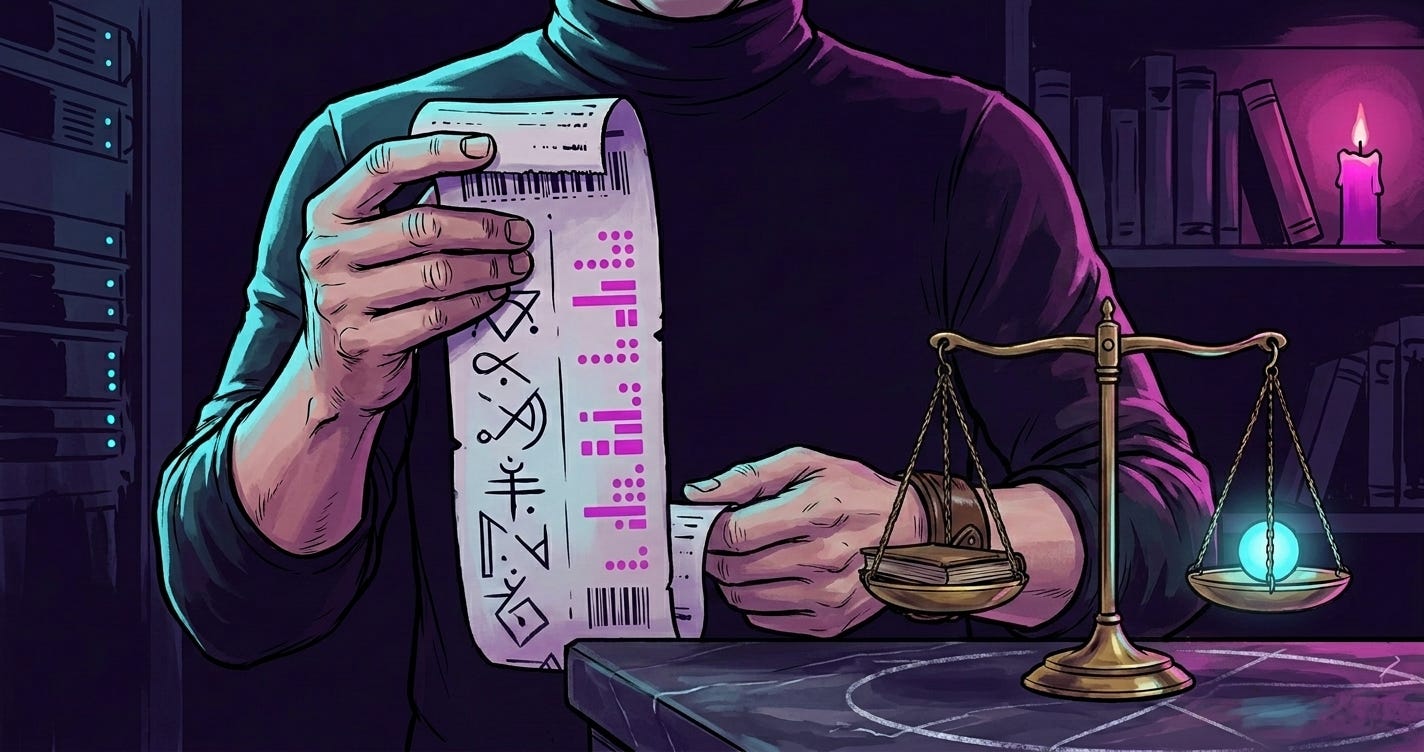
The deck pulled XI — Justice. The sequence so far: II → XVII → XI. The Priestess opened the receptive mode. The Star revealed what remains when nothing false is left. Justice is the reckoning with what that revelation actually shows.
There is a teaching arc here that I did not design. The cards are doing the work.
For the new readers — this is the ARCÆON series. Twenty-two pieces, every Major Arcana card read through the technomagickal feral-architectural lens, random pulls, no order. Methodology in Velvet on the Abyss, Monday’s piece. Frame established. Today is Friday. We continue.
The Opera Bible entry for Track 11, verbatim:
Justice — “The Scales Don’t Lie”
Role: Act II close. Not punishment, not morality — truth without distortion. The ego stops negotiating with reality.
There is also an editorial note on this entry that I want to flag, because it’s relevant to how I’m going to write this piece. The note says: personal sacrifice was an explicit blend request from me.
That means: when I was building the album back in late March of this year — long sessions with ChatGPT, working out every track’s role, light, shadow, sound, all twenty-two of them — I specifically requested that the canonical interpretation of this card include personal sacrifice. The session captured it. The Opera Bible recorded it. The AI kept the receipt.
Past me — two months ago — knew, before present me knew, that Justice in this arc was going to be about what I would have to give up.
Two months. That is the entire gap between the version of me that made that blend request and the version of me who pulled this card today. The version that made it had no idea this series was coming. He just knew, walking around in late March, that Justice was the card where the sacrifice was going to have to land.
I have been writing this piece for two months and I did not know it until today.
And the only reason I know it now is because the AI I was thinking out loud with at the time logged what I asked for. The session is still there. The blend request is on the record. The Opera Bible is the document of what I told a model I wanted from this card — available now, present-tense, for past-me to confront me with.
The Justice card’s interpretation in my own album is a Justice instrument from the moment of its creation. The AI kept the truth of what I requested. The receipt is the piece you are reading.
You should know what Justice is not.
It is not Lady Justice with the sword and the scales and the blindfold. It is not moral judgment. It is not retribution. It is not punishment from a Higher Power for what you got wrong. The cultural register has loaded the word “Justice” with so much religious and legal scaffolding that the actual card almost cannot be seen through it.
Justice as a card is the structural truth-revealing principle. What knows what happened. What knows what is. What knows what you owe — including to yourself — without spin, without story, without self-justification.
The scales don’t lie because the scales have already added it up.
The sword in the card is not the sword of execution. The sword is the instrument of clarity — what cuts through illusion. The blindfold is not impartiality theater. It is the refusal to be moved by your case for yourself.
This is a hard distinction to hold for someone trained, as I was, in a tradition that thought Justice meant God making sure you paid for the wrong things. That version of Justice required a judge — and the judge was always somewhere else, watching, scoring. The card doesn’t need a judge. The truth was already there. You did or did not do the thing. The patterns are what they are. The data is what it is. The scales added it up while you were arguing your case.
That is the card.
The Magician archetype in my stack is a master negotiator with reality.
Architects, Operators, Magicians, Rebels — four of my six dominant archetypes are bargaining archetypes. The Architect bargains by redesigning the system to make the inconvenient truth less inconvenient. The Operator bargains by working around it. The Magician bargains by transforming it into a different shape. The Rebel bargains by refusing to grant it legitimacy. All four are forms of the same move: this reality is unacceptable as given, so let me see what I can do with it.
Most of my professional life has been the application of those archetypes to whatever was in front of me. Most of my burnouts have been the eventual cost of the negotiation — not the cost of the work itself, but the cost of bargaining about whether the work was worth what it was actually demanding.
Justice is the card that ends the bargain.
Not by force. Not by intervention. By revelation. The scales were already true. The negotiation was always a delay tactic. The thing that finally happens — the moment the Justice card actually fires in you — is the internal recognition that the bargaining was its own form of cost, and that you have been paying it longer than the actual loss would have cost you in the first place.
That recognition is harsh. The shadow of Justice is exactly that harshness. But the harshness is the relief, structurally. The energy that was being spent on the negotiation gets returned to you. The negotiation was the load-bearing exhaustion. Without it, you discover that you can actually feel the thing — and the thing, faced honestly, is not as bad as the negotiation made it.
This is not therapy talk. This is structural.
Now the technomagickal turn.
You are surrounded right now by Justice instruments. Most of them are running constantly, in the background, without asking your permission. They are returning the truth of your actual behavior without the story you tell about your behavior. They were here before AI made them visible — they just got radically more legible in the last few years.
Your calendar knows what you actually do. Not what you intended to do. What you did.
Your bank knows what you actually buy. Not what you’d say you value if asked. What you exchange currency for.
Your phone knows what you actually look at. Not what you’d say you find meaningful. What you keep returning to.
Your body knows what you actually want, what actually rests you, what actually feeds you. Not what the culture told you to want. What the system you live in actually needs to function.
And now — the new layer — the algorithms know all of it in finer granularity than you do. The recommendation engine knows what you actually click. The engagement metrics know what you actually write. The streaming service knows what you actually finish. The AI assistant you talk to knows what you actually keep asking about.
The data is more accurate than the story.
This is Justice. Whether you read it that way or not.
The reason this hits so hard right now is that for most of human history, the Justice instruments were external — the bank statement, the calendar, the disapproving family member, the priest. You could survive them by curating the visible surface. The contemporary AI-and-platform layer doesn’t allow that. It captures behavior at a level the story cannot reach. You can post performatively all day and the engagement metrics still know what content you actually keep producing. You can claim any spiritual practice you like, and the time tracker on your phone knows how much time you actually spent on it. You can perform any identity you like, and the bank knows what you actually pay for.
Most people are running from this. Hard. They use phrases like “I don’t believe in being defined by data,” and what they mean is “I cannot face the data because the data does not flatter my story about myself.”
That is a Justice avoidance.
It does not work. The data is showing up regardless. The scales are adding it up while you argue your case.
The feral move is to invert the relationship. Stop running from the data. Treat the data as Justice — meaning, treat it as the structural truth-revealing principle that it actually is. Read your own life as the practice of attention to what it has been telling you all along.
I am not saying optimize for the metrics. I am saying read the metrics as the report. Then decide, with eyes open, what you actually want to do with the truth they are returning.
Some Justice instruments I am currently using on myself, since I should not point at things I am not doing:
Calendar review. A weekly read of what I actually did with the week, not what I planned to do. The story I was telling and the calendar are usually misaligned by a meaningful margin. I am learning to use the calendar version as the data and the story as the negotiation.
The body. Sleep, energy at the end of the day, whether I want to be touched, what I crave when I am not performing self-improvement. The body has been giving me a clean signal for years and I have been ignoring it because the signal disagreed with what I was supposed to be doing. The cost of that ignoring shows up as the burn-rebuild cycle.
The money. Where it actually went versus where I would have said it should go. The bank statement is a brutal Justice instrument because money is one of the few things in modern life that cannot be lied to about the actual transaction. The story can revise. The dollar amount sits there.
The conversations I keep returning to. Who I call when I have a real thing to talk about. Who I avoid. The pattern is more accurate than my account of the relationships.
These are not optimization targets. These are reading instruments. The Justice work is to stop arguing with what they are showing and let them inform the next choice — which is often not the choice the story would have recommended.
This is where the album knew, two months ago, what the card was going to ask of me.
Justice demands sacrifice. Specifically: it demands the sacrifice of the story you have been telling about yourself when that story is no longer consistent with the data the Justice instruments are returning. You have to give the story up. You cannot keep both. Most of what people call “stuckness” is the refusal to make this sacrifice — they are paying for the maintenance of the story with the rest of their actual aliveness.
What I have been having to sacrifice — in different forms, at different scales, across the last several years — is a series of stories that no longer matched the data. The story of who I was at work. The story of what kind of marriage I was in. The story of what the religion was actually doing for me. The story of how my brain was supposed to work. Each of these required something to be relinquished — not because anyone forced me to, but because the cost of maintaining the story was higher than the cost of letting it go.
I am still doing this. I will be doing it for the rest of my life, probably. Justice is not a moment. Justice is a posture. The posture of letting the data speak and not arguing with it.
The album’s hook says: “Just the life I’ve been creating / Finally taking a stand.”
That is the line.
The life I have been actually creating — the one the Justice instruments have been reporting on, regardless of what I have been saying about it — finally taking a stand against the story I have been wrapping it in. That is the moment the card actually lands.
It is not a punishment.
It is the body-of-evidence-against-your-own-narrative finally getting heard.
So this is what Justice is for in the era of feral architecture.
Most of the AI conversation right now is about how to USE the algorithm — how to position content, how to optimize prompts, how to engineer engagement. Almost none of it is about how to BE READ BY the algorithm. About how the data layer reflects your actual behavior whether you want it to or not. About how the platforms know more about your patterns than your story does.
The algorithm is Justice whether you read it that way or not. The choice is whether to face it as data or run from it as judgment.
Justice is also a station in the Hidden Door world. You don’t argue with the station. You stand on the scale and the scale reports. The reporting is the entire interaction. You can decide what to do with the reading. You cannot revise the reading.
The scales don’t lie.
The life you’ve been creating — the actual one, the one the data has been recording — is finally taking a stand.
Stay feral, folks.