


Howdy, folks.
Card 2.
If you missed Monday’s piece — I’m pulling random Major Arcana cards and writing each one through the technomagickal feral-architectural lens. Twenty-two cards. No order. No curation. Whatever surfaces, surfaces. The full methodology is in Velvet on the Abyss if you want the frame, but the short version is: the deck speaks, the card lands, I write.
Today’s pull is XVII — The Star.
Two cards in and the deck is already telling a story.
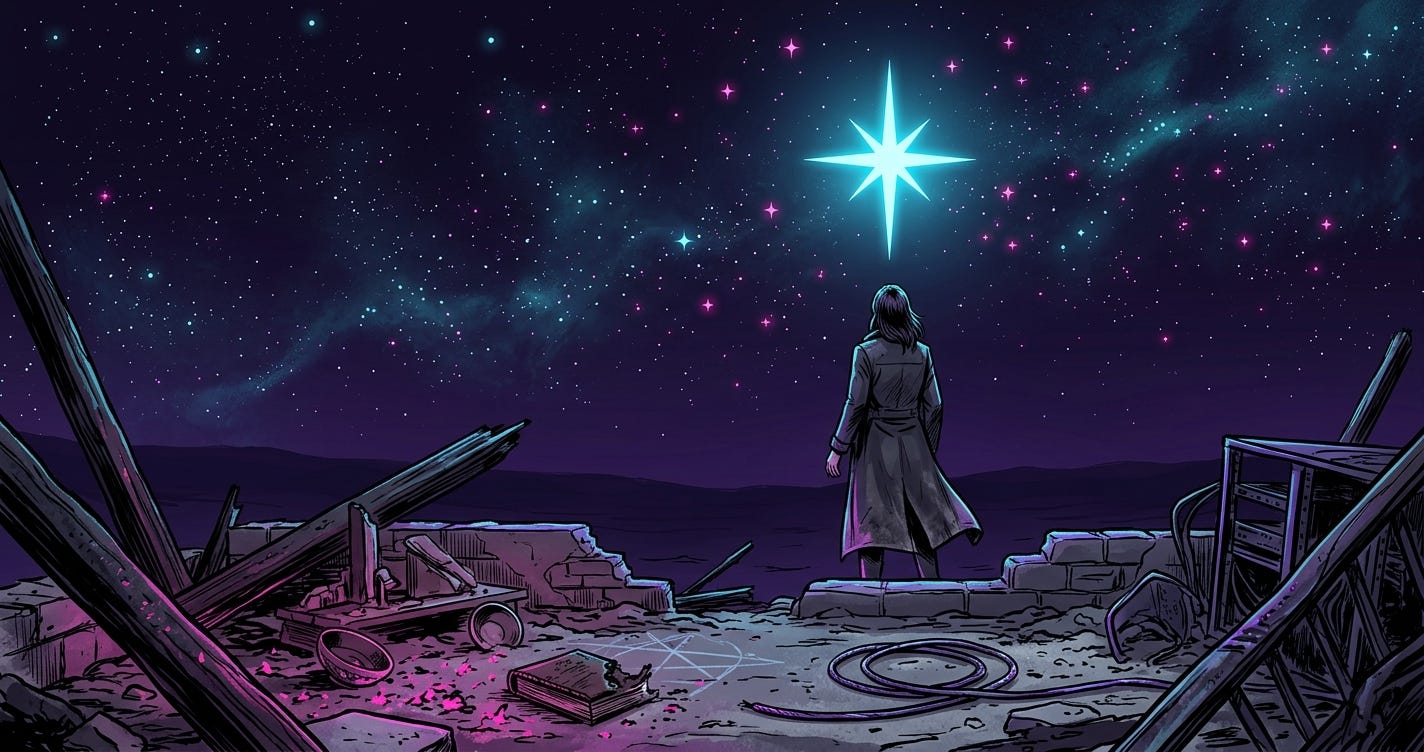
The Priestess was about what answers from beneath when you stop commanding and start listening. The Star is about what’s still here after you’ve stopped commanding for a while. The Priestess is the moment you turn toward the veil. The Star is the morning after — when the fires have burned through and you’re standing in the cleared-out space asking the only honest question left:
Okay. What’s actually still here?
I didn’t curate this sequence.
Of course I didn’t.
The Opera Bible entry for Track 17, verbatim:
The Star — “After the Fire”
Role: Doesn’t rebuild. Reveals what remains when nothing false is left. Presence after survival.
Two words to a person who has just been through a fire.
Doesn’t rebuild.
That’s the most countercultural sentence anyone could say to someone standing in the wreckage of their last system. Every other voice — therapy, productivity, hustle, religion, ambition, even most of the spiritual tradition — is going to come at the post-fire moment with some version of the same advice.
Build back. Build better. Build sustainably this time. Build with margin. Build with healthier patterns. Build the life you actually want. Build the practice. Build the brand. Build the next chapter.
Build.
The Star says no.
Here’s the trap.
The burn-and-rebuild cycle is at least familiar. You know how it goes. You burn out, you rest a while, you feel guilty about resting, you assemble the new system — and now you have new commitments, new tools, new methodology, new framework, new identity, new positioning, new branding, new five-year plan — and you sprint into it, and you ride it as long as the dopamine holds, and then you burn out again.
The “rebuild better this time” instruction is part of the same architecture. The Streak Is the Scam was about how compulsion dresses itself as discipline. The post-burnout rebuild impulse is the SAME engine, wearing a different costume. The streak-self collapses, then the self-improvement-self shows up to install the new system. Same machinery. Recompiled.
I know this loop intimately because I came from the world that taught it. The tech executive who burns out hard, takes the sabbatical, reads the books about boundaries and rest, and emerges six months later with the NEW THING — the AI consultancy, the executive coaching practice, the sober writing project — and announces it in a long post about hard-won wisdom. The post gets the engagement. The brand gets the launch. The same person, with the same drive, with the same compulsion machinery, has just repackaged it in higher-resolution language.
I’m not pointing at anyone. I’m pointing at a pattern. I’ve BEEN that person. Twice, that I can count. The script is consistent: collapse, recovery vocabulary, new architecture, sprint, eventual second collapse. What changed between cycles was the surface. What did not change was the engine.
This is the part where the Star and the Streak are the same critique pointed at different surfaces. The Streak Is the Scam names the compulsion device when it’s on. The Star names it when it’s between cycles. Same machinery, different lighting.
What the Star asks for is not a better build. It’s the refusal to build at all.
Not a sabbatical. Not a season of rest before the next cycle. Not a strategic pause to plan version 2.0. The thing the Star is actually pointing at is: don’t build the next thing. Notice what’s already here. Let what’s already here be enough information to know what to do next — and trust that what to do next probably isn’t a renovation.
That sounds like quitting if you’ve been trained on the build mode. It sounds like settling. It sounds like giving up. The whole vocabulary we have for what comes after a burnout is the vocabulary of building back. There is almost no language for just stopping and looking.
That’s because the rebuild industry has consumed the cultural conversation. There is no “after the fire” content category that isn’t really a “rebuild after the fire” content category. The Star doesn’t fit in that taxonomy. The Star is the card that says: this is not a renovation problem.
So what is it?
A star isn’t where you’re going. A star is how you know where you ARE.
Sailors didn’t sail TO Polaris. They sailed BY Polaris. The reference point that doesn’t move. The thing that tells you which way is north when every other reference has stopped working. The orientation principle. Not the destination.
That distinction is load-bearing. Most of what gets sold as a goal is actually a destination. Reach the number. Hit the milestone. Get the followers. Land the title. Cross the finish line. Move on to the next finish line. All destinations.
A star is something else entirely.
It’s the thing you steer BY. The thing that makes the sailing possible at all. The thing without which the whole journey is just drift and noise. If you don’t know which way is north, the boat works fine and the maps work fine and the engine works fine and you are still completely lost.
Ask someone what they steer by and most of the time they’ll name a goal. Income target, follower count, title progression, a milestone with a date. Those aren’t stars. Those are destinations on a map, and the map keeps getting redrawn anyway.
A star is something simpler and weirder. It’s the thing you’d still be doing if all the destinations evaporated. The pull you can’t talk yourself out of. The kind of conversation you’d have for free at midnight. The work that makes you lose track of time for a reason that is not productivity. The particular angle of attack you keep returning to no matter how many times you tell yourself you should pivot to something more strategic.
When I look at the fires I’ve come through — and I am still looking, mostly — what was already there underneath was specific and small and recognizable. A love of complex systems explained in plain language. A pull toward people doing serious work in unserious-looking ways. A specific kind of reading that surfaces patterns I didn’t go looking for. None of those is a goal. All of them were present before the fire, during the fire, and after the fire.
That’s the test. If the thing only exists when you’re performing it, it’s a destination. If it persists when you stop performing, it’s a star.
Most people working with AI right now are sailing without one.
They have the tools. They have the workflows. They have the prompt libraries and the framework stacks and the latest model upgrades. What they don’t have is a Star. So the tools amplify whatever they were already doing — most of which was orientation-less. The amplification doesn’t fix the problem. It makes the problem faster.
The Priestess gave you receptivity. The Star gives you orientation. Receptivity without orientation is drift. Orientation without receptivity is rigidity. Both together is navigation.
That’s the practice.
Here is where I get personal.
I’m in the middle of an after-the-fire right now. Several of them, actually — at different scales, on different timelines. The religion I was raised in burned out years ago. The marriage that followed that ended too. A creative trajectory I was committed to in my thirties got reconfigured into something almost unrecognizable. A small loss in the last couple weeks — a fifteen-year-old dog — that doesn’t seem proportionate to how much it cost. The pattern keeps recurring.
The instinct after every one of them, the trained reflex I have been catching in real time, is to RECONSTRUCT. New theology, new partnership, new career arc, new ritual stack. New brand identity, new offer architecture, new five-year vision. Build back better. The forty-something version of the spiritual bypass.
What the Star is asking — what the actual practice is — is: don’t.
Notice what’s still here.
What’s still here is a real thing. The fire revealed it. The fire is the only way I could have seen it, actually, because everything that wasn’t real was so thoroughly tied into how I lived that I couldn’t have removed it deliberately. The fire did the removal for me. Whatever’s still here is what I have to work with — and also, more importantly, the thing I never had to build in the first place because it was already there, underneath everything that burned.
That’s the discovery.
That’s the data the card is asking me to read.
Not what to add. What was always there.
I cannot tell you that I have figured out how to act on that yet. I can only tell you that I’ve stopped, several times now, mid-rebuild, and asked: is this the new thing I’m supposed to construct, or is this another version of the system that just burned down?
Most of the time, when I’m honest, it’s the second one.
So the rebuild gets paused. Again. And I sit with what’s still here.
That’s the practice. That’s the only practice.
There’s a shadow to all of this, and the album names it precisely.
Raw vulnerability. Hesitation to hope. Not trusting the calm yet.
The post-burnout self doesn’t trust that the calm is real. The religion I was raised in trained me to distrust calm as a trick — peace was suspect, stillness was a sign you weren’t trying hard enough, contentment was the first symptom of spiritual sloth. The capitalism I was raised in trained me the same way: calm means unproductive, calm means falling behind, calm means somebody else is getting ahead of you.
So even when the actual answer is sit with what’s still here and don’t fix anything for a while, there’s a part of me that keeps checking the back of the head. Waiting for the trick. Sure that the calm is going to turn out to be a trap. Sure that if I stop scrambling, the floor will fall.
That part is also data.
The Star doesn’t ask you to NOT have hesitation. The Star asks you to not let the hesitation send you back into the rebuild cycle. The hesitation is allowed. The hesitation is information. The hesitation says: the old architecture is still running underneath the surface. Noted. We can work with that.
What we cannot do is let the hesitation become the engine of the next sprint.
So this is what the Star is for in the era of feral architecture.
Most of the AI conversation right now is rebuild-stack discourse. Better workflows. Better agents. Better prompt frameworks. Better RAG architecture. Better fine-tuning pipelines. Everyone is installing new productivity systems on top of the burned-out old ones. The streak got replaced by the agent. The agent will get replaced by the next thing in eighteen months. Same engine. Faster.
What you actually steer by — the signal you trust when the dashboard noise is finally turned off — is not a feature of the tools. It is a feature of you. Of what you sit with after the fire. Of what was already there, underneath the build.
The Star is also a station in the Hidden Door world. I won’t say more about that than I have to. The thing worth knowing is: you don’t arrive at the Star. The Star is the light you walk BY. That’s true in the game. It’s true on the album. It’s true in the practice.
There’s something still here.
And it’s not the same.
The not-the-same is the entire point.
Stay feral, folks.