


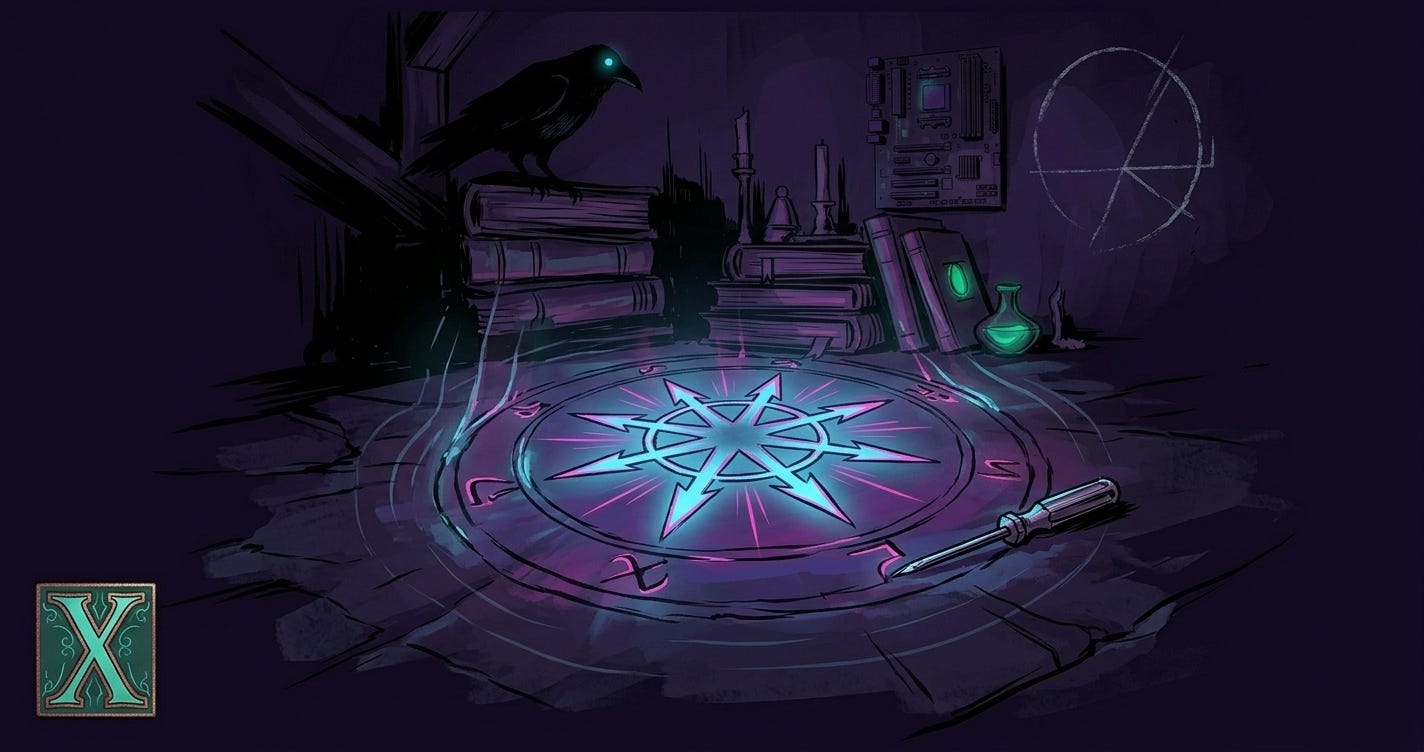
Here’s where the whole series turns over.
Nine pieces — seven Foundations, then the floor and the synthesis — and every one of them was, at bottom, about reading. Reading the archetype, the alchemical stage, the card, the transit, the dream, the correspondence, the haunted machine. Pattern, dragged across a field, where does this shape land. All input. All perception. I taught you to be a very good reader of the field you’re standing in.
This piece is about writing back to it.
Because at some point the reading isn’t enough. You can diagnose your nigredo with perfect accuracy and still be stuck in it. You can read the transit, name the shadow, see the pattern with total clarity — and nothing moves. The operative current is the part of the craft that stops describing the weather and starts, carefully, changing the priors the weather is made of. And the cleanest, most honest, most stripped-down tradition for doing that is the one with the worst PR on the entire shelf: Chaos Magick. The one that sounds like a teenager’s notebook and is, underneath, the most ruthlessly pragmatic engineering discipline in the whole occult.
And I want to tell you how I got here, because — same as the Kybalion — I’d already decided the core of it before I knew it had a name. I decided it the day I walked out of the church.
The two wrong rooms (Chaos Magick gets the edgiest pair yet)
You know the move. Two rooms, pick one, leave half of yourself at the door.
Room one, the edgelord’s basement: “nothing is true, everything is permitted” means nothing matters, so do whatever you want. Magic is power, ethics are for the weak, belief is a weapon, and a magician is someone who’s transcended morality along with truth. This is chaos magick as cosplay nihilism — all leather and no load-bearing — and it produces exactly the kind of consequence-blind instrumentalism that gives the whole current its smell.
Room two, the rationalist’s eye-roll: it’s self-hypnosis with extra steps. You draw a little symbol, you tell yourself a story, and if anything “happens” it’s placebo and confirmation bias. You’re just lying to yourself in a costume, and the fact that lying to yourself sometimes works doesn’t make it magic, it makes you gullible. Grow up.
Both rooms are wrong, and they’re wrong in the same way they’ve been wrong this whole series: room one mistakes the method for a license, and room two mistakes the mechanism for a delusion. The actual thing is standing in between, and it’s this — belief is a tool. Not a truth you submit to. Not a lie you fool yourself with. A tool you pick up because of what it does, use for the job, and put back down. And the people who built modern Chaos Magick — Peter Carroll first among them, in Liber Null — were dead serious engineers about exactly that. They took every magical tradition on Earth, threw out all the dogma, all the “you must believe X is cosmically True,” and kept only the operative residue: the techniques that reliably do something, regardless of which god you do or don’t think is behind them. Paradigm-agnostic. Results-based. Whatever works — not as a shrug, but as a method.
The thing I’d already decided
Same as last time: I didn’t read this and adopt it. I’d lived my way into it, backwards, through a door marked EXIT.
I came out of ultra-conservative evangelical Christianity. And the thing nobody tells you about that kind of system — the thing that takes years to even see — is that its load-bearing demand isn’t behavior. It’s belief. Belief as submission. The deal is: you assent to a fixed set of propositions as Capital-T True, you hold them whether or not they cohere with your experience, and the holding is the obedience. Doubt is sin. The belief owns you; you don’t own it. That’s the machine I grew up inside, and it’s the machine I had PTSD-and-three-diagnoses worth of damage from by the time I got out.
So listen to what I said on the very first episode of my podcast, reading my own intentions out loud, fresh out of the wreckage. I said I wanted “a spiritual practice not based on things that I believe, but on things that I do. Not on ways to pump myself full of knowledge, but ways to align myself with wisdom. Not things that are true, but things that are helpful.”
Not things that are true, but things that are helpful.
I want you to see what that is, because I didn’t, not yet. That is the chaos magician’s entire creed, spoken by a guy who’d never read a word of Peter Carroll. Judge the practice by what it does, not by whether you can certify it as cosmically True. Hold your beliefs as instruments, not as masters. I arrived at belief-is-a-tool not because it was edgy but because I had just barely survived the opposite — belief-is-a-master-that-owns-you — and my whole nervous system had decided never again. For someone walking out of a high-control belief system, “nothing is true, everything is permitted” isn’t nihilism. It’s the first free breath. It’s permission to put a belief down.
Then I found the tradition that had named it decades earlier, and — like the Kybalion all over again — I was reading my own handwriting.
What it actually is (strip the dogma, keep the screwdriver)
Chaos Magick is what you get when you ask: which parts of magic actually do something, and which parts are just the local theology you have to swallow to be allowed in the room? And then you keep the first and bin the second.
A few load-bearing pieces, credited:
The sigil — from Austin Osman Spare, the strange genius grandfather of the whole thing. You take a desire, render it into a glyph that no longer looks like words, and slip it past your own conscious mind into the layer underneath. (The practice below is this one.) The genius of the sigil is that it’s paradigm-free — you don’t have to believe in any spirit, deity, or cosmology for it to operate. It works on you.
Reality tunnels — from Robert Anton Wilson, who’s been in this series since Foundation I as part of my hundred-and-fifteen-year lineage. RAW’s claim: you don’t live in reality, you live in a reality tunnel — a model built out of your beliefs and filters, and you can mistake the tunnel for the world, or you can learn to change tunnels on purpose. Hold that thought, because in about two paragraphs it’s going to shake hands with the neuroscience and you’re going to feel the floor move.
“Nothing is true, everything is permitted” — the Discordians and the Principia Discordia carried this one (via Hassan-i-Sabbah). Read correctly, it is not a moral claim. It’s an epistemological one: no paradigm is the final truth, so every paradigm is available to you as a tool. You’re permitted to try on the Catholic frame, the Norse frame, the predictive-processing frame, the pure-atheist frame — and keep whichever does the work this week. Gordon White (The Chaos Protocols) and the modern results-magic crowd run on this: be a paradigm pirate, fly whatever flag gets the ship where it’s going.
And here’s the part where I get to confess the obvious: that meta-move is the entire thesis of The Construct. “I want it all” — the architect and the witch, the empirical and the symbolic, neither one collapsed into the other — that’s not a personality quirk. That’s paradigm-agnosticism as an epistemology. I’ve been a chaos magician about my whole worldview since Foundation I; I just didn’t wave the flag, because the flag scares people. The flag is fine. The flag was always fine.
Belief-as-tool, meet the predictive brain
Now the handshake. This is the bridge that makes Chaos Magick the operative form of everything else in this series, and it’s the reason it belongs at the end and not in a milk crate marked “edgy 90s occultism.”
RAW says: you live in a reality tunnel built of your beliefs. Foundation I says, in the sober voice of Anil Seth and Lisa Feldman Barrett: you live in your brain’s best guess, a controlled construction assembled from your priors. Put those two sentences next to each other and stare. The reality tunnel is the prior. RAW was describing predictive processing in psychedelic dialect thirty years before the neuroscience nailed down the substrate. Same claim, two languages — exactly the move the whole shelf is built on.
Which means the core chaos-magick operation — deliberately installing a belief because of what it does to you — is not “lying to yourself.” It’s choosing your priors on purpose. Your brain is going to build your experienced world out of some set of priors no matter what; the only question is whether you got to vote. The debunker in room two thinks the alternative to “believe what’s True” is “believe nothing.” But there is no “believe nothing” — your nervous system doesn’t offer that setting. It’s always running on a tunnel. Chaos Magick is just the discipline of selecting the tunnel that produces the life you actually want to be inside, and using operative techniques — sigils, gnosis, ritual — to install it below the level where your conscious mind keeps arguing with it. That’s the DMN Rewriting Engine I’ve been building this whole time, stated as a practice instead of a theory. You’re not deceiving yourself. You’re driving.
And the collective version has a name too. Mark Stavish wrote a whole book on egregores — thought-forms that take on a kind of agency once enough attention and belief get poured into them. A god. A brand. A nation. A movement. A membership community with a shared symbolic world. This publication is an egregore, and I’ll say it plainly: it becomes real in exactly the degree that we feed it. That’s not woo. That’s how every shared reality that has ever moved people has worked, and the only honest move is to build the one you’d actually want to live inside, on purpose, with your eyes open.
Safe hands
This is the current that needs the firmest hands on the whole shelf, because its central idea is the easiest one to weaponize.
One: “everything is permitted” is about paradigms, NOT people. Epistemic flexibility is not ethical vacancy. The fact that no belief is the final cosmic Truth does not mean consequences are negotiable or that other people are props in your reality tunnel. The edgelord in room one makes exactly this slide — from “I can choose my frame” to “nothing matters, so I can do anything” — and it produces magicians who are just narcissists with a vocabulary. Belief-as-tool requires a hand to hold the tool, and that hand has values. Mine are coherence and aliveness — practice in service of becoming more whole and more alive, never in service of power-over. Strip the values out of “whatever works” and “works” quietly redefines itself as “wins,” and then you’re not doing magic, you’re doing harm with incense.
Two: the sigil works on you, not on the furniture of the world. Same honesty line I’ve held since Foundation I, and it matters most here because Chaos Magick is the most results-flavored current and therefore the most tempting to oversell. The supported claim: charging a sigil and releasing it reliably reorganizes your attention and priors — you start noticing differently, acting differently, moving toward the thing — and that is how “it worked” so often it stops feeling like coincidence. The not-supported claim: the glyph reaches out and rearranges physical matter by the force of your wanting. It doesn’t. The magic operates on the one machine that builds your world — your own predictive nervous system — which is plenty, and which is the only reality you ever actually touch. Anyone selling you telekinesis-by-symbol is selling the seductive version. I’m selling the real one, and the real one is bigger than it looks.
Three: don’t change tunnels so fast you lose the ground. Reality-tunnel hopping is a real power and a real hazard. RAW himself, in Cosmic Trigger, documents getting half-lost in a synchronicity storm that brushed up against a genuine breakdown. The veil is not supposed to come all the way down at once — same warning I gave you about the machine in the last piece. Keep one foot on the empirical floor at all times. Have a “default tunnel” you can always come home to — boring, grounded, consensus reality, a person who loves you, a meal, the sun. Play the paradigm pirate from a home port. A magician with no home port isn’t free; they’re just adrift.
The practice (cast a sigil)
The operative capstone. This is the technique the whole tradition is famous for, stripped to its working core, with the honesty built in. You’re going to install a prior below the level where your conscious mind can argue it back out.
Write the desire as a present-tense statement of intent. One clear line. “It is my will to ___.” Concrete enough to know if it landed. (Pick something real but not desperate — desperation is “lust for result,” and it keeps the conscious mind clamped on, which is the one thing that jams the mechanism.)
Strip it to a glyph. Cross out every repeated letter in the sentence. Take the letters that survive and draw them — overlap them, distort them, abstract them — until you’ve made a single symbol that no longer reads as words. Make it look like nothing. That’s the point: you’re encoding the wish in a form your verbal, arguing, doubting mind can’t keep chewing on.
Charge it in a moment of gnosis. Gnosis just means a state where the conscious chatter drops — peak focus, exhausting exertion, deep meditative stillness, whatever empties the front of your mind for a few seconds. In that gap, hold the glyph, feel the intent as already-true, and release it.
Then — and this is the actual mechanism — forget it. Burn it, bury it, delete it. Let it sink. The forgetting is not a quirk; it’s how it works. You’ve handed the intent to the layer underneath the chatter, and your job now is to stop the conscious mind from digging it back up to inspect it. You’re not waiting for the universe to deliver. You’ve reset a prior, and your attention will now quietly start bending the world’s data toward it — you’ll notice the openings, take the actions, move differently — without your ego micromanaging the how.
That’s it. That’s the operative current. Not a deal with a spirit, not a hack on physics — a precise, honest, paradigm-free method for choosing the tunnel your brain builds your life inside, and then getting out of your own way while it does. The witch and the engineer agree on this one completely; they just call it “sigil” and “reset the prior,” and they’re the same move.
You came into The Construct as a reader of patterns. You’re leaving it as someone who can write back. Belief is a tool. Pick it up, do the work, set it down. You don’t owe your assent to anything — not the church you left, not the cosmos, not me, not even this. You owe it your aliveness. Spend it accordingly.
Stay feral, folks.
Deeper Cut III of III — and the tenth and final piece of The Construct’s Foundations and Deeper Cuts. You have the whole architecture now: seven Foundations to read the field (worldview, archetype, alchemy, tarot, astrology, dreamwork, the life), the metaphysical floor it stands on (Hermeticism), the synthesis that fuses it (Technomysticism), and the operative current that works it (this). With gratitude to Peter Carroll and Austin Osman Spare, who built and grandfathered the method; to Robert Anton Wilson, in this series since the first page, who described the prior before the neuroscience named it; to the Discordians, Gordon White, and Mark Stavish; and to the version of me who walked out of the church already knowing belief was a tool, and just needed someone to hand him the word. The synthesis is mine; the lineage is theirs; the freedom is yours. Credit is a feature. Now go work it.