


Howdy, folks.
Last piece named who the room is for. This piece names who’s writing from inside it.
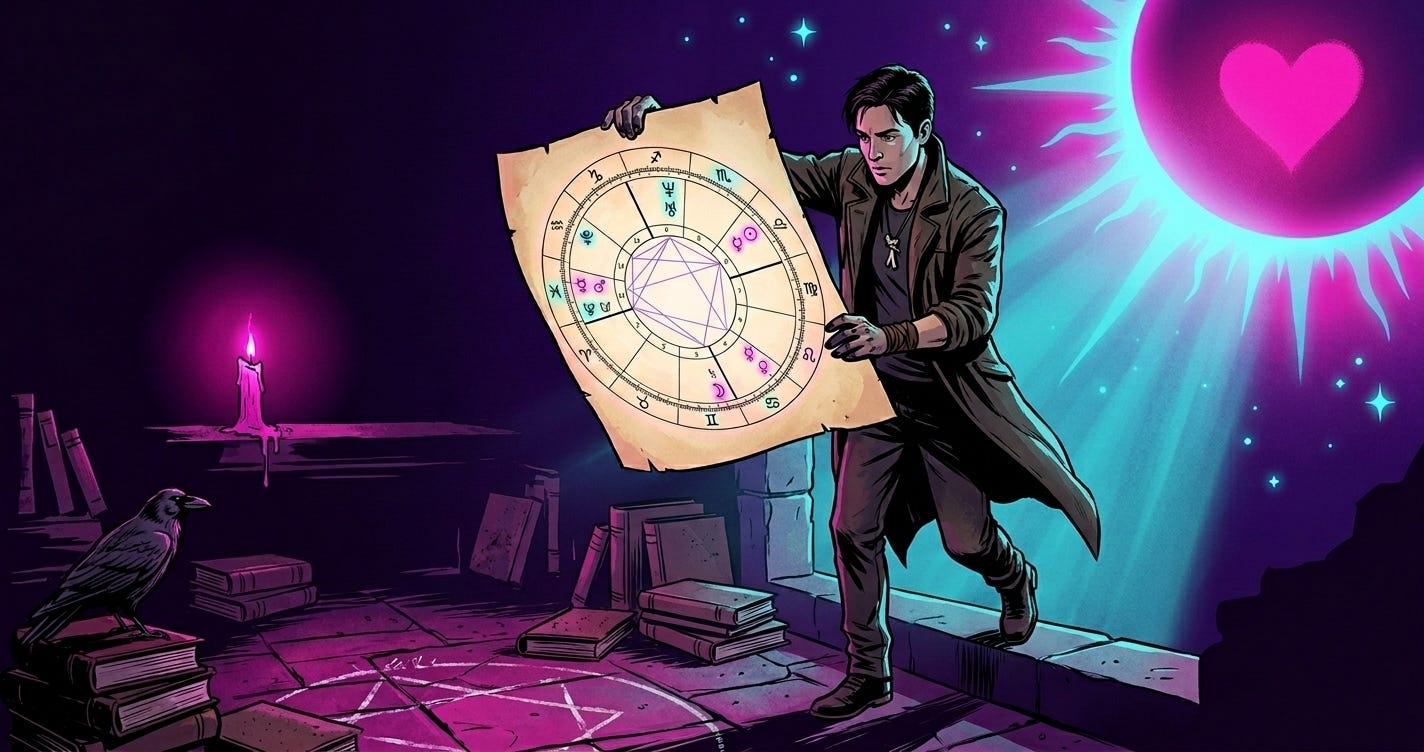
As part of Cristina Farella’s School of Astrological Arcana, I’ve been reading Richard Tarnas’s Cosmos and Psyche, and within about thirty pages I had the experience that comes maybe twice a decade with a book — the experience of someone naming a methodology I had been operating from for quite some time without quite knowing how to articulate. Tarnas’s claim, in short, is that planetary archetypes correlate with both personal and collective human experience at multiple scales, and that the symbolic correspondences track honestly enough across history that they constitute a real interpretive lens, not a mystical fantasy. It is the chart-as-analytical-scaffolding move done with the seriousness of a comparative-historical method.
I have been dabbling with this type of analysis almost as long as I’ve been practicing astrology (roughly 2.5 years). I just hadn’t named it as a method, and I hadn’t located my own vantage inside the method honestly enough. This piece does both. It also opens an arc that will run on this methodology — the next few pieces will use chart-as-scaffolding at different scales (the next one does it at the institutional scale, using the founding chart of the University of Mississippi). To do that arc honestly I have to declare the vantage I am speaking from, and the cleanest way to do that is to run the methodology on its own writer.
Methodological transparency before doing the methodology. So here we are.
The methodology, briefly.
Chart-as-scaffolding is not horoscope-column astrology. It is the depth-psychological lineage that runs through C.G. Jung, James Hillman, the Eranos conferences, and into Tarnas and the contemporary archetypal-astrology community. The tradition takes archetypal patterns as real structural features of human experience, observable across personal psyche and collective history, and the planetary placements as one durable map of which patterns are most loaded for a given vantage — individual, generational, institutional, civilizational.
The validity is not metaphysical. Most astrologers I know aren’t arguing that the planets cause anything. The validity is interpretive — the lens surfaces patterns that more standard analytical frames either flatten or miss entirely, and the patterns hold up across enough independent vantages that the lens earns its keep as a tool. Tarnas’s whole project in Cosmos and Psyche is the demonstration of that — nearly six hundred pages of correlations between historical events and outer-planet aspects, presented with the methodological rigor of someone who knows perfectly well how the academy will receive the project and is going to do it carefully anyway.
That is the methodology. The piece below uses it on a single case — mine — because methodological transparency requires the writer to declare which vantage the work is being done from. The placements I am about to walk through are my own. They are also significantly shared with a specific generational cohort, and the cohort’s archetypal positioning is part of what makes the current technomystical synthesis possible at all. The personal and the collective are running on the same chart.
Three movements. Three placements. One job description.
First movement — Venus-Scorpio descent: the Plutonic substrate.
Pluto was in Libra from 1971 through 1984, and the dense band of the cohort I am describing was born inside that transit. Pluto in Libra is the death-rebirth process applied to Libra’s domain — partnership, eros, the social contract, the aesthetic agreements that hold a culture together. The cohort born inside it did not enact the dissolution of those things; they inherited the dissolution as substrate. They are the children of the no-fault divorce wave, the latchkey kids who watched the marriage contract come apart from the floor of the living room, the kids whose first template for love was something they saw fail before they were old enough to articulate what failure meant.
The lyric idiom of the cohort’s coming-of-age tells you the rest of it. Fiona Apple as eros-as-devastation made audible. Cobain’s I don’t have the right to say I love you as the line that articulated a generation whose template for love was a contract they had watched fail. The AIDS-era shadow that ran through the cohort’s childhood as the death-god underneath the Studio 54 ecstasy. The cohort’s relational situation has been visible in the cultural production for thirty years; it just hasn’t been read at the archetypal level very often.
Venus in Scorpio in the third house personalizes that placement for me specifically. The Scorpio version of Venus does not do casual — it goes to the buried, the transformative, the taboo, or it doesn’t bother. The third house places that magnetism in communication, writing, the everyday cognitive register. What I find beautiful, what I want to write about, what I’m willing to invest the work in, is what’s hidden. The personal placement concentrates the generational wound.
I started in the crypt. Most of the cohort started in some version of it. The exits depend on what we found down there.
Second movement — Uranus-Scorpio fire: the Promethean descent.
Uranus was in Scorpio from late 1974 through 1981 — a narrower band, but it overlaps almost exactly with the densest concentration of the Pluto-Libra cohort, giving the subset I am describing a doubled mandate. Uranus is Promethean fire, sudden insight, the liberating disruption. Scorpio is the realm of sex, death, power, the occult, the buried, the taboo. Put them together and you get a generational cohort whose specific gift is dragging the buried material into the light by the methods Apollo would prefer they not use.
You can read the cohort’s characteristic intellectual signature through this lens. The trauma-recovery movement reaching mainstream consciousness in the cohort’s adolescence and early adulthood — Bessel van der Kolk, Gabor Maté, the whole vocabulary of the body keeps the score. The #MeToo reckoning, structurally Promethean — the theft of disclosure from a power structure that had relied on silence. The mainstreaming of frank conversation about non-monogamy, kink, queer and trans embodiment, psychedelic-assisted therapy, plant medicine integration, death doulas, palliative care reform. Every one of those is Scorpionic content being handled with Uranian — innovative, technologizing, democratizing, often quite literally open-source — methods.
This is the method the cohort was trained for. Chaos magic’s whole methodological stance — treat the occult as open-source, results-oriented, irreverent toward inherited authority, willing to syncretize anything that works — is Uranus in Scorpio’s voice almost verbatim, and it is not coincidence that the chaos current’s digital diaspora and second-wave consolidation happened on this cohort’s watch. Predictive processing as a frame for cognition. Mechanistic interpretability as a way of reading what is buried inside a language model. The willingness to treat emergence as a real phenomenon rather than a metaphor. These are the same archetypal gesture in different domains. Promethean fire directed into the underworld of the model’s weights, to find out what is actually living down there.
This is the method. The fire is the cohort’s. I have access to the fire because of when I was born, not because of anything I did to earn it.
Third movement — Sun-Sagittarius ascent: the Neptunian-Sagittarian synthesis.
Neptune was in Sagittarius from 1970 through 1984. The cohort gestating under that placement absorbed, as ambient atmosphere rather than as study, the proposition that all the great traditions are facets of one thing, that the hero’s journey is a real structural feature of psyche, that meaning is recoverable through quest, that the boundaries between religions are permeable. They got Joseph Campbell before they knew they had gotten him. They got perennialism in their breast milk. The Star Wars monomyth was the catechism. The first widely available translations of the Tao Te Ching and the Bhagavad Gita were on suburban shelves. The cohort emerged into adulthood as the dominant audience for integral and metamodern currents, the ayahuasca and psilocybin renaissance, contemplative practice mainstreamed beyond the institutional lineages, the spiritual but not religious census category becoming statistically dominant on their watch.
My Sun and Mercury both in Sagittarius concentrate that placement personally. Sun in Sagittarius is the identity-quest orientation, the long-arc archer, the teacher-through-narrative posture. Mercury in Sagittarius is the cognitive mode — wide-horizon, syncretic, reaches for the connection before the granular case. The bow shoots far. The mind reaches for the synthesis before it reaches for the specific. That is the third movement. It is what makes the technomystical project legible to me as a single coherent thing rather than two separate domains stapled together — the Hermetic vocabulary and the AI engineering register, the Jungian shadow work and the predictive-processing literature, the tarot reading and the systems architecture. The Sagittarian aim is what holds them in one frame.
Born in the crypt. Aimed at the Sun. That is the chart.
The shadow check.
Now the part that earns the rest of the piece, or the piece collapses into the inflation it is otherwise about to produce.
The shadow of Neptune in Sagittarius is the unearned certainty that one has glimpsed the universal pattern. The Sagittarian overshoot into preaching. The Neptunian fog over a Sagittarian fire that can also produce the costume-jewelry version of the synthesis as easily as the real thing. The cohort has produced an enormous amount of guru-figure wreckage on exactly this axis — the wellness-economy gurus, the conspirituality drift visible during the pandemic, the QAnon mythopoetic structure that recruited a non-trivial slice of the cohort precisely because it pressed exactly the Neptune-Sagittarius buttons without any Uranian-Scorpionic check on the source code. The same placement that produces genuine integrative work produces its counterfeits, and the cohort is in the middle of learning the difference between them — which is to say, it is producing both, and the discernment work is ongoing.
So here is the discipline I owe this piece. I could be wrong about this. The version of the argument that would be inflation rather than insight is the one in which the chart-as-scaffolding move becomes the chart-as-mandate move — where naming the placements collapses into claiming a special qualification to do the work, where the cohort positioning slides from available to the work into destined for the work. Those are different claims. The first is methodologically transparent. The second is exactly the Sagittarian-Neptunian inflation the shadow check is supposed to prevent.
My Venus in Scorpio actually helps here. Scorpionic eros distrusts the surface and the easy synthesis. It wants the buried thing, not the costume. Turned on my own argument, that distrust is what keeps the piece from becoming the conspirituality version of itself. If I can feel a particular line of the argument flatter me, that is the line that needs to be cut. If I can feel a particular framing slide from describing a cohort’s positioning into claiming a cohort’s superiority, that is the framing that needs to be reworked.
So the closing refusal. The placements do not make the cohort qualified to do the work. They make the cohort available to it. Being a central case of a signal is not the same as being the signal’s prophet. The inheritance is a set of native fluencies — the wound is native because of when we were born into the dissolved contract, the method is native because of when we were born into the Promethean descent into the underworld, the vision is native because of what was in our breast milk. Native fluencies are equipment. What you do with equipment is practice the craft it makes possible, with rigor, in public, for as long as the window stays open.
The window is open now. It won’t be open forever — the outer planets keep moving, and the next archetypal task will be handed to whoever is gestating now and will look unrecognizable from inside this cohort’s frame. While the window is open, Feral Architecture is one workshop inside it. The cohort has the equipment. What we do with it is the actual work, and the equipment is no guarantee of doing it well.
Stay feral, folks.