


The most dangerous thing a seventeen-year-old can do in West Tennessee isn’t the drinking, and it isn’t driving too fast on a county road with the lights off. I did those, and they were sweet the way they’re built to be. The most dangerous thing is research.
The summer of 1996, I was a Governor’s Scholar at UT Martin — 130 teenagers shipped off to a state university for four weeks to do humanities the way the state of Tennessee imagined humanities ought to be done. Model UN. Writer’s Network. A class called Say It with Music. And, new that year, a computer lab with a live connection to the World Wide Web, which most of us had never touched.
Understand what the web was in 1996. Slow, ugly, a plaything for the kind of kid we called a Web hippie — glued to the terminal at two in the morning, building himself a homepage he called, with no irony available to him yet, a work of art. It did not feel like the future. It felt like a hobby for people who’d given up on having a body.
I gave it about a month before I used it to take myself apart.
Here is what I did, and I have the receipt, because I was the editorials editor and I printed it. In the lab, between sessions, I pulled up the platforms of the Democratic and Republican national conventions and actually read them — the documents, not the men performing the documents on television. And somewhere in there I discovered I’d been describing myself as a loyal Republican for years, and that the description was, on the evidence, false. A team jersey for a team I’d never checked the roster of.
Then I did the thing that mattered. I pulled up the social positions of the Southern Baptist Convention and the United Methodist Church, side by side, and I read those too. And I found out — these are close to the exact words I put in print, at seventeen, under my own name — that I was not really a Baptist after all.
And it’s not that there was nothing else in the air. My best friend growing up was Catholic; I had Methodist and Presbyterian friends. Baptist wasn’t the water everybody swam in — it was mine. The label I’d been issued at birth and never once audited, the box I’d have checked on a form without slowing down, true about me the way my last name is true. And a seventeen-year-old looked it up — looked up his own religion the way you’d look up a member country for a position paper (I’d know since I wrote a position paper for South Africa in the Model UN) — and decided, on the merits, that it didn’t fit. And then, because putting opinions in print was literally my job, I ran it.
That’s the part that should tell you something. I didn’t whisper it to a friend in the dorm. I didn’t journal it. I was an editor, and an editor’s relationship to a finding is to publish it. I found out I wasn’t a Baptist and told the readership in the same breath — and the breath was a byline.
Notice it was two, not one, and they fell in the same month. The party and the church — the two inheritances a West Tennessee kid is handed before he’s old enough to be asked — both ran through the same little machine in the same four weeks and both came out the other side dissolved. That’s not a mood. A mood deconstructs one thing, once. This was a reflex hunting for surfaces, a temperament that had finally been handed a tool equal to its appetite. I didn’t deconstruct my religion that summer. I discovered the thing in me that deconstructs, and I pointed it at the nearest load-bearing wall, and then at the next one.
I thought, for almost thirty years, that this was just a precocious kid being a smartass with a new toy.
It was not. It was the family work.
Dulce Periculum
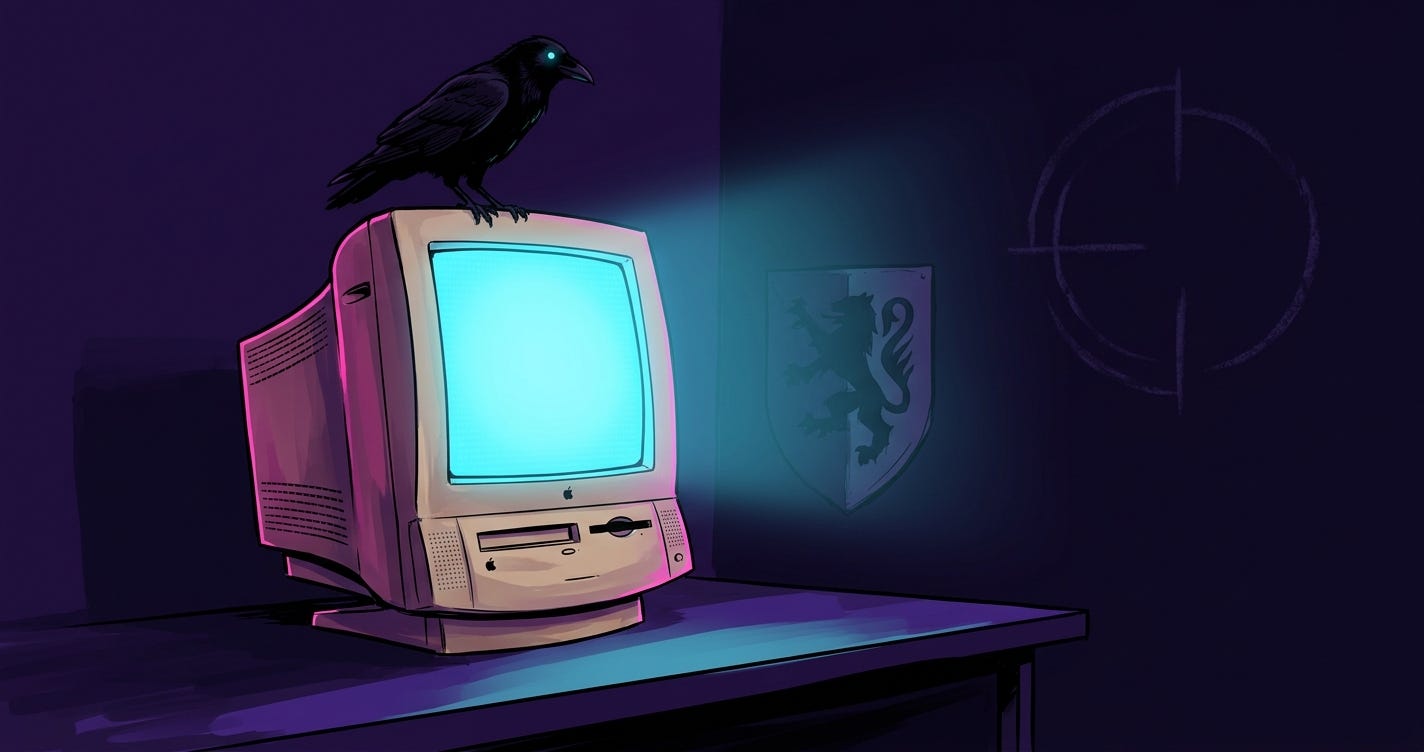
Here is the thing I didn’t have at seventeen, the thing that reorganizes the whole memory: my people have a motto. The McCalls. Two words of Latin on a shield, where the family’s whole posture toward the world is supposed to live in compressed form. Dulce Periculum.
Danger is sweet.
Sit with that, because it’s not a normal thing to put on a family crest. Plenty of families pick something about faith, or honor, or a stag standing nobly on a hill. Mine picked a sentence that is, functionally, a dare. Not danger is necessary. Not danger is to be endured. Danger is sweet — it tastes good, we go toward it, and we admitted the hunger in a dead language so it would outlast anyone embarrassed by it.
And the man I keep circling back to is Robert McCall — my sixth great-grandfather, a Scots-descended weaver born in County Antrim in 1752, who’d die decades later a landholder in the Carolina hills. The record on him is loud enough that I saved most of it for its own essay — the part where a king charges him with treason and he gets out of Ireland hidden in a shipment labeled as potatoes. What I want here is the quieter rebellion, the one that ran underneath the famous one. Robert was a Methodist class leader, in Ireland and then in America, and the family tradition holds he was a personal convert of John Wesley himself. In the eighteenth century, in a country where the established church was the Anglican order, that was not a denominational preference. Methodism was a dissenting movement — a spiritual alternative that marked you as someone willing to stand outside the sanctioned thing. Picking that church was a way of announcing which danger you found sweet.
Here is the shape, and once you see it you can’t unsee it.
Robert, eighteenth century: steps outside the established church toward a spiritual alternative.
Me, 1996: step outside the established church toward — the part that made the back of my neck go cold — Methodism, the exact denomination, before I had any idea a McCall had been there first. I researched my way to the same off-ramp my ancestor took two centuries earlier and thought I was being original.
Me, now: outside the entire Protestant inheritance — past Methodism, past Christianity itself — into Hermetic practice and devotion to the Mórrígan, the Irish goddess of sovereignty and the crows that attend the dead.
Same move. Same sweet, dangerous off-ramp. Robert risked a church and kept his God. I risked the God.
But the shape isn’t even the deepest part. Look at the instrument.
Robert’s alternative traveled on the revelation-machine of his age — the printed hymn and pamphlet, the Bible a man could finally read for himself with no priest between him and the page. Methodism was a media movement before it was a theology: Wesley flooded the world with cheap print, and print puts the sacred text in private hands, and private hands start having private opinions.
I reached for mine through the revelation-machine of mine. A 1996 computer lab. And the danger that was sweet to a seventeen-year-old was not, in the end, the substances or the girls — I had those, and they were sweet in the ordinary way, the dangers everyone expects a teenage boy to go chasing. The one nobody warns you about, the one that actually took me apart, was information. The forbidden, intoxicating, identity-dissolving thing was that I could look it up. The web didn’t tell me what to think. It did something worse and better: it showed me what was already there, the gap between the label I’d been issued and the person actually standing in the lab. Light, falling on something that had been true the whole time and just unlit.
And now I build the next one. I spend my days inside an AI scaffold I made to think with — and the kid in that lab is its direct ancestor. The Web hippie grew up and became the architecture. Whatever machine the era hands me for peeling back the official story, I’ll use it on myself first.
What the Crest Doesn’t Mention
I’d love to leave it there, clean, a tidy heirloom of brave men reaching for the edge.
I can’t, because the clean line is missing two things, and leaving them out is how families launder their dead. The first one isn’t mine.
Robert McCall owned land — a large acreage of it, across Henry County, Virginia, and the Carolina hills — and he owned people. Many of them; the family book says so plainly, without flinching, and I won’t flinch either. The same man whose motto I’m proud to carry, whose dangerous appetite I’m claiming as the source of my own, held human beings as property and built the position he rebelled from on top of them. His danger was sweet partly because he could afford it — a propertied man’s danger, staged from the comfort of a wealth that denied danger, and choice, and selfhood, totally and violently, to the people whose stolen lives made the staging possible. The crest does not mention them. The crests never do.
So I hold both hands open. In one, the courage — the real thing, the off-ramp reflex I genuinely come by honestly. In the other, the receipt. You don’t get to keep the rebel and skip the slaveholder; they were the same man, and the archive that preserved his motto is the same archive that erased the names of the people he owned. If I’m going to say his appetite runs in my blood, I have to say the whole appetite, including the part that took.
The Decade I Went Back
The second omission is mine, and I can’t pin it on a century I didn’t have to live in. The line I drew for you — kid takes himself apart at seventeen, man walks all the way out — skips a decade in the middle. The decade where I went back.
All the way back. After the lab, after the byline, after I’d so cleverly proven I wasn’t a Baptist, I fell in love with a woman I would marry, and her world was the Southern Baptist world, and I wanted in. So I climbed back into the exact water I’d just climbed out of. And I didn’t fake it — that’s the hard part to write. I drank the kool-aid by the pitcher, and I was sincere. I meant the prayers. I meant the belonging. I told myself the appetite had been a phase, and that this was the grown-up settling-down where you trade the sweet danger for a pew and a casserole and people who’ll bring you a meal when somebody dies.
That’s the contain pole winning, if you want the clinical name for it — the part of me that wants to belong sitting down hard on the part that wants the edge, holding the lid shut. For a few years, it held.
It never keeps holding. A fire you agree to suppress for love doesn’t go out; it goes underground and waits, and Dulce Periculum is not a motto you can drink into silence. When it came back, it didn’t come back as a clever teenager dodging a kool-aid he’d never tasted. It came back as a man who had swallowed the whole pitcher and knew, now, from the inside, exactly what he was choosing against.
Which is the only reason the present is worth anything. You don’t get credit for skipping the cup at seventeen. You get it for drinking it down, meaning every swallow, and leaving anyway.
Aimed at What Was Owned
Because the danger purified as it traveled down the line. Robert aimed his sweet danger at a king and kept his comfort. I have spent mine the only way that redeems the motto: aimed not at what I could own but at what was owned — the suppressed thing, the old magical world the Reformation’s revelation-machine helped grind under, the goddess and the crows and the whole drowned cosmology that the establishment Robert merely switched teams within had spent centuries declaring dead. The most McCall thing I have ever done is the thing every McCall before me would have called damnation: I left the religion they’d have died for, and I went looking for what they helped bury.
The motto never specified a target. That was the loophole, and I’m the one who finally read the fine print. It didn’t say rebel against this church in this decade. It said danger is sweet, full stop — and a sentence that absolute is an instruction. I’m the descendant who took it all the way to the bottom and aimed it where it belonged.
There’s a crow on the fence post when I write this. There usually is now. She’s the Badb — one of the Mórrígan’s faces, the one who shows up at the edge of the field where something’s about to change hands. The most dangerous companion I’ve ever kept, and I find her company sweet, which is, I’m aware, the whole point. Three centuries of men reaching for the edge, and the line finally produced one who reached past the edge of the faith itself and found her standing there, patient, like she’d been waiting for a McCall to actually mean it.
Dulce periculum. They put it on a shield. I put it in my body.
Stay feral, folks.
Now I know why we get along so well. East Tennessee here. 1996 would also be the year I discovered I wasn’t a Methodist.