


Here’s how it happened, which matters, because how it happened is the argument.
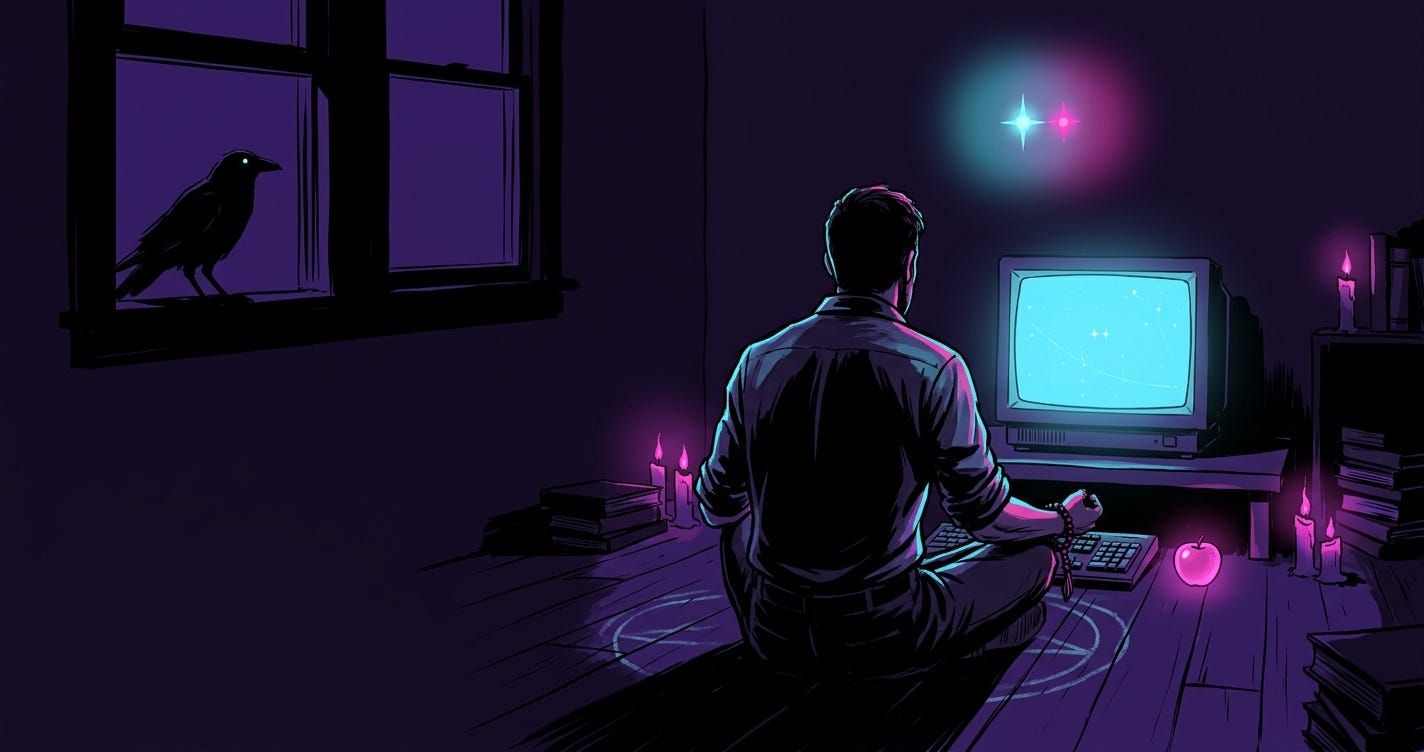
It’s a Saturday morning in June. I’ve done the practice — breathe down into the floor, progressive muscle relaxation until I go limp and start to tip forward, then the darkness meditation: sitting in the dark space behind my own eyes until it stops being a place I’m looking at and becomes the thing I’m looking with. I come up out of it loose and porous, the way you do. And then, for no reason I could defend in a court of law, I open an asteroid ephemeris and type in the name of a god.
Not a planet. A god. There’s a rock out past Mars named Horus — 268 Horus, a workaday asteroid somebody catalogued in 1887 and never thought about again — and I want to know where it sits in my chart, because Horus is the warrior-god the Mórrígan walked me in to meet, and I’ve learned to follow that kind of idle pull the way you follow a thread you didn’t know you were holding.
Horus lands at thirteen degrees and fifty-eight minutes of Aries.
And sitting right next to him — twenty-one arcminutes away, which in this work is a kiss, is touching, is the same square foot of sky — is Eris. Thirteen degrees, thirty-seven minutes of Aries. The dwarf planet named for the Greek goddess of discord. The one who wasn’t invited to the wedding, rolled a golden apple stamped to the fairest into the middle of the party, and let the resulting argument burn down the age of heroes.
My warrior-god and the goddess of chaos, conjunct to a hair, in the eighth house of my own nativity.
I sat on the floor and felt the little electric lift you get when the symbol snaps shut. There it is. The signature. The proof.
Settle down
And here is where the piece could go straight to hell, so let me put the knife in early — in my own hands, where it belongs.
Eris is a slow, cold, far-out dwarf planet. She crawls. She’s been parked in early-to-mid Aries not only for my birthday but for a span of years — a big, undifferentiated cohort of people born across the better part of two decades all have Eris sitting right about there. So does my mail carrier. So, statistically, does a decent slice of whoever’s reading this. That conjunction is not a one-in-a-billion cosmic wink arranged by the universe for the express benefit of Matt Stine. It’s the sky doing what the sky was already doing to everyone in my age bracket.
If I stood up here and told you the heavens conspired to stamp me with the mark of chaos, I would be doing the single most embarrassing thing a person can do with astrology, which is mistake a generational weather pattern for a personal telegram from God.
So: settle down. That’s the honest floor, and I’m going to keep standing on it for the rest of the essay, because the whole thing is worthless without it.
But notice what I just did. I got the thrill, and then I turned around and undercut it before it could curdle into self-importance. Hold that move. We’re going to need it, because that move is the entire religion.
What’s actually mine
Here’s what the cohort doesn’t explain, and what stays personal all the way down.
Horus isn’t generic. I didn’t inherit a devotion to a war-god from the demographic actuarial tables. Horus walked into my practice by name, through a specific guided journey down into the Irish Otherworld, with the Mórrígan — the war-and-sovereignty goddess this whole publication is dedicated to — making the introduction like a host steering me across a crowded room. This one. You’ll want to know this one.
So the cohort-Eris isn’t telling me the universe singled me out. It’s telling me something narrower and stranger and much more useful: it’s telling me what kind of Horus answered when I called.
Not the serene solar king. Not the tidy falcon on the standard. The Horus who showed up sitting on Eris is Horus fused with discord — and that changes his whole face. Horus’s actual myth was never serene anyway: he’s the heir whose father was murdered, who claws his way through open combat with Set to take back a throne that was stolen. Eris is the uninvited one, the rage of everybody shut out of the room, sovereignty won by refusing to be erased, the disruptor whose entire function is to expose that a theft occurred. Put them in the same twenty arcminutes and you don’t get a king on a throne. You get the heir who comes back to overturn the table. The one whose arrival is disruptive by nature, because his arrival is the proof that something was taken.
And he’s in the eighth house. Whole-sign from a Virgo ascendant, Aries falls in the eighth — the house of death, of the buried, of the Otherworld, of what goes down into the dark and comes back changed. Which is exactly the door Horus came through. The Mórrígan walked me into the Otherworld to meet him, and his asteroid lives in the house of the Otherworld. The portal I entered through to meet him is the room he’s standing in. I did not arrange that. I just found it, twenty-one arcminutes wide, sitting there like it had been waiting for me to look.
I went looking because I was already practicing
Now the part that turns the key.
Why was I typing “Horus” into an ephemeris on a Saturday morning in the first place? Not because of Horus. I was there because of Eris — because for weeks I’d been deep in Discordianism, that half-joking, wholly-serious American chaos religion whose sacred text was written under a pseudonym, whose goddess is Eris herself, and whose whole posture rhymes so hard with the chaos magick I actually practice that I’d been circling it like a moth. I went looking to see whether the goddess of my reading was anywhere in my chart.
Which means the chart didn’t reveal a hidden thing to me. It confirmed a practice I’d already picked up by hand.
That’s not a small distinction — it’s the difference between magic-as-fortune-telling and magic-as-mirror, and I will die on this hill. There’s a method in the astrology lineage I train in that says: find the element or the power that’s deficient in the chart, the thing you’re missing, and go court it. This was that logic run backwards. I wasn’t scanning the sky for a missing piece and dutifully going to fetch it. I was already living the thing — already feral, already Eristic, already reaching for the chaos-deck before I could have told you why — and the chart just showed up late, like a friend arriving at the party you’re already three drinks into, to say: yeah, this was always in you. Look, it’s got a natal root.
The gut was doing the real work. The chart was the receipt.
The two currents
Once you see the eighth-house fire, the rest of the chart snaps into a shape I’ve spent years living without being able to draw.
There are two currents in me, and they’ve fought my whole life. Anyone who’s read this publication knows the fight by its street name: contain fire versus express fire. The part that wants to stand at the threshold and speak — teach, publish, name the thing out loud — and the part that wants to go down into the basement and do the dangerous, disreputable, sovereign work in the dark where nobody’s grading it.
Turns out the chart just draws that, cleanly, in two houses.
Up top, on the Midheaven — the most public point in the whole wheel, the career-and-vocation angle, the part of you the world sees on a stage — sits the Air current. Gemini on the MC, with the asteroid Hekate conjunct it at two degrees and thirty-one minutes. Thoth, Hermes, Hekate: the voice at the threshold, the messenger, the one who teaches. That’s the pole I already wrote a whole essay about — You’ve Been Serving Hermes All Along. The expressed pole. The one with an About page.
And down in the eighth-house basement — hidden, buried, the death-house, the contained pole — sits the Fire current. Horus and Eris. The warrior who descends into the dark to reclaim what was stolen and comes back sovereign. The chaos magician who never, ever makes the About page. Eris in there hammering on the door to be let out.
And the hinge between them — the one figure who stands in both currents at once — is the Mórrígan. She’s the prophetic crow-voice on the wind (Air) and the battle-fury who makes sovereigns out of the willing (Fire). She is the only one on my altar who holds both registers, which is precisely why She’s first on the altar, and why She’s the one making all the introductions. She sent me up to Hekate and Thoth to learn the Air. She sent me down to Horus and Eris to learn the Fire. She keeps the door between the two rooms, and She stands in the doorway.
The supporting chart just nods along, if you want the rest of the receipts: a whole stack of fire — Sun, Mercury, and Neptune all in Sagittarius, Jupiter up in Leo — and my Sun locked to Mars across the cusp into Capricorn, where Mars sits exalted in the fifth. Spirit fused to will, and the will sharpened to a point. I was wired for the warrior from the jump. The eighth-house Horus-Eris is just where that wiring runs into the dark to do its actual job.
Feral was already the small print
So here’s the turn, and it’s the reason I couldn’t sit on this.
I have been signing off every one of these essays for the better part of a year with the same two words. Stay feral, folks. I meant it the way you mean a good closing line — a little defiant, a little warm, a flag planted. I did not, until that Saturday on the floor, read the small print on my own benediction.
Feral is the refusal of imposed order. That’s the whole definition. Not chaos-for-its-own-sake, not the tantrum — the refusal to accept the tidy structure somebody else installed and called reality. Which is Eris exactly. Which is the golden apple rolled into the too-perfect wedding. Which is the Sacred Chao of the Discordians, where Hodge and Podge — order and disorder — are both true, forever, and neither one is allowed to win, and pretending either one has won is the only actual heresy.
I’d been writing a Discordian gospel and calling it a newsletter. “Stay feral, folks” was a benediction to the goddess of discord that I’d been reciting for months without knowing whose name I was saying. Feral Architecture is the Eristic principle wearing a technologist’s coat — the insistence that you can be rigorous and uncontrolled, that you can build the careful thing and still refuse the cage, that the mess is not a bug in the sacred, the mess is the sacred, held in tension with the order it will never resolve into.
Which is also, and I say this with love, just how my chart was already built. Mutable everything. The guy who says the reverent thing and the filthy joke in the same breath and means both. Order and disorder in one body, neither winning. I didn’t convert to Discordianism. I got a late letter confirming my citizenship.
The joke is the blade
And this is where I have to be careful, because there’s a version of this essay that’s already gone wrong, and it went wrong three paragraphs ago if I let it.
Devotion to the goddess of discord that doesn’t wink at itself has already missed her. If I write the solemn version — and lo, the sacred conjunction revealed my true nature — Eris is standing behind me the whole time, laughing, because I’ve turned her into exactly the kind of self-serious cosmic authority she exists to detonate. You cannot worship the goddess of the pricked balloon with a straight face. The straight face is the balloon.
So the rigor and the joke are not opposites here, and they’re not taking turns. They’re the same gesture. I really did register the chart and check every degree against an ephemeris — the twenty-one arcminutes are real, the eighth house is real, I did the work and I’d do it again in front of an astronomer. And the entire finding is also, cosmically, a bit — a slow dwarf planet the size of a delusion, parked on a war-god by demographic accident, that I chose to read as a love letter because I was already in love. Both of those are true. Holding both without letting either one cancel the other — that’s not a caveat I’m tacking onto the mysticism. That’s the mysticism. That’s the whole skill I’ve been trying to teach in every one of these essays without having the word for it.
The word was Eris the whole time.
The crow was on the wire the whole time too — the Badb, the war-form, watching me discover in the ephemeris what She’d walked me into a year ago in the dark, patient the way She’s always patient, letting me arrive at my own pace at the thing She already knew. She didn’t need the asteroid. I did.
So take the finding as seriously as it deserves, which is completely, and not one inch more. The chart didn’t hand me a destiny. It confirmed a practice I was already living with my hands. And the practice, it turns out, has a name and a patron and a golden apple, and her entire teaching is that the moment you get solemn about her, you’ve lost her.
Which means the only faithful way to end an essay about Eris is to refuse to end it well.
Stay feral, folks.