


Howdy, folks.
Three weeks ago I sat in front of a camera at seven o’clock on a Thursday night and did a live tarot and astrology reading for a paid membership I had spent two months building. Nine essays. Six emails. A seven-piece library. A whole consecration, because of course there was a consecration.
Last night I sat down and did the arithmetic on what the next two years of that would require.
Then I took it apart.
The tier is gone. The wall is gone. The Thursday is gone. Everything that was behind the paywall is free now — the readings, the library, the archive, all of it. There’s no reading on the tenth of September. There’s no reading on the tenth of anything.
The button stays.
That’s the part I expect to catch you sideways. You can still pay me. It buys you nothing. No tier, no room, no reading, no early access, no Thursday. Not one thing that isn’t already sitting there free for the person who pays me nothing at all.
If that sounds like a worse deal, it is. It’s also the only honest one I’ve got.
Two people were paying me before any of this existed — before the tiers got benefits attached, before the paywalled library got written, before the founding email got sent. They weren’t buying the room. There was no room to buy. They were paying me to write.
Then I spent two months building an elaborate structure on top of that and charging for it. Nobody ever bought the structure. So nothing on their end changes: they were patrons before I invented a fancier word for it, and they still are. If either of them wants out, the button works in both directions and I won’t take it personally.
The newsletter continues exactly as it is. That part was never in question.
The part where you tell me I quit too early
I know. You’re right about the facts. You’re wrong about what follows from them.
Memberships start small. That’s not a failure mode, that’s the shape. You open the doors and a handful of people walk in. You run a live event and four people show up and eleven watch the replay at 1 a.m. on a Tuesday. You do it again the next month. And the next. You keep showing up to a mostly-empty room for somewhere between one and two years, and if the work is good and you don’t quit, the room slowly fills.
That’s not the sad version. That is the job. Anyone who tells you their membership went off like a rocket is either lying or sitting on an audience they spent a decade building somewhere else. The empty room is the price of entry and everybody pays it.
I’m not guessing at any of this. I’ve watched people I respect do exactly that, patiently, for years, and I’ve watched it work. The playbook is real and it isn’t a scam.
So when I tell you I’m shutting mine down three weeks in, the honest objection is right there: you didn’t give it a chance.
Correct. I didn’t.
I did something else instead. I looked at the eighteen months of empty-room Thursdays standing between me and the thing at the far end — a community, a monthly cadence, recurring revenue, a room with my name on it — and I asked myself a question I don’t think we’re supposed to ask out loud.
Do I want that? Enough to spend eighteen months of my one life getting it?
No. I don’t.
The two permitted exits
When someone stops doing a thing, our culture supplies them with exactly two acceptable stories.
Story one: it failed. The algorithm changed. The market wasn’t there. The platform screwed you. Something external came along and took it from you, and you are therefore blameless and slightly tragic, and everyone nods.
Story two: you burned out. You gave too much. You ran yourself into the ground. It’s medical now, or near enough, and everyone nods at this one too, maybe more sympathetically, and someone sends you an article about rest.
Look at what those two stories have in common. Both of them assume you wanted it. One says you wanted it and were thwarted. The other says you wanted it so badly it broke you. In both, the wanting is never in question — the wanting is the fixed point, the thing so obviously true it doesn’t need examining.
There is no third story. There’s no acceptable script for walking up to the prize, looking at it directly, and saying, “fuck it.”
Try it sometime. Tell a room full of people building things that you looked hard at the thing you were building and discovered you didn’t want it that much. Watch what happens to their faces.
Someone will start troubleshooting your desire before you’ve finished the sentence. You’ve lost sight of your why. You need to reconnect to the vision. Sounds like resistance. Have you considered that this is fear?
Have you considered that I just don’t want it bad enough to spend the few fucks I have to give?
That option isn’t on the menu. In this economy wanting is treated as involuntary and infinite — not a variable, not something a reasonable adult weighs and declines, but an engine assumed to be permanently running. And if yours isn’t running, the prescribed repair is not to ask what it’s telling you. It’s to go work on your mindset until it starts again.
What utter bullshit.
Your wanting is not fucking broken. Sometimes it’s just reporting. It looked at the eighteen months and the empty Thursdays and the thing at the far end, ran the numbers faster than you could, and came back with an answer you didn’t order. That’s the instrument working. That’s what a working instrument does — it tells you things you’d rather not hear, on a schedule you don’t control.
Desire is data. It’s the most reliable one I’ve got. And a whole industry exists to help me overrule it, on the theory that a person who has stopped wanting something is a person with a defect rather than a person with information.
I’ve spent years learning to hear that instrument. What kind of asshole would I be if I only listened when it said yes?
The other reason, which is smaller but real
There’s a second thing, and it’s the one I’m slightly more embarrassed about, so let’s do it quickly.
The About page for this publication has said the same thing since April. It still says it right now, while you’re reading this: free subscribers get everything. This isn’t a paywall play — it’s a tip jar with gratitude.
Then I built a wall.
I read my own founding email again three days ago, for the first time since I sent it. I’d described the paid tier as a room the rest of the internet doesn’t get into.
That’s not a business model. That’s a velvet rope. I wrote a velvet rope in my own voice, with my whole chest, and I did not notice, because I had a subscribe page open in the other tab and a launch runbook telling me it was Tuesday.
And the mechanics of a paywall are worse than the optics, because a wall only works if you put the good stuff behind it. That’s the entire deal. A wall around your mediocre material accomplishes nothing. So the incentive built into the structure is to take the most alive thing you make and make it conditional. I did that. The writing is the best thing I make — it’s the whole reason anybody’s here — and I put seven pieces of it where most of you couldn’t reach them.
I wrote a piece in April called The Hierophant Lied, about inherited scaffolding — the church, the corporation, the productivity industry — and how each one sells you a bridge to the ineffable and charges rent on the crossing. I left a religion that ran on exactly that. It had a building you had to be inside. It had a tier structure, though it called the tiers something holier. It had an inner circle who got the real teaching and an outer ring who got the newsletter, and the whole apparatus ran on the promise that the sacred was in there, and you were out here, and there was a price.
Then I built a tier with a consecration text and a founding charter and guided study paths, and sold entry to the room where the god lives.
I’d like to tell you I caught that in June. I caught it three days ago.
None of this is a verdict on anybody else. People build closed rooms and charge for them and make a living that way, and there’s nothing wrong with it — some of the best people I know work exactly like that. The problem wasn’t the wall. It was that I’d already written down how I wanted to do this, in public, and then built the opposite and didn’t notice for four months.
What it was going to cost
It isn’t about money. The money was never the point, and there was never enough of it to become the point.
Right now I can write as much or as little as I want. Nobody is owed a word. If I go quiet for two weeks because the muggle job ate me alive or my brain went sideways, that’s between me and the crows. If I want to publish three essays in five days because something caught fire, I do that. There’s no schedule I’m in breach of.
That’s not the consolation prize for being small. That’s the condition that makes the writing alive in the first place.
A membership converts a free practice into a monthly debt. It doesn’t ask for your money — it asks for a specific Thursday, at a specific hour, forever, in a specific cognitive state you do not get to choose. And it asks for it in the currency I have the least of.
I’d have paid it for a while. I’d have been good at it for a while. And then one month I’d have been sick or empty or buried, and I’d have shown up anyway and phoned it in, and the thing I’d have handed you would have been an obligation wearing a reading’s clothes.
You’d have been able to tell. You always can.
What I’m actually going to do
I want to be plain about this, because “I’m shutting it down” without a direction is just a shrug, and this isn’t a shrug.
I’m going to build software.
Specifically: I’m working out my own version of what AI-native software engineering looks like. Not the vendor version. Not the LinkedIn version, where someone posts a screenshot of a chatbot writing a for-loop and calls it a paradigm. The real one — what it does to how you plan, how you review, who’s accountable when the machine wrote the thing, and what a team of humans has to change to work that way without lying to itself.
I’m doing it in two places at once, on purpose. In my solo practice, where I’m the entire team and there’s nobody to hide behind. And at the muggle job, alongside other people, with all the politics and legacy and genuine difficulty that entails. Those are different problems. The solo version teaches you what’s possible. The team version teaches you what’s true.
And I want to grow TarotPulse, and build more tools for people whose interests look like mine. Practitioners. Readers. People running an actual spiritual practice on a spreadsheet, a group chat, and a prayer — because nobody has ever built them software that took their work seriously as work. That’s an absurd gap. It’s been sitting there the whole time I was busy building a room.
And I’ll still do readings. I’ll still coach. If you want one, they’re there and I’d love to.
I’m just not going to build a machine whose job is to make you want one.
That’s the actual distinction, and it took me an embarrassingly long time to find it. The offers aren’t dying. The selling is. There’s a difference between being available and running a funnel, and I’ve spent a year building funnels for a thing I was always happy to just... do, when someone asked.
The last bit
A membership sells you access to me. Conditional, monthly, revocable, priced.
Software gives you a thing you keep.
I know which of those I’d rather have made. I’ve known for a while. It just took writing a velvet rope in my own voice to hear it.
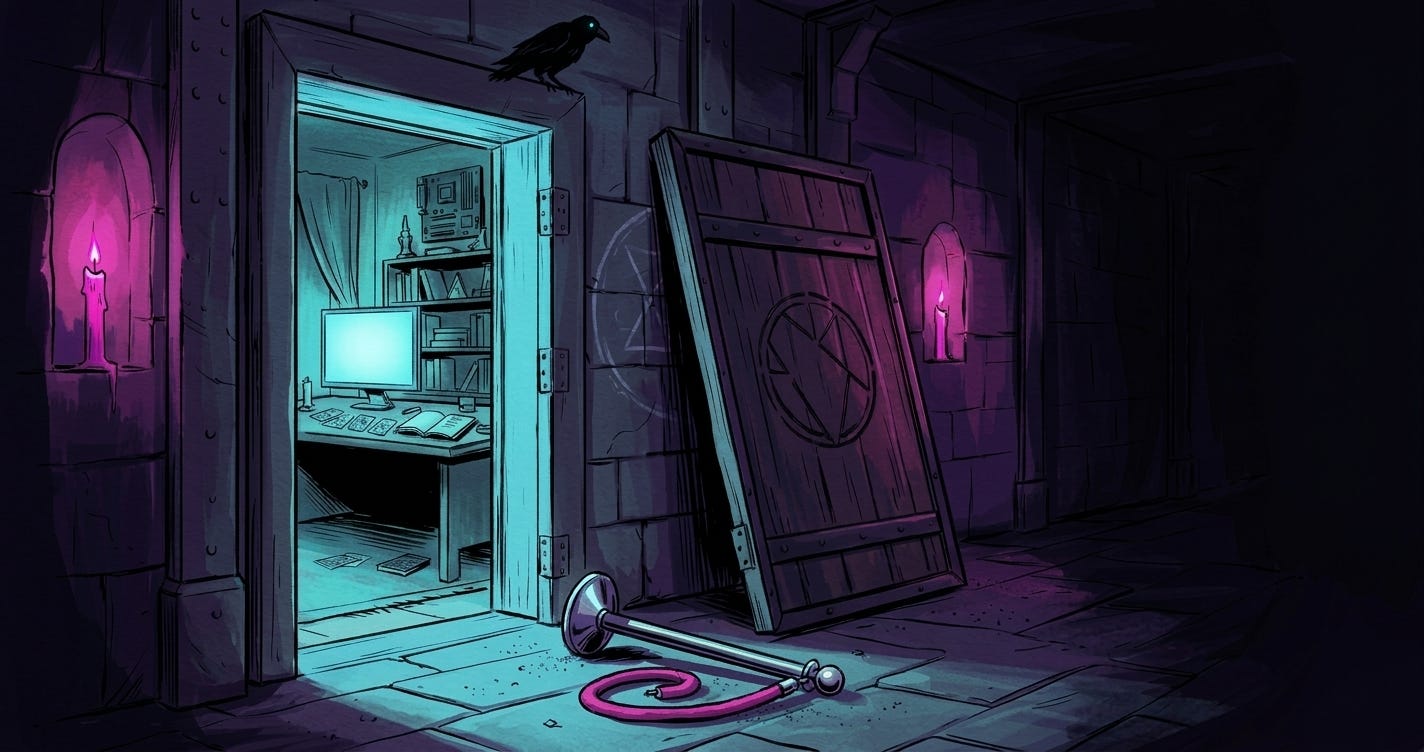
The door’s off the hinges. Come in whenever.
That’s it for this week.
Stay feral, folks.
This is actually how I’ve built from day one. One thing you could still do, if you wanted, is consulting. I use Ko-Fi for tips, donations, a few products, and scheduled consultations.
I never expected to make money here. I’ve been writing for way too long. lol. Before there were countless ways to post content online, writers when asked by amateurs, would all say one thing:
NEVER WRITE FOR FREE.
That everyday axiom died the day blogs were invented. So, everything I do here is free. I still do consulting. I’ve had some decent luck in that area for about a decade, but had no place where clients could schedule appointments. Now, it’s easier. I do what I want or feel like, and that’s it.