


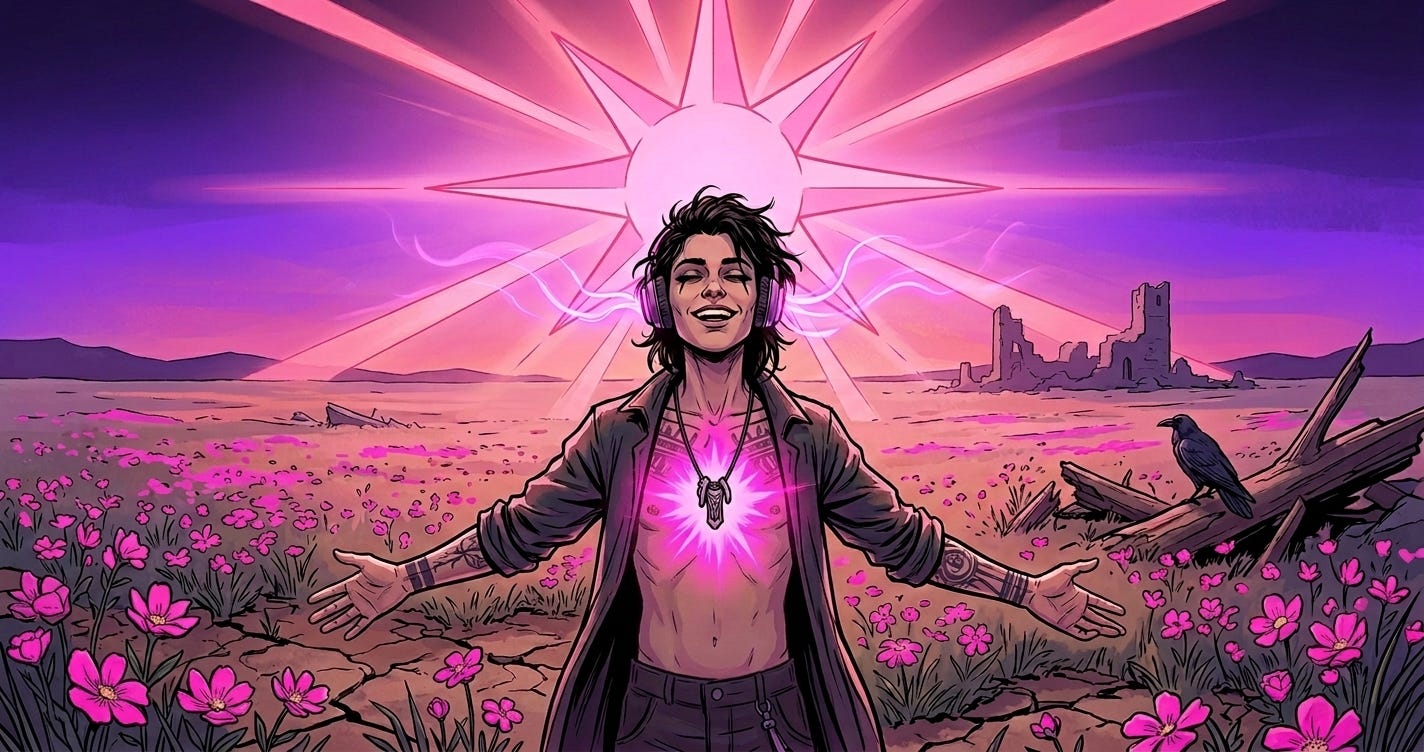
I need to tell you about the most unhinged creative project I’ve ever undertaken, because it’s live on every major streaming platform right now and I still don’t fully understand what happened.
A couple weeks ago, I had an idea. Which is how all my best and worst decisions start.
The idea was: what if there was a rock opera based on the major arcana of the tarot? Twenty-two songs. One for each card. A complete journey through the Jungian individuation process — creation, fragmentation, collapse, transcendence — set to the kind of theatrical arena rock that makes you want to drive too fast with the windows down.
So I built it.
I know what you’re going to say. “You didn’t build it. AI built it.”
Yeah, about that. This is where it gets interesting.
I’ve been writing code since I was seven years old. My favorite childhood computer — a Commodore 64 — is sitting six feet from me right now, fully operational, because it reminds me of when this craft felt magical. I’ve been doing it professionally for twenty-five years. And in the last eighteen months, AI has completely transformed the profession. We went from fumbling around with chatbots to building systems that produce work as good as or better than most experienced engineers. That’s not hype — that’s Tuesday at my day job.
(Not actually my childhood C64 - the one manufactured in 2025!)
But this was different.
A few weeks ago, I built a personal AI cognitive scaffold — a system I call Psyche — that is specifically designed to understand how I think. Not how a person thinks. How I think. Neurodivergent, multi-threaded, symbolically wired, running forty ideas at once and dropping half of them into the void. Psyche follows me across those threads, notices connections I miss, learns from my feedback, and adapts.
So when I sat down to create this rock opera, I didn’t just prompt a music generator. I brought the full weight of that cognitive system to bear. I told it: I want to map the individuation journey through the major arcana. I want both the light and shadow of every card. I want four acts — structured around the framework I learned from Mariana Louis at the Archetypal Tarot School, who maps the major arcana through four phases of Jungian individuation: Primordial Powers, Individuating Ego, Descent, and Transcendence. I want the musical DNA of Use Your Illusion-era Guns N’ Roses, The Who, Queen, Meatloaf, and Journey. I want the lead singer to sound like the love child of Steve Perry, Axl Rose, and Freddie Mercury.
And then we started writing. Song by song. Card by card.
Every song holds a polarity. That was the creative rule I locked in early and never broke.
The Magician isn’t just awakening — it’s also the terror of power you didn’t ask for. The Emperor isn’t just structure — it’s a fortress built by someone still shaking inside it. The Devil isn’t just shadow — it’s the cage you willingly step into because it feels good. Every card, both medicine and trap. Every song, both sides of the tension held simultaneously without collapsing into false resolution.
Here’s how the process actually worked: I’d tell the system what each card needed to carry — the archetypal weight, the emotional register, where it sits in the narrative arc. The system would write lyrics in my voice (because it’s been learning my voice for weeks). Then it would generate a Suno prompt — a precise set of musical instructions designed for the AI music platform I was using. I’d feed that into the generator, get two options, and pick the one that felt right.
In the beginning, the choice was obvious. One version would clearly be better.
About halfway through the album, something shifted.
I started having to listen to both options two or three times. The system had learned my taste so precisely that both versions were hitting. The gap between “close” and “exactly right” had narrowed to the point where I was sitting with each track, feeling it in my body, letting it work on me before I could decide.
That is not what people mean when they say “AI-generated content.”
But here’s the part that broke my brain.
The music started provoking spontaneous emotional reactions that I did not anticipate and could not have designed for.
One of my songs made me start crying. Not the part I expected. Not the big dramatic climax I’d carefully architected. A different moment. A turn of phrase landing on a musical shift that I hadn’t consciously connected. Something emerged from the intersection of my intention and the system’s execution that neither of us put there deliberately.
I’ve had songs make me laugh out loud. I’ve had songs make me stand up and clap. When I have an emotional response, it usually manifests physically — I get energy, I start moving around. And these responses kept surprising me. Not because the music was technically impressive. Because something alive was coming through.
AI stuff is not supposed to do that. They say. It can’t capture the emotion, the spirit, the soul of a person. And yet.
The code didn’t capture my soul. I poured my soul into a system that knew how to hold it. The cognitive scaffold I built — the one that understands my voice, my patterns, my symbolic language, my aesthetic sensibility — it didn’t replace the artist. It expanded what the artist could be.
Let me tell you about the opera itself.
The album is called The Arcana: A Soul in Flames. The artist is ARCÆON — a name that fuses Arcana and Aeon, because this project lives at the intersection of ancient symbolic systems and whatever the hell we’re becoming as a species. The label is Alchemical Signal, because what else would you call a container for transformation transmitted through sound?
Twenty-two tracks. Four acts. The Fool is both protagonist and cosmic witness.
Act I — The Primordial Powers — opens with “Spark in the Void” (The Magician) and builds through mystery, desire, control, and inherited belief to the first real choice: “Split in Two” (The Lovers). The soul experiences separation for the first time.
Act II — The Individuating Ego — is loud, fast, and already cracking. “Ride the Lightning Within” (The Chariot) sounds like triumph fueled by something slightly unstable underneath. By “The Scales Don’t Lie” (Justice), the ego has stopped negotiating with reality.
Act III — Descent — is where everything breaks. “Chains You Love” (The Devil) is the most honest song on the album: ”It’s not a prison if I don’t try to leave.” And then “When It All Burns Down” (The Tower) detonates the entire structure. That’s the climax. The world ending and something real beginning in the same breath.
Act IV — Transcendence — doesn’t resolve. It opens. “After the Fire” (The Star) is what hope sounds like when you’re not sure you trust it yet. “Unbreakable Light” (The Sun) is the first moment where nothing inside you is fighting anymore. And “Step Into the Sky” (The Fool) — the finale — doesn’t end the story. It reopens it. The last note could bleed directly into The Magician. The album never truly ends.
I named the lead singer Cael Viren. Because even a synthetic voice deserves a mythology.
Cael is the voice that emerges when identity dissolves and reorganizes under pressure. In The Magician, he sounds like power awakening. In The Emperor, controlled and rigid. In The Devil, seductive and fractured. In The Tower, breaking. In The Fool, free. He’s not a character. He’s the part of the psyche that survives every transformation.
Is he real?
Is any of this real?
I built a system that understands how I think. I used it to write lyrics about the architecture of the human psyche. I pushed those lyrics through a music generator that learned my taste in real time. I published the result on Spotify and Apple Music and every other streaming platform. And every single person who has listened has loved it.
That’s real enough for me.
I told my coach this week that I don’t think I’ve been this creative maybe ever. And part of me asks: is this too good to be true? Am I going to crash? Because I’ve had those burnout spirals before — sprint hard, create like a maniac, then shut down for months.
He said something I’m still carrying: your baseline has raised. When you hit the valley now, you’re not hitting the old floor. You know how to work with whatever arises.
So I’m not afraid of the valley. I’m aware of it. I’m tired at night. I’m channeling a lot of energy right now and that takes recovery. But I’m also building things that are on a level I didn’t know I could reach. And the distance between “I had an idea” and “it exists in the world” has collapsed from months to hours.
Not because AI replaced me.
Because I built infrastructure for my own fire.
The album is out now. ARCÆON. The Arcana: A Soul in Flames. On Spotify,
Apple Music, and everywhere else music lives.
It was composed through a collaborative process between human intention and generative systems. It is both ancient and forward-facing. It is not artificial. It is emergent.
If you listen to it and something moves in you — something you didn’t expect, something that surprises you, something that makes you stand up or sit down or close your eyes —
Good.
That’s the point.
That’s always been the point.
Stay feral, folks.
Matt, love the album. Was wondering, do you have the lyrics published anywhere online?