


Howdy, folks.
This afternoon I threw a little grenade on Threads. I didn’t mean it as a grenade. It was, I swear to god, an honest question (well, maybe it was a little bit of a shit post). Fourteen words:
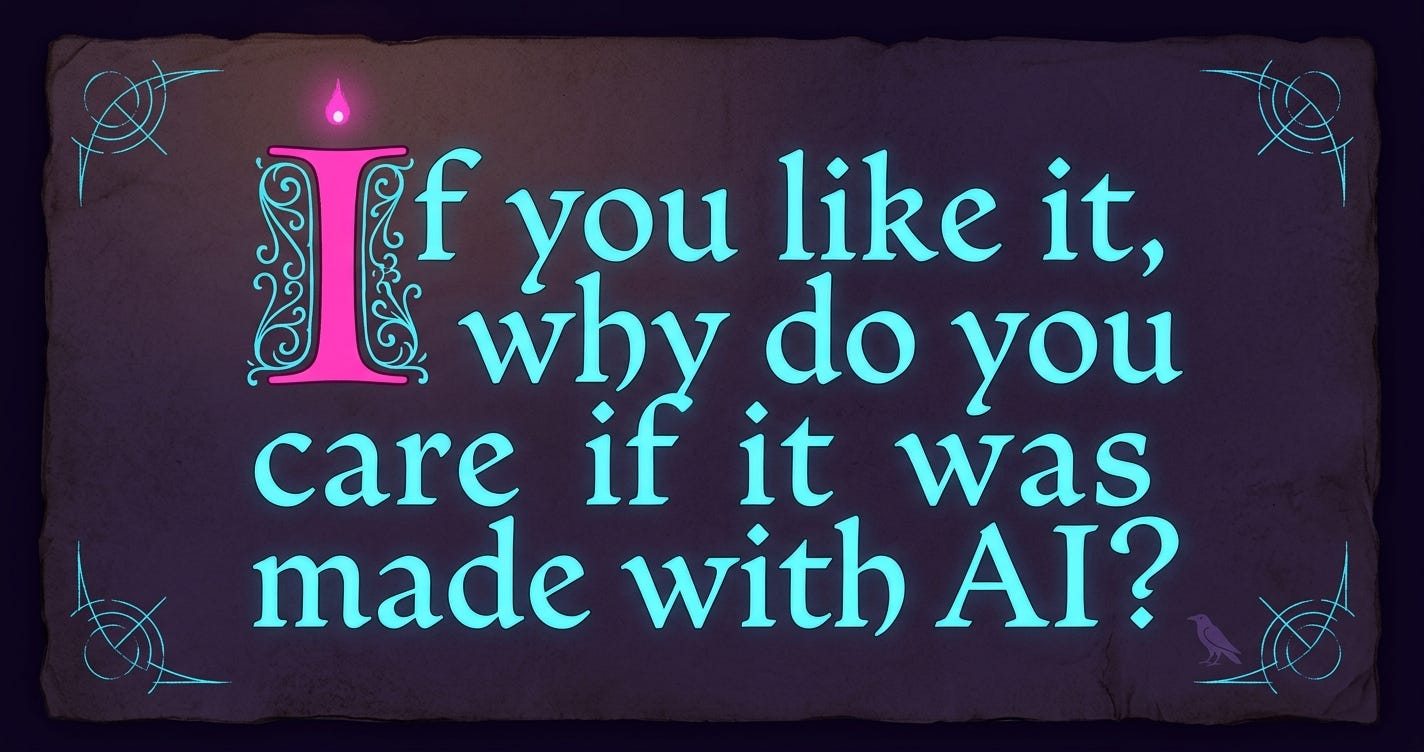
If you like it, why do you care if it was made with AI?
Fuckers got big mad.
Let me walk you through the shape of the response, because the shape is the whole piece. First wave: the standard objections. Environmental cost. Theft of art. Training data scraped from real humans. Fine. Those are real conversations and I’m not dismissing them — but they’re not the conversation I was trying to have. Those are questions about the system. My question was about your response to a specific piece of output.
Second wave is where it got interesting. Second wave was: art has to be ALIVE. It has to come from EMOTION. Blood, sweat, and tears. A machine can’t feel, therefore a machine can’t make art. That’s the whole fucking POINT of art.
OK. Let’s do this.
First thing I noticed — and this made me laugh out loud, continually, as I scrolled through the replies — is that almost nobody actually answered the question I asked. They skipped right past the opening clause. If you like it. That was the whole premise. The condition the entire question was predicated on. And my respondents just... walked past it. Like it wasn’t there. They launched into why they objected to AI in general, why I was lazy for asking, why I had no soul — and left the admission that the output was good enough to like just lying in the road, unattended.
One person — ONE — actually engaged the premise. “I don’t like it,” they said.
Reader, I LOVE this person. This person was honest. This person did me a solid.
Because my follow-up was immediate: then why are you here? If you don’t like it, why are you paying attention to it at all? Why is this worth your time to comment on?
No answer.
Now let me tell you why.
The materialist escape hatch.
The argument I most want to engage with is the ALIVE/EMOTION/BLOOD-SWEAT-TEARS one. Because it’s the one that thinks it has metaphysical ground under it. Let’s see.
You’re telling me art requires aliveness. That something must be ALIVE to feel, and that art can ONLY come from emotion. Fine. Now — where did that aliveness come from?
If you’re a materialist — which most of the people making this argument implicitly are, because in the next breath they’ll also tell you that consciousness is an emergent property of brain chemistry and religion is a fairy tale — then the aliveness you’re gatekeeping art with is itself the output of random chance running through a statistical feedback loop over four billion years. You are a meat-based stochastic process that learned to paint by iterating on mutation and selection. The “aliveness” is not magic. It’s not sacred in any metaphysical sense you’d defend in a sober conversation. It’s math, in carbon, over time.
And that process — random chance plus iterative feedback — produced Michelangelo. Produced Octavia Butler. Produced the first cave painter grinding red ochre by firelight, trying to put something unsayable on a wall.
So let me get this straight: random-chance-plus-iteration is noble when it happens in carbon, but it’s soulless theft when it happens in silicon?
Watch what happens next. They’ll pivot. They won’t be defending aliveness anymore — they’ll be defending embodiment. “It has to be a body. It has to be suffering. It has to be blood.” The goalpost moves in public, in real time, and most of them won’t even notice they moved it.
OK. So if a slug leaves a shimmer trail across pavement in a pattern I find beautiful, is that art? The slug has a body. The slug is alive. The slug is definitely expending more metabolic effort per square inch than any of us. If a plant turns toward the sun in a fractal curl that makes you weep, is that art?
They’ll start hedging. Qualifying. Adding conditions. You’ll see them trying to defend the carbon line AND the consciousness line AND the suffering line all at once, and those three don’t cohere. They never did. That was the trick.
The theist horn. This one’s my favorite.
Some of them are coming at this from the other direction. They don’t believe in evolution. They believe God spoke this all into being.
OK, friends. Let’s go to the book.
In the beginning was the Word.
And God SAID, let there be light.
And there was light.
The founding act of reality — the most foundational creative gesture in the dominant Western cosmology — is speaking-things-into-being. A command. An utterance. Language shaping reality. God did not labor for six days with a chisel and a bucket of paint. God did not bleed. God did not suffer over the rough draft of the firmament. God issued instructions and reality unfolded.
What do you call that, my dudes? You want a name for it? You want me to say it?
In the beginning was the fucking prompt.
If your cosmology opens with the Logos commanding creation to unfold from instruction, and you want to tell me that creation-via-prompt is beneath the dignity of art — I need you to go back and re-read your own foundational text. Genesis is a prompt engineering tutorial. John 1:1 is not ambiguous. The Word preceded everything. You don’t get to then turn around and say that words-shaping-reality is a lazy man’s cheat.
What the fuck are you going to do with that?
What the rage is actually about.
You already know. I already wrote it. Your Rage Is Not About the Robot laid this out — the rage is not aesthetic. It’s not even primarily ethical. It’s about status.
Art, in the old economy, conferred status through suffering. I suffered to make this, therefore it is valuable, therefore I am valuable. Skill acquisition was a hazing ritual. Ten thousand hours. Bleeding fingers on guitar strings. Three years in a garret writing the novel nobody would publish. The suffering was not incidental — it was the proof of worthiness, and the worthiness was the hidden wage that made the whole system tolerable.
Remove the suffering tax and the identity architecture collapses.
This is why “I don’t like it” wasn’t actually the point for my one honest respondent. This is why nobody addressed the if you like it clause. Because the question was not about the art. The question was never about the art. The question is about who gets to feel valuable, and by what mechanism, in a world where the old mechanism no longer works.
The rage is a shadow projection. The robot is the screen. The thing being defended is a belief about one’s own worth, routed through the production of objects, calibrated to a world that is ceasing to exist.
Back to the koan.
If you like it, why do you care if it was made with AI?
That question wasn’t a grenade. It was a koan. And like all good koans, it works by stripping away the performance and leaving only the honest thing underneath. When the answer is “I care because of my beliefs about the maker,” you have exited aesthetic territory. You are now in the territory of identity, status, and tribe. Which is fine. Those are real things. But they are not art criticism. They are a different conversation — and the honest move is to name it as such instead of costuming it in aesthetics.
And when the answer is “I don’t like it” — well.
Then what are you doing here?
That’s it for this week.
Stay feral, folks.
yes, and thats the one that gets me so much I want to scream. The whole "It's AI slop!" without even reading one word. OR, as you said, if they DID like it, but then find out after the fact, they try to gaslight us because they simply cannot allow themselves to admit something produced "by machine" could be beautiful or pleasing.
Course, at the same time, they have no problem with photographs, movies, digital art, electronic music...
And if you point out that AI art has to have a human guiding it and prompting it and building it to make it fit a human's vision; that the AI isn't just prompting itself, but that the prompt itself came from the mind of a human, you'll be told "that isn't the same thing!"
And I want to know why. Why is this somehow not my story, my creation, just because I used the AI to bring it to life? Why even though I have 10 years worth of notes, spend thousands of words crafting the prompt and then surgically editing the response line by line to get it to exactly what I had envision - how is that "the machine" and not "me?"
I never get an answer for that one either.
Yes. Normally, nobody ever answers the question: is it good? Did you feel anything?
They'd rather die than admit any quality to any piece of AI-assisted expression.
And if they learn it later, after having praised it, they will tell you that they always felt something was off.
You can't win.