


Picture the hold of a ship in 1775, somewhere in the gray middle of the Atlantic, and hold the picture a second, because somebody is hiding in it.
A man, a woman, and a baby not yet a year old. Around them in the dark, the cargo they are pretending to be: potatoes. Sacks and sacks of the humblest thing the island grows, the food of people who weren’t allowed much else — and tucked among them, labeled as them, counted as them, a family with a death sentence sitting on the man’s neck. Six months at sea. Six months of breathing that close, salt and rot and the baby’s fevers, every groan of the hull maybe the one that gives them up.
He is in there because of something he made.
I want to stay in that hold a beat before I tell you who he was, because the whole inheritance is in the image and I nearly walked past it. My sixth-great-grandfather did not flee Ireland as a wanted revolutionary, sword drawn, banners up. He fled as produce. The single most overlooked thing in the world. And the reason there was a price on him at all is the same reason I’m related to anyone worth writing about: he was an artist, and his art was treason.
The maker’s mark was the crime
His name was Robert McCall. Born in Antrim in 1752, a weaver by trade — and not a journeyman one. The family book (there is a family book; every American family with notions has one, and the notions are half the fun) says he “could design anything for weaving.” Anything. Hand him a loom and a thing in the world and he’d give you the thing back in linen.
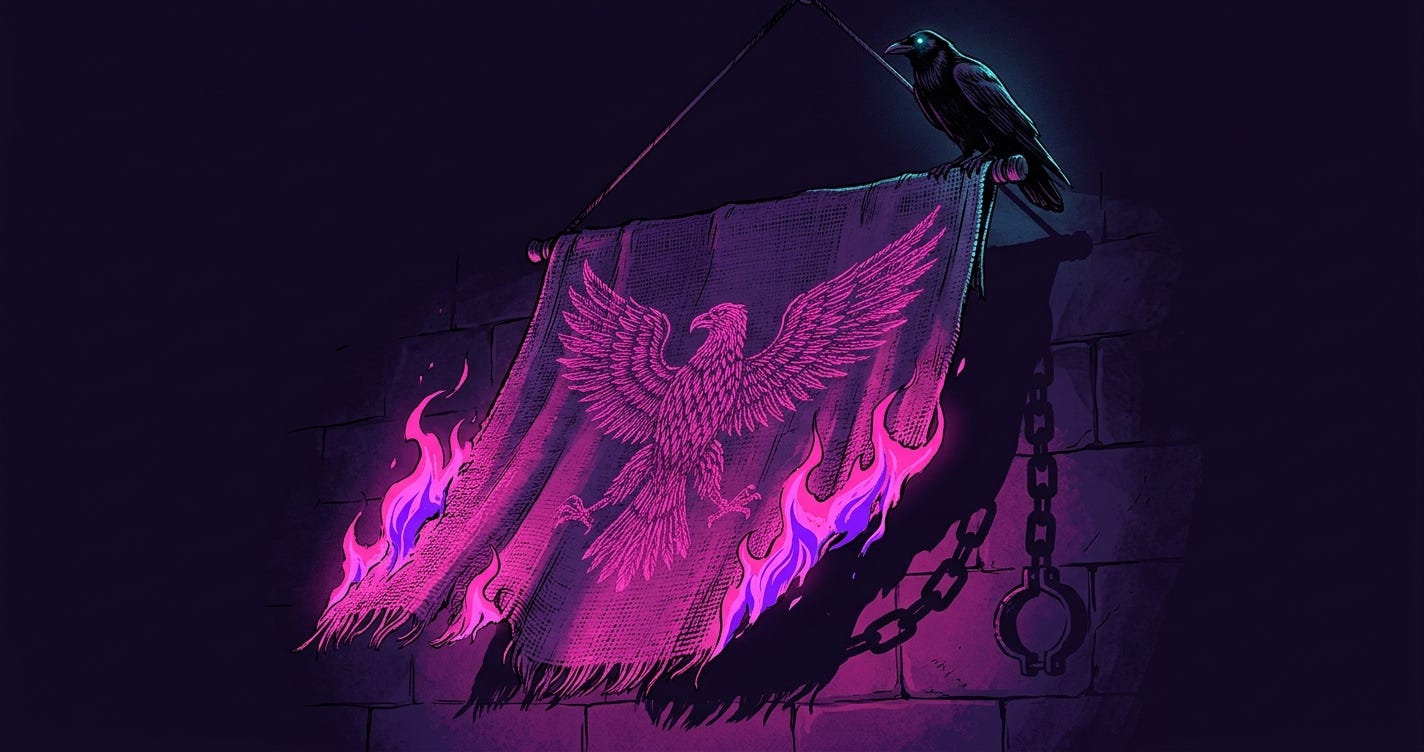
What he chose to weave was an American eagle. And then — and here you have to take it the way the family has carried it for two centuries, which is to say as gospel that may or may not have happened — he presented it to King George III.
Read that again. An Ulster weaver, a colonial subject, hands the King of England a length of linen with the eagle of the American rebellion worked into it. Not a pamphlet he could deny writing. Not a shout in a tavern that the drink could excuse. A made thing, slow and deliberate, thread over thread over thread — the kind of object that takes weeks and announces that every one of those hours was spent on exactly this. The king took it the way it was built to be taken, an insult with a needle in it, and charged him with treason, and ordered him beheaded.
It’s the patience that gets me. Any fool can lose his temper and say something treasonous. Robert committed treason at maybe forty threads an hour, for weeks, on purpose. The medium was the message and the message was: I see your empire, and I am quietly weaving the other thing.
Here’s the cut, and it’s why this is the door I’m walking the whole rest of my blood through: they did not sentence a soldier. They sentenced a maker. The crime was the craft. The art and the defiance were one object — you could not seize one without seizing the other, because they were woven together, literally, in the same cloth. The maker’s mark was the crime.
If you’ve read me for more than a week you already know why my hands went cold when I found this. We’ll get there. Let me get him out of Ireland first.
He went out as potatoes
The death sentence is real — in the story — so the question becomes the oldest one there is: how does the maker get out alive?
He goes out as potatoes.
I cannot improve on that, so I won’t try. The man whose art was too dangerous to let live escaped the empire by becoming the least dangerous thing it could picture: inventory. Root vegetables. The one cargo nobody searches, because who in God’s name searches the potatoes. He’d already shown a gift for taking what he wanted out from under authority’s nose — the family says he married Elizabeth Aiken by stealing her out of a window, her people having decided their royal-descended daughter was too fine for a weaver. (Royal descent: also in the book, also unverified, also precisely what every family book on earth claims. I love it anyway.) The window first. Then the entire Atlantic. Clarktown, Ireland, 1775, six months pretending to be food.
And the symbol is too clean to leave alone. He didn’t escape despite coming from a colonized, half-fed island. He escaped as it. The potato — the crop the empire was content to let the Irish have because it grew in poor soil and kept the labor cheap and breathing — is the exact disguise that carried the rebel across the water. The colonized ground hid its own. The thing they’d been reduced to is the thing that smuggled out the thing they refused to stop being. I’d have wept if I’d thought of it. Robert just did it, and lived.
The colonel
Here is where a worse essay would let you ride the admiration clean to the end. Because it keeps going, and it keeps being good.
Robert landed in a country about to do out loud what he had done in linen. He became a colonel of a North Carolina regiment under General Daniel Morgan — and if you know your Revolution, Morgan is the one you’d want over you, the rifleman’s general, the one who actually won things. The book puts Robert at Saratoga in 1777, at Yorktown in 1781, present at the surrender of Lord Cornwallis — which is to say present at the precise hour the empire that had wanted his head laid down its sword. The weaver outlasted the sentence long enough to watch the king lose. You could not write it straighter if you tried.
Over fields like those the carrion birds always came, and the people my family would one day learn to pray to had a name for that bird: the Badb, the Mórrígan in her crow-shape, the one who attends the killing and takes no side, because death on a battlefield has never once cared whose cause was just. I think she was there. I’ve come to think she’s been over this whole line the entire time, patient as a weaver, waiting to see what we’d make of what we were handed.
It’s a hell of a story. Eagle, treason, potatoes, Morgan, Cornwallis on his knees. If I stopped here you’d close the tab feeling wonderful about your boy.
I’m not going to stop here.
The receipt
Robert McCall owned human beings.
Land and enslaved people, in Henry County, Virginia, and Burke County, North Carolina. That is not family lore gone soft over two centuries. That is the confirmed part — the part the book sets down as flatly as the loom and the eagle, no drama, no window, just property.
So hold it. Hold both hands at once, because this is the actual reason I’m writing the whole arc instead of just posting a cool dead relative on the internet. The man who wove one people’s liberty into cloth, who risked his neck for it, who crossed an ocean as a vegetable to keep his head and then took up arms so a new country could be rid of its king — that same man held other human beings as property on the far shore of that same promise. He fought for a freedom he was, at that very moment, denying to people he owned. The eagle and the auction block. Both his hands. Both mine.
I’m not going to reach for “man of his time,” because the men and women he enslaved were also of his time, and they did not consent to it, and there were people in 1781 who looked straight at slavery and called it the abomination it was. The excuse is just a way of not looking — and the entire point of this work, of digging up the dead and asking them what they put in my hands, is to look.
And look at who got written down. The book spends pages on Robert: the eagle, the window, the royal-descended bride, the six-month voyage, the general he rode behind. The people he owned get a clause. No names. No ages, no trades, no escapes worth a paragraph, no motto stitched over a door. The same family devotion that spun a weaver into a legend could not be troubled to record that the human beings in his fields had names — and that erasure is its own inheritance, quieter than the eagle and twice as damning. The archive remembers the maker and forgets the ones made to serve him. I can’t repair that from a laptop two and a half centuries downstream. I can at least refuse to read past it like it isn’t the loudest thing on the page.
You do not get to inherit only the half that flatters you. It took me a while to land there, but I’m sure of it now. If I’m going to claim the weaver’s defiance — and I do; I feel it in my hands every time I make a thing the institution would rather I didn’t — then I have to claim the receipt in the same breath. One bloodline, carrying the rebellion and the bondage together. To take the eagle and quietly let the ledger fall behind the couch is to do the exact thing the “man of his time” dodge does: edit the ancestor down into someone I can live with. He wasn’t someone you live with easily. He was magnificent and he was complicit, and sanding off either one is a lie I’m not willing to tell for the sake of a tidier post.
The weaver’s grandson
The loom is still running. That’s the part I can’t shake.
Two hundred and fifty years on, one of his descendants still makes things the dominant order would prefer he didn’t — still weaves the forbidden symbol into the work, hands it over, and waits to see who calls it treason. I didn’t know about Robert when I started doing it. I found him after, which is the way these things always go: the body knows the pattern long before the mind turns up the receipt for it. The maker’s mark is the inheritance. And so is the warning stitched into it — that a man can be brave enough to risk his head for one freedom and cruel enough to deny it to others inside the same life, that the courage doesn’t excuse the cruelty and the cruelty doesn’t cancel the courage. They just ride down the line together, both of them, waiting to see which one you’ll feed.
The crow that sat over Saratoga is sitting over me now. She doesn’t take a side either. She only watches what I make, and who I make it for, and whether I’ve got the nerve to look at the whole of it — the eagle and the ledger, the loom and the lock — and weave anyway, with my eyes open this time.
I’m going to keep weaving. Eyes open. It’s the only version of the inheritance worth keeping.
Stay feral, folks.