


Howdy, folks.
Usually I write the piece first and the cover comes after — pull a concept from the draft, figure out the visual, ship the art that matches the argument. This one went the other way.
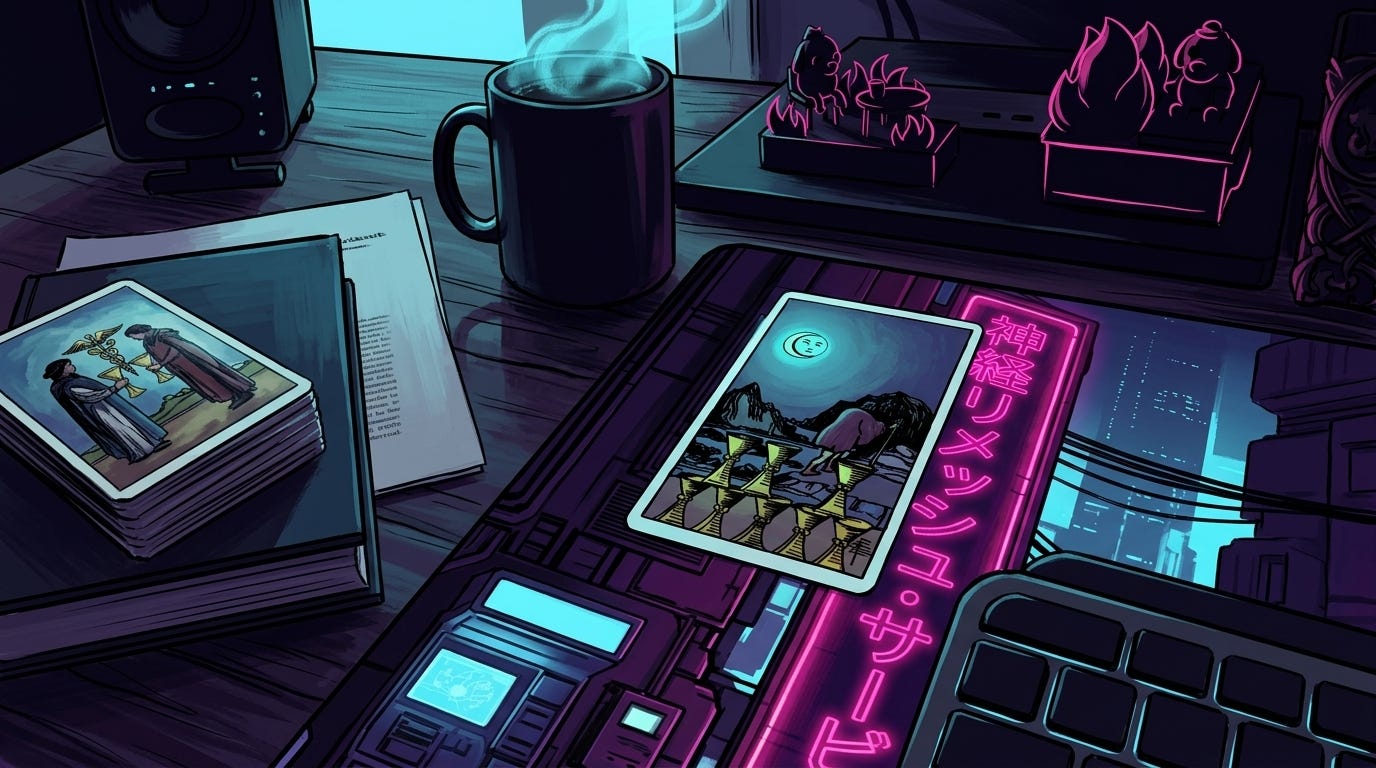
I drew a card before starting this draft. Just one, the way I used to for clients before I started writing about the same stuff in a newsletter. The Eight of Cups. No spread, no specific question except what wants to be written? I set it on the desk, took a picture of it, and that photograph is what the cover above was generated from. The card, the mat, the light at the moment I drew it — all of it ran through the Feral Architecture aesthetic without losing the source. Because the point of this piece was to let the card come first and let the argument emerge downstream.
So what did it say?
The quick-read of the Eight of Cups is leaving what no longer serves you. True enough. But that’s the billboard version. The card is working a layer beneath that, and when I sat with it, that deeper layer was the one naming what’s actually happening.
The cups are still full
Look at the image itself for a minute. Not the traditional meaning of the card. Just the picture. Eight cups stacked in a gap-on-top arrangement. A cloaked figure walking away. Night, moon, mountains, water.
I was trained in archetypal depth-psychology tarot, primarily through the work of Mariana Louis. What that tradition teaches you to look for is what’s in the image that the quick-read would rush past. And the detail in this card that stops me cold every time I sit with it is this: the cups are still full.
The figure isn’t walking away from an empty table. Nothing spilled. Nothing broken. Nothing was wrong with what was built. The wine is still in the cups and the cups are still stacked, intact, ready to be sat with. The walker leaves anyway.
That’s the card’s actual move. Not escape. Not disillusionment. Not a rage-quit from something that went bad. A sober departure from something that was never wrong — that simply can’t hold the current version of you anymore.
The card refuses to give you an easy out. If you stay, you’ll carry a cost. If you leave, you’ll carry a cost. There’s no painless move — only the question of which cost is in service of what’s coming and which one is just friction. The card points at the walking.
What comes before it
In the hero’s-journey frame, the Eight sits late in the arc. The Ace called you out. The Five broke you open. The Six gave you your breakthrough. The Seven was where you got lost in fantasy about what the breakthrough was going to mean. By the time the Eight arrives, the hero has been through the thick of it and is trying to come back — or refusing to.
The Seven of Cups is where projection lives — seven cups, each one a different vision of what your life could become, all of them both real and not real, all of them intoxicating. Desire wearing the costume of destiny. The visions keep getting bigger. Some of them have already begun to collapse under their own weight and you haven’t noticed because the next one is already dazzling you.
The Eight is the morning after.
It’s the sober awakening from the Seven’s fog. The walker sees which cups were castles in the air and which ones were real. The real ones are still on the table. And she walks anyway — not because the real ones are insufficient, but because they’re not what’s next.
The twenty-five-year cup
Last week I wrote a piece naming a split I’d been maintaining for twenty-five years — the technical architect in one room, the tarot reader and Jungian practitioner in the other. I said out loud that they were the same person doing the same work, and that the split was a lie the cultures I operated in had required me to maintain.
That piece was about the integration.
This one is about what the integration required me to leave.
A partial list from the last two weeks. I retired a coaching brand I’d marketed exhaustively on LinkedIn for months. I killed the working name I’d been using for my ideal-customer archetype because it was trauma-recovery-coded in a way I hadn’t seen at first. I let go of Stay Resonant as my closing signature because it had calcified into professional varnish and I wanted my voice back. I sent a reintroduction email to my old Substack list telling them, politely, to come find me at the new fire or not, no hard feelings. I replaced the About page on this publication with one that names me as a priest of An Mórrígan, which is not a sentence I was writing six months ago.
None of what I left was wrong. It was all real when I built it. The cups were full, and they’re still full back there on that table, and I’m walking.
The auspice
The number eight has a particular flavor to it, at least in the way I’ve come to read it. Think about the Roman augurs — the priests who read bird flight as omen, who called that kind of reading auspice. The eight is action, yes. But it’s action that emerges from reading a sign.
Here’s what that frame does to the card. The cups in the foreground aren’t what the walker is leaving from. They’re what the walker read. The emotional container itself was the omen. The reading and the leaving are the same motion.
In engineering terms: the system’s metrics were the sign. You don’t leave a codebase because you’re tired of it. You leave because the codebase has been telling you something for a year and you finally heard it. The thing you built is the instrument that reads your own life back to you, if you know how to listen.
Most people never develop the feeling function enough to read their own containers. They keep sitting at tables where all the cups are full and nothing has gone visibly wrong, long past the point the cup-reading has already rendered its verdict. They override the verdict with logic. They rationalize staying because staying is defensible.
The Eight of Cups is the card of listening anyway.
Rescue from without
Here’s the piece that surprised me when I first studied this card. The Cups figure is not departing by conscious choice. Not in the active, I-picked-up-my-staff sense.
Mapping each Minor Arcana suit onto Campbell’s hero’s-journey is a well-worn interpretive move, and when you apply it, position eight lands on a specific beat that Campbell called the rescue from without — not the frenzied active flight, but the other kind. The kind where the ego has refused the return for too long and something older than the ego arrives to start the walking on its behalf. The fog of the Seven lifts faster than the ego can brace for. The figure comes-to already mid-step. The moonlight shows exactly the next foot of path and nothing more.
This maps to real experience uncomfortably well. You don’t always decide to leave. Sometimes you’re already walking before you notice. The sacral response beats the analytical vote. The feeling function has already rendered its evaluation and you wake up three steps down the path wondering when the motion started.
That’s not a failure of agency. That’s the feeling function being the rational function it was designed to be — evaluation happening on an unconscious substrate before the ego ratifies it. The job isn’t to override the leaving. The job is to honor it.
The craft
If there’s a Feral Architecture thesis underneath the card, it’s this:
Leaving is an architectural move.
Not a reaction. Not a failure. Not a preface to the next thing. A discipline on its own terms — requiring developed feeling, mature trust of the unconscious, willingness to sit in the crushing both-ways-ness of it. The same way a good architect knows when to retire a system that still technically works — not because it’s broken, but because it no longer fits the organizational truth it was built to serve.
Most engineers can’t do this. They build systems that outlive their honest function because the metric of success is still running rather than still true. The Eight of Cups is the craft of noticing the gap between running and true, and walking even though everything on the table is still technically full.
The cups will remain. Someone else can sit at that table if they want to. The wine isn’t bad. It’s just not yours anymore.
Stay feral, folks.
— Matt