


Howdy, folks.
Here’s a morning brain dump that wouldn’t let me go.
X — formerly Twitter — runs its core product with about 25 engineers. Two designers. A couple of PMs. Nikita Bier at the top as head of product. That’s the team. Five hundred million users. A global platform. Twenty-five people in the product engineering room.
Before the acquisition, Twitter had about 2,000 engineers specifically. Call it eighty-to-one. Not 250-to-one like the viral posts claim — that math compares total headcount at 7,500 to just the product engineering team today, which is apples-to-oranges journalism dressed up as a banger tweet. The honest number is 80×. Still stunning. Still science fiction if you’d said it out loud in 2019.
(Fair caveat before we go further: the recommendation algorithm is maintained by a separate team at xAI — roughly another 30 engineers. So the product layer is 25, and the AI layer is partially outsourced. The leverage is real, but it’s not magic. It’s lean.)
I run TarotPulse with one engineer. That’s me. I’ve got Claude riding shotgun. Twelve paying clients. One product.
25 engineers + AI → 500 million users. 1 engineer + AI → 12 clients.
That feels roughly proportional.
Not because I’m comparing myself to X. That would be delusional. I’m noticing something structural: the ratio of engineers to platform complexity has collapsed at every scale. The leverage curve has flattened so dramatically that the difference between 1 and 25 is a difference of magnitude, not a difference of kind.
The solo builder isn’t playing a lesser version of the game. They’re playing the same game.
Let that sit for a second.
The Quiet Part
I’m not going to do the breathless “AI will replace developers” routine. That’s not what’s happening, and the people writing that take are usually selling something. What’s actually happening is subtler and structurally weirder.
Five years ago, the ratio of engineers to platform complexity was a fixed thing. You wanted to run a product serving 500M users, you hired 2,000 engineers. That was the deal. You wanted to run a side project serving twelve clients, you either did it yourself in your spare time or it didn’t exist.
Now the ratio isn’t fixed. It’s not even a gradient. It’s been compressed into a single continuous line where the math works at every scale. The same mechanics that let 25 people run X are the mechanics letting me run TarotPulse. I’m not building a lesser version. I’m running the same operating model, proportionally downsized to the shape of one human’s life.
This is the techno-mysticism thesis in miniature. Not the shiny founder-podcast version — the structural one. Leverage used to be a privilege of scale. Now it’s a commodity.
And a commodity cuts both ways.
Which brings us to the shadow.
The Part I Have to Name or the Piece Is a Lie
I had friends at Twitter when the layoffs hit.
What Musk did was inhumane. I’m not being polite about it — I mean inhumane in the dictionary sense. Mass slashing. Fear culture. Erratic behavior that made even the survivors feel in constant danger of the next Friday afternoon purge. People refused the severance because they thought it was unfair. People are still in court. The damage is not hypothetical. It has names and addresses and custody arrangements and prescriptions.
So when I say “25 engineers instead of 2,000,” I am also saying: 1,975 people who used to do that work are not doing that work anymore. They are somewhere else. And “somewhere else” in 2026 does not mean “easily placed in an equivalent role at another platform company.” It means a labor market where the jobs those people trained for have compressed by two orders of magnitude in three years.
If I celebrate the leverage story without naming this, I am writing the capitalism-eating-itself fan fiction.
Not interested.
The Other Shadow
There’s a second one, structurally separate from the human cost but tangled up with it.
If 25 engineers can do what 2,000 used to do — across every company, not just X — where do the 1,975 go? Not rhetorically. Actually. Across the whole economy. At what point does the leverage curve eat enough of the middle that the customers stop existing, because a customer is a person with a job that hasn’t been optimized out of existence yet?
Nobody buys the product when nobody can afford to eat.
I don’t have the five-bullet-point policy answer. I’m not going to pretend there’s a tidy landing I can gesture toward that makes the tension dissolve. The leverage story is real. The displacement story is real. Both are true. They point in opposite directions. The same technological capability that makes a solo builder viable also makes mass displacement a structural feature of the economy, not a bug you can patch.
Remember the utility piece from a few weeks back? The one where I said AI wants the cultural position of a utility without earning the operational reliability — and the unspoken “backup plan” was always the humans will know how to do it?
The humans got fired three years ago. The backup plan is already gone.
So What
I’m not going to resolve this. That’s the whole point of Feral Architecture — we don’t domesticate the paradox by wrapping it in a neat policy frame. We let it stay sharp.
Here’s what’s actually true:
I am grateful every day for the leverage that lets me run TarotPulse solo (and by solo, I mean the tech side of the house - Jaye Anne keeps the business running and the classes classing). It is one of the most alive pieces of work I’ve ever done. It would not exist without AI. It would not exist without the same structural collapse of engineering headcount that made X’s 25-person team possible. The gift is real.
And.
People I love got hurt in that collapse. Are still hurting. And the collapse isn’t done — it’s compounding. The leverage curve that gives me the life I want also takes the lives other people built. Both of those sentences are true. Neither cancels the other.
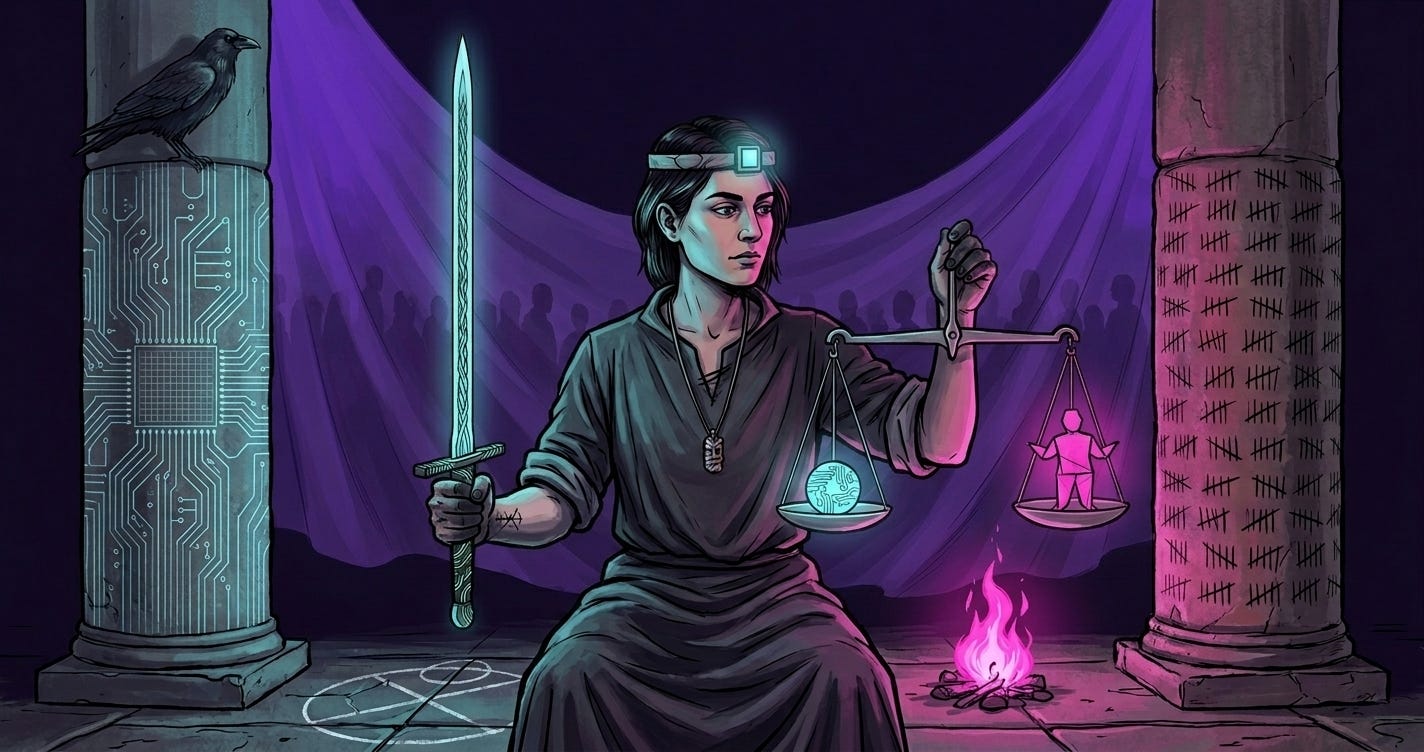
The fire that cooks your food also burns the house down.
That’s not poetry. That’s thermodynamics.
What you do with that information is your own work. Mine is this: refuse to pretend the celebration doesn’t have a cost. Refuse to pretend the cost means I should give back the gift. Refuse to resolve. Hold both.
Stay feral, folks.
i grew up dirt poor. i've always been weirded out by some of the privilege manifested by folks in tech.. like they feel they _deserve_ this because they can write code.
tech has been the only growth industry of my lifetime. it has grown all out of proportion to the rest of the middle class and the economy. i always felt like sooner or later that gravy train would have to come to an end. and now it seems like it probably is.
the answers we need are not the easy ones (teach people to code, preserve our walled garden), but the collective ones (redistribute wealth, govern better, tax the rich, build opportunity for everyone and not just people born near silicon valley and good at math.)
That's a powerful story. I'm very lucky in my industry as a technical writer that my employer recognizes the value of a human behind the words that reach the customers. I'm constantly reading and researching, looking for the missing pieces that will increase my reach and leverage the technology to create the dreams that I see. I haven't got it pulled together yet.
I appreciate your willingness to look at both edges of the blade. It helps to clarify some of the breathless, one-side viewpoints that collapse to complexity down to soundbites.