


Howdy, folks.
A few weeks back I wrote a piece — “If You Like It, Why Do You Care?” — and the comment thread did what comment threads do when a piece has live wires. It pulled in everyone who had something serious to say about the AI question and let them all stand next to each other in the same row. Sarah Smith brought the IP argument from inside that thread. I answered her on Friday. Today’s piece is for Paul Gresty.
Gresty said this:
“AI is not our friend. It is, at its core, a tool intended to make it easier for companies to fire their employees, and reduce labor costs. I say this as somebody watching the AI reaper carve through their particular field of employment. And that applies to artistic fields just as much as it applies to, say, translation, or customer support. Don’t think that the artists who are championing AI now are any safer than those who won’t touch it.”
I want to be honest about what this argument is, because it’s not the snark one and it’s not the bad-faith one. It’s the labor one. And it is different from the art one, which is the whole reason it needs its own piece.
The reaper is real.
Let me start by granting the entire frame.
Generative AI is being deployed right now, in 2026, as a labor-cost reduction vector across multiple white-collar fields. Translation companies have cut staff. Customer support orgs have moved tier-one work to LLMs and let people go. Copywriting departments have been thinned. Voice actors are watching synthesized voice eat into commercial work. Concept artists are watching production pipelines shift to AI-augmented workflows that need fewer humans at the front. Design teams are running prototyping cycles with fewer mid-level designers. The discourse where “AI won’t take jobs, it’ll just augment people” gets repeated at conferences has receded, because the layoffs have made that discourse uncomfortable to recite out loud.
Gresty isn’t watching this from the cheap seats. He’s watching it carve through his field. Neither am I. I’ve been laid off once already with this question in the air. I’m in another room now where the question is alive for a lot of the people I work with. The fear is not abstract for me. Worth flagging for what’s coming: I was on the refusal side at the time. It didn’t save me.
The displacement is real. The acceleration is real. The fact that artists in 2026 cheering AI deployment may themselves be next on the list is real. I am not arguing with any of that.
What I’m arguing with is what comes next.
The Luddites lost. The organizers won.
There is a version of labor history people in tech don’t tell themselves, because the version they do tell themselves is “machines come, workers get displaced, eventually everyone finds new work, line goes up.” That version is wrong in the parts that matter. But it’s also wrong in a way that doesn’t help workers, so let me tell the version that does.
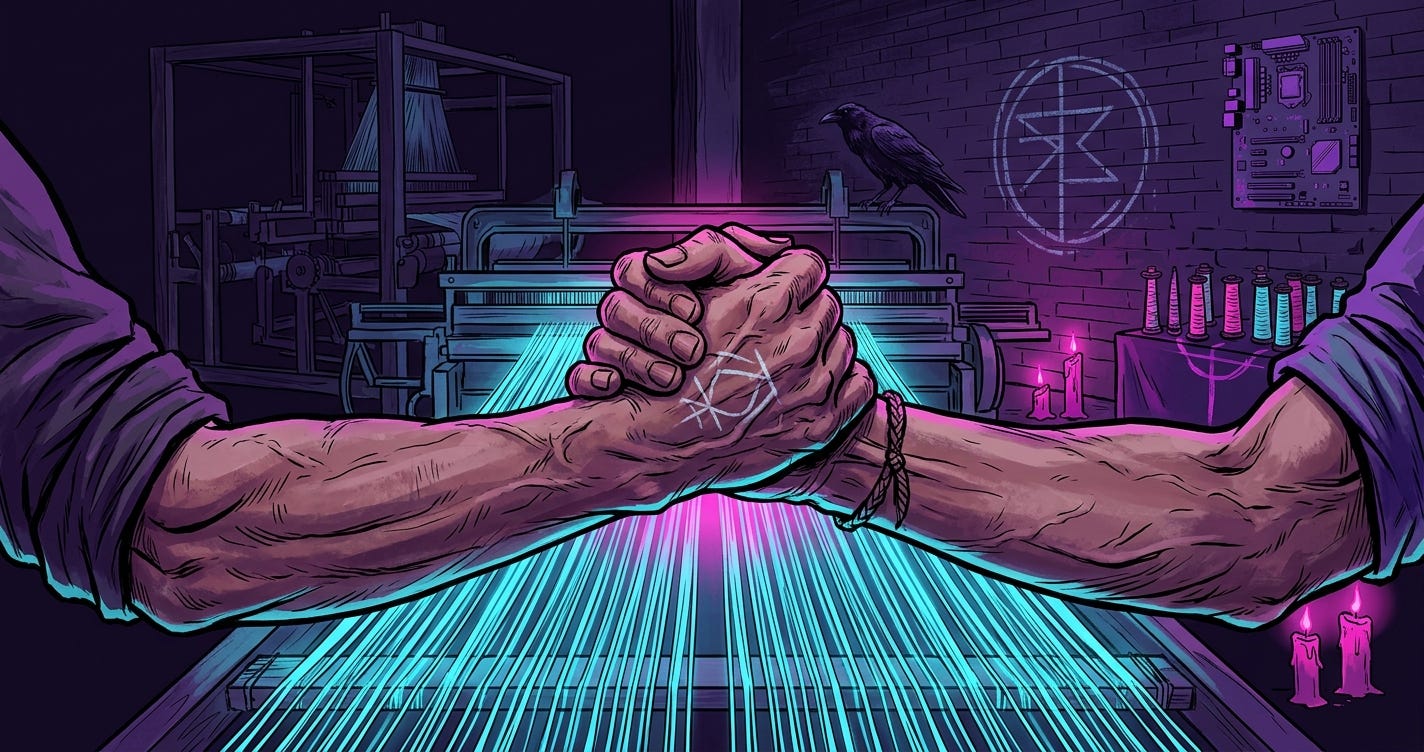
The Luddites smashed the looms. They were not stupid, and — this is the part the cliché flattens — they were not anti-machine. They were skilled textile workers in early-1800s England, organized in their craft, attacking specific manufacturers who were using mechanization in what they called a fraudulent and deceitful manner — meaning capital deploying machines to gut existing labor standards and break the leverage workers had built over generations of practice. They weren’t fighting machines. They were fighting capital using machines as the vector. The looms weren’t the problem. Whose looms, on whose terms, with whose protections — that was the problem.
They lost. Not because their analysis was wrong, but because their tactic — direct attack on the equipment — got crushed by roughly twelve thousand government troops, mass trials, executions, and penal transportation. The British state didn’t refute the Luddites. It killed their movement.
What actually won, over the next century, wasn’t the refusal of machines. It was the slow, often violent organizing of the humans who operated them. The 8-hour day was not won by smashing factories. It was won by workers in factories, working machines, refusing to do it on the boss’s terms anymore. The weekend was not won by refusing to operate equipment. It was won by people who operated the equipment, organized, and shut down production until the terms changed. The minimum wage, OSHA, the right to organize, the abolition of child labor — none of those came from refusing the technology. They came from organizing the people who used it.
This is the part where the contemporary AI conversation goes off the rails. The conversation defaults back to a Luddite frame — the technology is the enemy, refusing the technology is the moral move — and it does this even though the entire history of labor in industrial economies tells us that the refusal frame loses. Every time. The frame that wins is the organizing frame. Whose AI, on whose terms, with what protections, with what share of the surplus, with what right of refusal in the workplace itself.
That is the conversation labor needs to be having in 2026. It is not the conversation it is currently having.
Tool is not deployment.
There’s a category confusion riding underneath the labor frame and it’s worth naming directly, because once you see it you can’t unsee it.
“AI is a tool intended to make it easier for companies to fire their employees.”
That sentence collapses two things into one. The tool is one layer. The deployment is another. A loom is a loom. A loom run by a thirteen-year-old in 1820 for fourteen hours a day is a deployment. The loom didn’t make that deployment necessary. The relationship between mill owner and worker did. The mill owner used the loom because it was the available vector for the deployment they wanted. The loom is not innocent — but it is also not the deployment.
AI is the same. The model is a tool. The decision to fire the customer support team and route inquiries through an LLM at 11pm on a Sunday so the firing happens before anyone can mount a response is a deployment. The model didn’t make that deployment necessary. The relationship between firm and workforce did. The firm used the model because it was the available vector for the cost-reduction it wanted. The model is not innocent — but it is also not the decision to fire the team.
This distinction matters because the moves you make against a tool are different from the moves you make against a deployment. You don’t strike a tool. You strike a deployment. You don’t unionize against a model. You unionize against the firm that’s choosing to use the model to gut your team. You don’t refuse to use a wrench because the boss is using wrenches to break the union. You refuse the boss.
The conflation of tool and deployment is doing real work in the current discourse. It is the same conflation the mill owners actively encouraged in 1820 — the machines are why you’re poor, not us — because the conflation makes the workers fight each other and the equipment instead of fighting the people who own the equipment.
Sovereign and firm are not the same animal.
Quick adjacent point and then I’ll move on.
A sovereign creative using AI to extend their own practice and a Fortune 500 firm firing its content team to replace it with generated output are not the same act, and the language we use about them should not treat them as the same act. Both involve AI. So does the AI assistance helping a single dyslexic kid get through their college essay and the AI assistance helping an insurance company auto-deny claims at scale. The technology is the same. The acts are not.
I bring this up because the labor critique sometimes collapses these together and lands as “any artist using AI is a scab,” which is — and I’m sorry to be direct about this — not how solidarity works. Solidarity has never been refuse the technology. Solidarity has been organize the workers. A sovereign artist using AI to ship work they otherwise couldn’t ship is not the firm. The firm is the firm. Calling the sovereign artist a scab is fighting the wrong target with the right energy, and it is a move capital benefits from every single time.
Who benefits from this framing?
Worth asking, before we leave this. Who is helped by the version of the AI conversation where the working artist using AI is the villain?
It is not the laid-off translator. The laid-off translator is helped by organizing the remaining translators, by bargaining collectively over deployment terms, by fighting for retraining funds and severance and the right of refusal in the workplace, and by building solidarity coalitions across the fields getting hit by the same deployment pattern. The laid-off translator is not helped by spending the limited political energy of the moment on a Twitter argument about whether a Substack writer using AI to draft prose is a class traitor. Not even a little. That argument doesn’t get a single laid-off translator their job back, or their severance up, or their next contract signed.
You know who is helped by that argument? The firms doing the firing. Because while the working artists are mad at each other about whether you can use a tool, the firms are doing the actual deployment, on their terms, with no organized labor in the room to negotiate the terms with them. The fragmentation of the working-creative coalition is doing capital’s work. Every hour spent fighting other working artists about AI usage is an hour not spent organizing against the firms whose deployment decisions are eating the field.
This is not new. It is the oldest move in the playbook. Convince the workers that other workers are the threat. Always works. Cheap. Effective. Beloved of management.
What the actual ask is.
I’m not asking you to be happy about the layoffs. I’m not asking you to find a silver lining for the translator watching their field get gutted. I’m not asking you to pretend the deployment isn’t happening or to soft-pedal what it costs.
I’m asking you to fight the deployment, not the tool. To put the political energy on the relationship between firm and worker, not on the moral character of the artist using the model. To organize against the deployment patterns — the no-notice firings, the post-layoff use of departed workers’ output as training material without consent or compensation, the contracts that strip the right of refusal, the displacement without retraining funds, the AI-generated content flooding markets that used to support working writers — and to do that organizing with the working artists who are using AI, not against them.
The 8-hour day was not won by refusing the loom. It was won by the people running the looms, organized, refusing to run them on the boss’s terms.
That same move is available now. It is the only move that has ever worked.
Stay feral, folks.
Here's something that is missing in this whole debate over AI. Even before this new AI boom, most things were automated. Computers have been coding through prompts for 2 decades maybe more. Customer service went automated 35 years ago, the Arts have seen computers creating art, music, even text for 35-40 years now. Data inputting has been automated for decades, data analysis has been computer generated now for 30 years.
The only thing that has really changed with this new boom of AI is, how readily available it is for the common Joe. That is the threat, competition is the threat not the use of it, not how it's being organized. Example the music industry is 3/4 of what it was in the 80s, displaced by computer programs.
But Label companies are in a panic with AI, why? Because Joe Blow in a basement can now become a recording studio without hundreds of thousands of dollars worth of equipment. Some artist are freaking out because now Joe blow with a idea can produce a song, a image, without having to go through the gutters and spend thousands on equipment and training.
Fact is anyone alive today has lived with some form of AI most of their lives from robocalls to video creation(think Avatar)