


Howdy, folks.
I didn’t go looking for this one. That matters, so I’m going to say it first.
Wednesday morning, I’m scrolling a Substack thread under a Charity Majors note — Charity being one of the sharpest engineers writing about how software actually fails, as opposed to how the slide decks say it fails. And underneath her post, a reader named Jim Grey leaves a comment that stops me cold. He says, roughly: it’s remarkable how you, Kent Beck, and Gergely Orosz all published the same basic theme today.
Three of the most credible voices in software engineering. Same day. Same idea. And the idea was this: AI doesn’t supply discipline. It amplifies whatever discipline — or dysfunction — you already had.
I sat there for a second with the specific feeling you get when something in the room rearranges itself without moving. Because I’d published that exact thesis two days earlier. From the completely opposite side of the building. Mine led with Plato and landed on Jung; theirs led with test suites and landed on tech debt. Same claim. Different church.
I was one of the five. I just didn’t know it until Wednesday.
The thing everyone said
Let me name them, because this is a celebration, not a takedown, and credit is the whole point.
Kent Beck — the man who gave us extreme programming and test-driven development, so not exactly a tourist — published a piece called Trust Factory. His line: “we’re accumulating code faster than we are accumulating trust.” The XP practices, he argues — testing, pairing, continuous integration — were always machines for manufacturing trust. AI generates code at a rate that burns that trust down faster than you can build it. The discipline has to come first, or the speed eats you.
Gergely Orosz, who writes The Pragmatic Engineer and is read by approximately every working developer on Earth, published slow down to speed up when working with AI agents. Same beat: devs are now generating twice as much code — or more — as they were six months ago, and that compounds every quality and reliability problem you already had unless you deliberately, consciously, slow the hell down.
Charity Majors — AI enthusiasts are in a race against time, AI skeptics are in a race against entropy. Her framing is the most elegant of the three. AI accelerates whichever direction you’re already pointed. Point it at a disciplined system and it compounds your strength. Point it at a mess and it compounds the mess, faster, until entropy wins. Discipline is the deciding variable, not the technology.
Lauren Ciccomascolo built a twenty-four-agent system to hold a multipassionate life and wrote it up — and her version of the same thesis is that the system works precisely because it protects her existing discipline and voice instead of replacing them.
And me. Technology Is Light That Reveals What Was Already There. AI doesn’t create the rupture; it removes the cover that let you ignore the rupture. It reveals — and amplifies — what was already in the maker.
Five people. Five doors. One room.
Here’s where the engineer reaches for the back button
Stay with me ninety seconds, because I know exactly what you’re thinking, and you’re not wrong to think it.
You’re thinking: call it confirmation bias. A guy who already believes in synchronicity goes looking for a pattern and — shock — finds one. You’re thinking: slow news week, the idea was just in the water, five people drinking from the same trough isn’t a miracle, it’s a Tuesday. You’re thinking the most damning thing of all, which is: and now he’s going to bring up astrology.
Yeah. I am. But I’m going to do it in a way you can check, because I think the rigor is the interesting part, and because a claim you can’t falsify isn’t worth making.
So first, let me concede the whole rational case, because it’s mostly true. This was not five bolts from a clear sky. The “AI amplifies what’s already there” idea had been building for months — JetBrains wrote a version of it back in December, the DORA research has been measuring it for over a year, and the cleanest statement of the entire thesis came from Birgitta Böckeler at Thoughtworks back in April, when she wrote that a coding agent “has no intuition that we don’t do it that way here.” The idea was a wave. It had been gathering for a long time.
But a wave still has a crest. And the crest is where this gets strange.
The crest
The thing Jim Grey noticed wasn’t that the idea exists. It’s that the standalone-essay form of it peaked — four writers, independently, hitting publish — inside a twenty-eight-hour window. June 1st and 2nd. The wave had been building for half a year and it broke, hard, in a day and change.
So I did the thing I built a tool to do. I pulled the exact publication timestamp of each piece — not the date, the minute, straight from each publication’s RSS feed, which records the moment the thing went live. And I cast the sky for each one.
A quick word on why this is checkable and not vibes. Planetary positions are geocentric and global — at any given instant, the Sun is at the same degree of the zodiac whether you’re in San Francisco or Memphis or Reykjavík. Where you stand only changes the horizon, not the planets. So I can line up five publication moments and compare the sky over all of them honestly, no thumb on the scale.
Here’s what I was looking for. In the old symbolic language, the Sun is the thing made public — the statement, the idea stepping into the light. Saturn is discipline. Structure. Rigor. The rules, the long patient work, the part that isn’t fun. And a sextile — a sixty-degree angle between two planets — is the symbol of an opening: a supportive, available connection that asks a little effort to use. Sun sextile Saturn is, almost too neatly, the idea meeting its discipline. The fire being handed a structure that serves it instead of smothering it.
That aspect was forming across the whole window. Watch the orb — the distance from exact — at each writer’s publication moment, in the order they published:
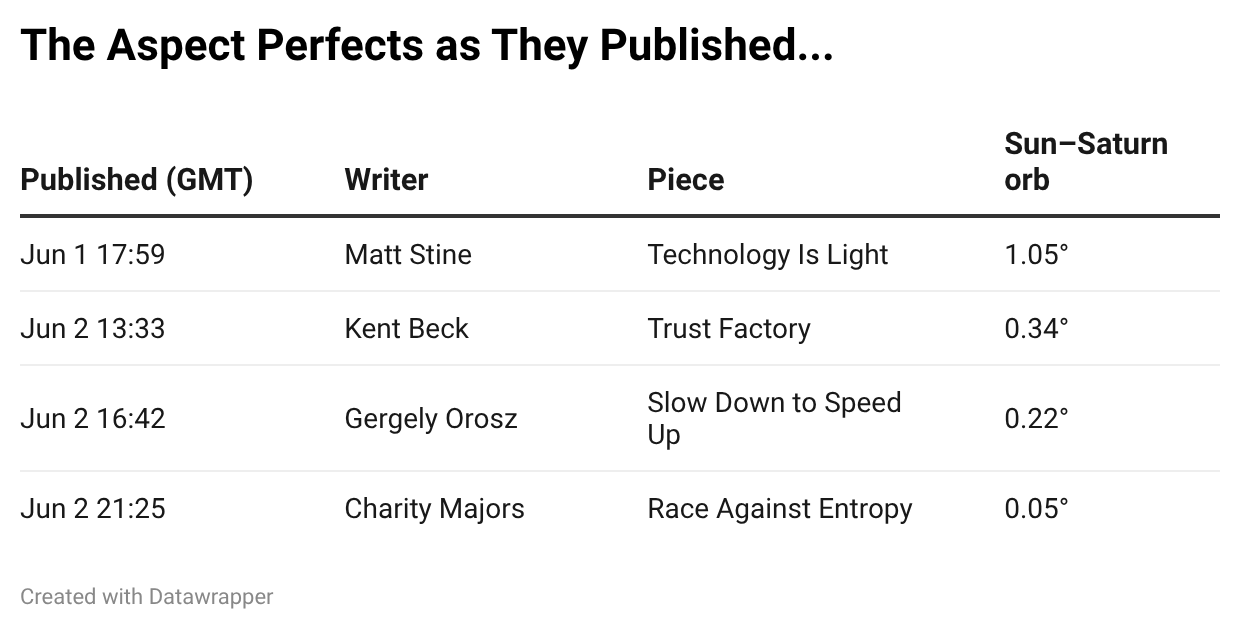
Read it twice.
It tightens. Monotonically, in the exact order we hit publish. From a full degree out, down to five one-hundredths of a degree — functionally exact — at Charity’s piece, the last one out the door. The sky spent twenty-eight hours closing “the idea meets its discipline” toward perfection, and four people who have never coordinated anything in their lives published the standalone-essay version of the idea meets its discipline as it closed, with the last one landing it dead on the number.
The thesis they converged on was the aspect perfecting over their heads.
I’m not going to oversell that sentence. I’m going to let it sit there and be exactly as weird as it is.
The part that made me put the coffee down
It gets better, and this is the detail that moved it, for me, from neat to pay attention.
The Moon moves about thirteen degrees a day, so it’s the one fast hand on the clock — it changes signs every couple of days, and the sign it’s in colors the mood of a moment. On the morning of June 1st, when I published my piece, the Moon was in the last degrees of Sagittarius — the sign of philosophy, big-picture meaning, the cosmic frame, the long view. Of course it was. Mine was the Hermetic one. The one with Plato in it.
Sometime that night, the Moon crossed into Capricorn — Saturn’s own sign, the sign of discipline, structure, the serious unglamorous work. And every one of the three engineers published the next day, June 2nd, under that Capricorn Moon.
The philosophy piece went out under the philosophy Moon. The discipline pieces went out under the discipline Moon. The mood-sign of each publication matched the room it was written from. I did not arrange that. Nobody did.
The control case, because you deserve one
Here’s the move that separates this from seeing the Virgin Mary in a grilled cheese.
There was a fifth piece — Lauren’s twenty-four-agent essay — and it’s the same thesis, but it published nine days earlier, on May 24th. If I were cherry-picking, I’d quietly fold it into the cluster and not mention the date. I’m doing the opposite, because her chart is the proof.
On May 24th, the Sun–Saturn sextile did not exist yet. The Sun was still eight degrees away from forming it — out of range, no aspect, nothing. Lauren’s chart instead carries Sun sextile Neptune and Sun conjunct Uranus: the signatures of vision and radical invention, which is exactly what a twenty-four-agent system is. Her sky is different because her piece came before the crest.
So two completely independent methods — the boring one, RSS timestamps; and the disreputable one, a chart — draw the same line in the same place. June 1st and 2nd are the tight cluster. May 24th is the precursor. The timestamps say so and the sky says so, and they agree without consulting each other. That’s not what apophenia looks like. Apophenia doesn’t survive a control case.
And it isn’t even just software
One more, because the moment I started looking I couldn’t stop. That same week — May 27th — a writer named Patrick Dempsey published AI Completed the System We Built. Identical structural thesis to mine: technology reveals and completes what was already there. Same week. Different field entirely — he’s writing about education, not code.
So this wasn’t an engineering-blog quirk. The pattern jumped domains inside the same window. Which is, if you’ll forgive me, the entire thesis eating its own tail: technology reveals what was already there was itself a thing that was already there, surfacing across unrelated rooms at once, made suddenly visible. The idea is light. And the week it crested, the idea revealed itself.
What I’m actually claiming
Let me be careful here, because the careless version of this is genuinely stupid and I don’t want to be holding it.
I am not saying the planets made anyone write anything. Kent Beck wrote Trust Factory because Kent Beck created Extreme Programming and Test-Driven Development back in the nineteen-nineties and has been thinking about trust in software ever since, full stop. The causal story is complete without me. I’m not adding a cause.
What I’m saying is quieter and, I think, stranger. There are two ways to read this week. One is a clock — calendar dates, RSS timestamps, the sequence of human decisions. The other is a sky — the same twenty-eight hours described in the language of angle and degree. And the two descriptions rhyme. The clock says “the discipline thesis crested.” The sky says “the idea-meets-discipline aspect perfected.” Same event, two languages, and the translation is uncannily clean.
I don’t think the sky is pulling the strings. I think the sky and the discourse are the same pattern, read in two different alphabets — and that the symbolic alphabet, the one we were all told to put away because it isn’t real, turns out to be a perfectly serviceable instrument for reading a moment you’d otherwise experience as random noise. That’s all the Seer ever was. Not a fortune-teller. A second set of eyes for patterns the first set filters out.
And the only reason I caught any of it is that I wasn’t looking. I stumbled into a comment thread, and the chart was already drawn. The sky drew the room before any of us walked into it. That’s the kind of synchronicity I’ve learned to trust — not the ones I go hunting for and conveniently find, but the ones I trip over with my hands full, that turn out on inspection to hold to five hundredths of a degree.
Go check the timestamps. Go cast the charts. I’ll wait. That’s the whole point of saying it out loud instead of keeping it in a journal: it’s falsifiable, and it didn’t falsify.
Stay feral, folks.
I’ve been getting an immense amount of value out of my chart via Claude, so reading this tech intersecting with astrology was a delight.
Also, your point about tech accelerating what’s already there is a good heuristic. Nuclear energy can be the most efficient source of electricity or it can disappear an entire city. Technology itself is neutral, it just amplifies what’s already there.