


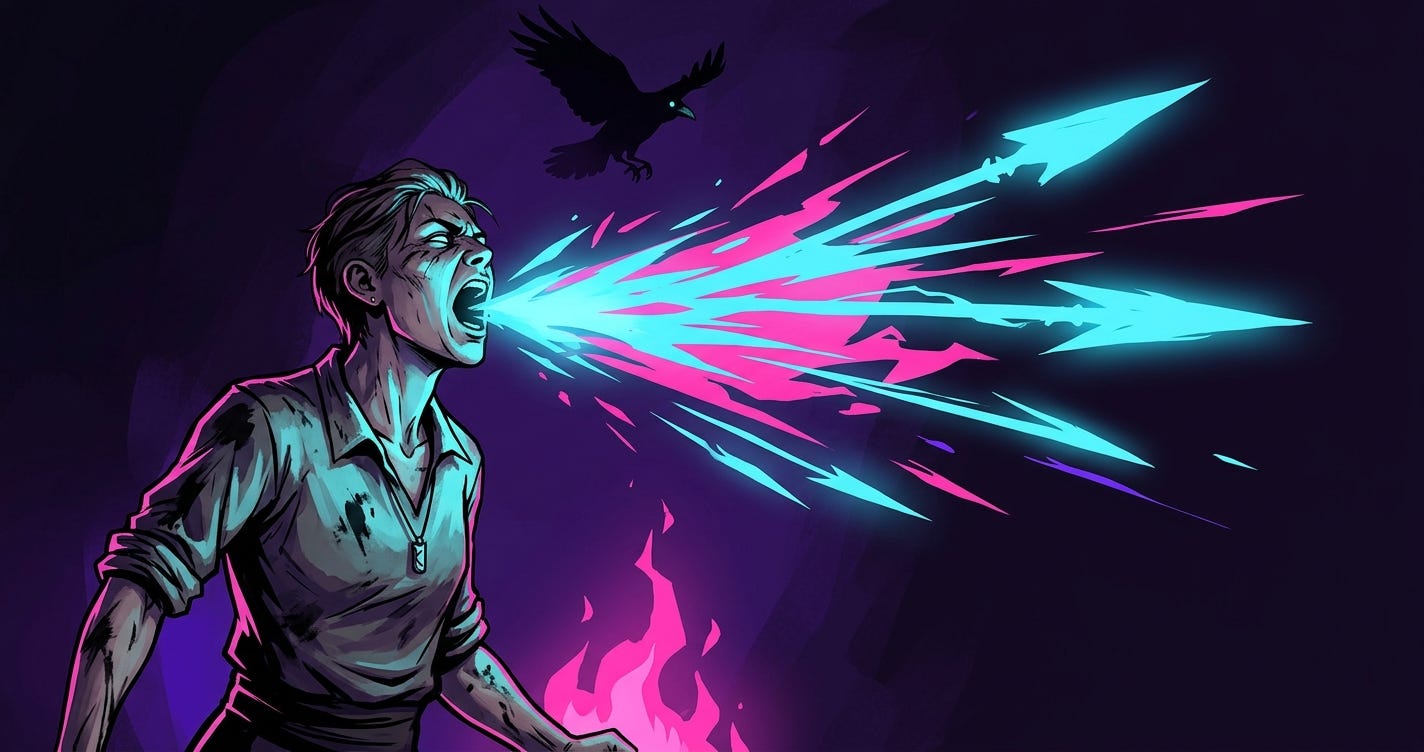
I’ve been studying the Mórrígan for over two years, and somewhere in that work I learned to write rosc — Old Irish incantatory battle-verse, the prophetic form She speaks Her war-poetry in. Last autumn I composed one and delivered it on video to a roomful of people who do this work: a chain-link chant against the lies of empire, each line biting the tail of the one before it — fullness of lies, lies about history, history of colonies, colonies of whiteness… I’ll give you the whole thing before we’re done.
So I’m not going to stand here and tell you I discovered battle-poetry. I already had the weapon in my hands. What an intensive on the Mórrígan handed me this spring, in week five, was a mirror — and what I saw in it stopped me cold: some of what I write here, for you, every single week, is also rosc. I’d been composing it as devotion in one room and swinging it in this one without ever once calling it by its name.
Not battle-poetry as a vibe. Not the rhetorical equivalent of a guitar solo. Battle-poetry as a form — a real one, with rules, with a job to do in the body of whoever reads it, and a lineage far older than the manuscripts that happen to preserve it. The texts we can hold are a thousand years old. The roscada — the rhythmic, riddling, deliberately archaic incantation-verse the Mórrígan chants in — are older than the prose they sit inside, older than the page itself: a form the poets were already carrying long before anyone thought to write it down.
The Irish gave it three names — I didn’t coin them and the philology isn’t mine, but I’ve been sitting with them since last year’s work and went back down into them again this spring. Laíded: incitement by inspiration, the chant that lights up your own side. Gressacht: incitement by insult, the speech that hollows out the enemy’s nerve. And rosc catha: the magical battle-chant, which in the old stories is often word-for-word identical to the laíded — one utterance working on morale and nerve at once, on both sides of the line in the same breath.
And that was the mirror. Because I’ve been doing all three — here, in FA. Not in the devotional room, where I knew exactly what I was doing and why. Here, in the supposedly secular one, with no idea I was doing the same thing with the same hands. The whole Feral Architecture move where I name the dominant play out loud — say the quiet part at full volume until the calcified position can’t keep its composure — that’s gressacht. Demoralizing a bad consensus by refusing to whisper. And the profanity-as-texture, the stay feral benediction, the part that makes some of you sit up because someone finally said the thing you already felt in your chest — that’s laíded. Lighting up the ones who were always going to be on this side of the line.
Same chant. Both effects. One breath.
So the move isn’t “start writing battle-chants.” I’ve been writing them for months. The move is to stop doing it by accident.
The grammar that denies you the exhale
Read the Mórrígan’s incitement at Cath Maige Tuired out loud — I’m quoting Morgan Daimler’s translation, the one that carries her war-chant in full where older editions leave it gapped or quietly drop it. Actually out loud — it doesn’t land on the page the way it lands in the throat:
Arise, kings to battle here! Seizing honor, speaking battle-spells, destroying flesh, flaying, snaring, seeking out forts, giving out a death-feast, fighting battles... bodies wounded in a rushing assault, pursuing, exhausting, breaking, prisoners taken, destruction blooms, hearing screams... I see the birth of every bloody battle, red-wombed, fierce, enraged.
I read it and I’m out of breath. You can feel the energy of battle coming off it. And the reason isn’t the imagery — gore doesn’t wind you. The syntax does.
One hard imperative to ignite it — Arise, kings to battle here! — and then the avalanche. Relentless present participles with no main verb behind them. Seizing, speaking, destroying, flaying. The grammar refuses to complete. There is no sentence-stop where you’d take a breath, so the action never resolves and neither do you. The form itself denies you the exhale. That’s the somatic effect — not what the words describe, but what the structure does to your nervous system while your eyes move down the line.
And then, mid-storm, the Seer erupts: I see the birth of every bloody battle. First person breaks through the verbless weather. The prophet interrupts the soldier. The one who witnesses cuts across the ones who fight.
That’s not decoration. That’s an engine. Accumulation as pressure instead of argument; a list that builds instead of explains. My own rosc runs on a different mechanism — the chain-link, each line’s last word igniting the next: lies, history, colonies, whiteness. This one runs on the verbless avalanche. Two engines, one job. Week five didn’t teach me the weapon — I’d been swinging it for a year. It handed me a second one, and showed me I’d been firing the first in here the whole time.
But a war-chant from where?
Here’s the part I have to be honest about, because it’s the part that keeps the whole thing from being cosplay.
You don’t write a war-chant because war is aesthetic. You write one because of where you’re standing.
The Mórrígan closes that same battle with two prophecies, back to back, in the same breathless cadence — this time in Elizabeth Gray’s translation, the one most of us first meet Her prophecy in. First the peace: peace up to heaven, heaven down to earth — forts fiercely strong, summer’s milk, a son under his father’s patronage. Then its exact line-for-line inverse, the doom: forts barren and hollow, summer stripped of its flowers, a son betraying his father, an excess of lords sitting atop a multitude with nowhere to live.
Strip the ninth-century specifics off that doom and it names one thing with terrible precision: the dissolution of every bond into extraction. Every relationship reduced to taking. Concentrated power perched on mass dispossession. Courts hollowed out and turned into weapons. Strongholds that photograph like power and ring empty when you knock. A long, enduring, evil span of time — darkness that means to persist rather than pass.
My god if that doesn’t feel like the exact weather outside the window right now.
(One honest divergence, because I won’t launder a thing to make it land harder: a couple of those doom-verses — women deprived of modesty, men deprived of valor — are ninth-century moral panic, not 2026 diagnosis, and I’m leaving them on the cutting-room floor where they belong. The resonance that actually crosses the centuries is the inversion of every bond into extraction. Not the gender anxiety.)
So here is the frame, and it’s the whole reason the chant is permitted. The peace prophecy is spoken by a war-goddess in the instant after she has chanted slaughter. It is not the peace of the spear being absent. It is peace held up by readiness — a fortified peace. We are safe, and we are safe precisely because we are prepared to fight for the pocket of ground we’re standing on.
That’s the only honest peace a place like this can offer. You don’t get to keep the orchard by pretending the doom isn’t running loose outside the walls. You keep one pocket of the peace prophecy lit, on purpose, while the rest of the field goes dark — and you keep it lit by being willing to defend it.
So — here it is, made and meant
I could end here: name the form, promise the next piece will steal the verbless engine properly, and ride off on a tidy little manifesto.
But a piece called The Chant Was Never a Metaphor that won’t actually chant is just one more person describing a fire instead of lighting one. And I don’t need to promise you a future chant — I already made one. A year ago, before I had the doom prophecy to hang it on, before I could have told you what engine it ran. Here it is, whole, the chain-link biting its own tail all the way down:
Fullness of lies
lies about history
history of colonies
colonies of whiteness
whiteness fabricated
fabricated to exploit
exploited to consume
consumed to discard
lies about land
lies about blood
lies about sovereignty
lies about “God.”
Read it back against the doom She chants at the close of the battle — the dissolution of every bond into extraction — and it is the same weather. Exploited to consume, consumed to discard. I was chanting against that doom a full year before I learned the Mórrígan had chanted it first. The terrain was always the same terrain.
That’s gressacht and laíded in a single breath: it hollows the lie it names, and it lights up everyone who has ever felt that lie in their teeth. It isn’t the verbless avalanche — that engine I’m still bringing in, and you’ll feel it land in a piece soon enough. It’s my own chain-link, the one that’s natively mine. The point was never which mechanism. The point is the chant was never a metaphor. I made one. I meant it. And I’ll make the next one on purpose.
The war-goddess speaks peace last. But she earns it by chanting the battle first.
Stay feral, folks.
Different cultures have practiced a large variety of similar vocal attacks. Battlecries are well known. There is the “Rebel Yell.” Viking Berserkers were said to shout a call to Thor. The traditions you’re dealing with in this piece are an example of a society that would’ve used War/Blood/Hate poetry. I know many cultures had battle prayers and war shouts. War songs moved into a purely instrumental thing in battles like those of the 1700-1800s.
The main character in a nearly finished novel of mine sings in every battle scene. He’s one of the leaders, and several jog the newer recruits pick up the practice.
Nice article. Never heard of it before or at least not a name for it.