


Let me make the confession, and then immediately correct it, because the dramatic version is wrong.
The dramatic version goes: I descend from five centuries of clergy, an unbroken line of ministers handing the faith down, and I’m the one who finally broke it. It’s a great cold open. It also isn’t true to the family I grew up in.
The family I knew weren’t clergy. Devout, a lot of them — quietly, undramatically devout — but nobody stood in a pulpit, and nobody expected me to. In my family the faith didn’t come down from an altar; it came down from a folding chair in a fluorescent-lit classroom. My parents taught children’s Sunday school for years. I’m fairly sure my dad’s father taught the adults. Lay people, teaching. Nobody was called to anything in the capital-C sense. You showed up on Sunday and you passed it on.
So when I took the whole inheritance down to the studs and kept going — out past the property line entirely, into Hermeticism and Jungian depth work and the service of An Mórrígan, an Irish goddess of war, sovereignty, and death (Irish — not the smeared pan-”Celtic” thing the marketplace sells by the candle; specific, and hers) — I wasn’t betraying a dynasty of priests. There was no dynasty to betray, not in living memory. I left the faith I was raised in, the way a lot of people leave it, and I genuinely didn’t think about lineage at all.
Then, recently — and I mean recently, mostly in the digging that turned into these last few essays — I went looking into the deep end of the family. And the story rearranged itself.
The four who were called
Go back far enough — past the folding chairs, past anyone I ever met — and the office is wearing formal clothes.
Start in Edinburgh, around 1580, with Reverend Daniel Wilkie — on my mother’s side, a maltman’s son and the first of his people to leave the craftsman’s bench for the pulpit. He took his Master’s at St Andrews, was ordained in 1605, and the next year was presented to his parish by King James the Sixth himself — the tradesman’s boy handed a pulpit by the King of Scots. A Reformed minister, and his entire vocation was to stand up in front of a gathered room and transmit, out loud and in words, a spiritual practice. That was the job. Gather them, hold the room, hand it down.
Then Lieutenant William Wilkie, 1734 — a Methodist clergyman in the colonial Carolinas. New continent, new denomination, identical act. Gather the people, hold the room, pass the practice forward.
Then Robert McCall, 1752 — the weaver I told you about on Monday, the one who escaped Ireland disguised as a sack of potatoes. Before that escape and long after it, he was a Methodist class leader on both sides of the ocean, a man some of the family insist was converted by John Wesley himself. The class meeting was his liturgy: a small room, a handful of souls, the practice moving mouth to ear on a rhythm.
And then me. 2026. Hermetic, Jungian, sworn to An Mórrígan, with a newsletter where a pulpit used to be.
Four men. Two of my parental lines. Four hundred and forty-four years from Daniel’s pulpit to my altar. I’ll be straight about the wiring: the genealogical tissue between a 1580 Edinburgh minister and a Carolina pew has the gaps any family tree this old drags behind it, and I won’t pretend the links are cleaner than they are. But the four vocations are documented and solid — four people in my blood called to the same strange work.
And it didn’t even travel down a single wire. Daniel and William are my mother’s people; Robert is my father’s mother’s — two separate branches that never met, each producing the same vocation independently, until both currents pooled, centuries later, in one person. A calling that shows up once is a job. A calling that shows up on both sides of a family that never met is closer to a structural fact about what that family is for. I’m not the exception to my lineage. I’m where two of its currents finally pooled.
I didn’t break the chain. I’m the fourth link.
Here’s what I missed when I first laid the four of them out and assumed I was the end of the line.
They believed they were transmitting doctrine — Calvin’s God, Wesley’s grace, the specific theology of the specific church. And by their lights they were; that’s what they’d have told you the job was. But that is not what actually came down the line to me, because I did not get the doctrine. I threw the doctrine out with both hands. What I got — the thing that survived five centuries and four denominations and my own scorched-earth deconstruction — was the vocation underneath it. The thing the doctrine was only ever riding on top of. The call to stand at the threshold between the seen and the unseen, get literate in it, and walk other people across.
That is the inheritance. Not the faith — the office. Daniel didn’t hand me Reformed theology; it died in transit. He handed me the shape of a life spent transmitting spiritual practice in words. So did William. So did Robert. Strip the denominations off all four of us and we are unmistakably the same animal: the one in the family who gets pulled to the threshold and cannot keep his mouth shut about what he sees there.
So here is the cut, and it reorganized how I understand my own life: I didn’t break the chain. I’m the fourth link in it. I did the single most ancestral thing a person from my family could do — I answered the call. I just answered it in the only language I had left after the church lost me, which happened not to be a Christian one. The apostate is the heir. Leaving the faith was keeping the faith — if the faith was never really the doctrine in the first place.
It’s worth naming what survives and what doesn’t, because the line between them is the whole inheritance. Doctrine is brittle — it’s content, and content dates, cracks, gets outgrown and left at the roadside. What doesn’t date is the posture: taking the unseen seriously, walking to the edge of the explainable and coming back with something for the people who couldn’t make the trip. That isn’t Protestant. It isn’t even Christian. The container keeps changing — Reformed, Methodist, Hermetic, whatever my grandchildren reach for. What it carries from hand to hand is the part that was ever actually mine to pass on.
I said yes once already
Here’s the part I left out of my own confession, because I’d half-forgotten it was the same thing.
Around 2005, deep in the Southern Baptist church and before I’d deconstructed a single brick of it, I felt called to preach — strongly enough that I said it on a prayer card dropped in the congregation’s request box, and named it to the people closest to me. And then nothing. It didn’t go anywhere. I filed it for twenty years under a thing I briefly believed in my twenties.
It wasn’t a thing I briefly believed. It was the call, arriving exactly on schedule, and I named it with the only word the room had handed me. “Called to preach” is what called to stand at the threshold and transmit spiritual practice sounds like when the one sanctioned container in earshot is a Baptist pulpit. The summons was accurate. The address was wrong. It stalled not because it was false but because I’d aimed a 444-year-old vocation at a door that could never hold the person I was going to become — the doctrine would have had to crack first, and it wasn’t time yet. So the call did what calls do. It waited. It needed me to leave before it could land.
And here’s the part that turns the screw: I didn’t only feel the call. For a few months in that same stretch, I taught a Sunday school class. A Southern Baptist Sunday school teacher is the Baptist cousin of Robert’s Methodist class leader — not identical, but the same lay seat: the unordained one who gathers the small room and hands the practice down. So I didn’t merely hear the office knock. I sat in the chair — briefly, with no idea it was the family trade — and then it lapsed in a few months, the way the prayer request lapsed. Even that rhymed: the office lit up in me, I did the work, and it didn’t hold, because the container was never going to be mine.
So when I tell you I’m the fourth bookend, understand I’m not taking it from the genealogy alone. I felt it myself, by name, twenty years ago, and said yes in a language that turned me away. I’ve been answering this call most of my adult life. I’m only now answering it in my own tongue.
The fourth liturgy
Every one of them had a liturgy: a recurring, scheduled, communal act where the transmission actually happened. Daniel had the Reformed Sunday service. William and Robert had the Methodist class meeting — the small repeating gathering where a leader holds the room and the practice gets passed, person to person, on a rhythm you could set a calendar by.
So here’s the spoiler, since we’re being honest about inheritance tonight: I’m building one too.
I won’t call it a church. It has a Substack and a price tag and the whole modern apparatus, and its name is The Hermetic. But take the clothes off it and it is precisely the thing Daniel built, and William, and Robert. Starting on the new moon of August 13th, once every lunar cycle, I’m going to sit down in front of a room of people who came looking for exactly this and read the sky and the cards out loud — a New Moon Reading, on a rhythm, every month. It’s the class meeting, four and a half centuries on, with the moon’s phase where the cross used to hang.
And this — what you’re reading right now — is the other half of the office, the literate half. Literate transmission of spiritual practice is the family trade, the way other families do carpentry or law, and Feral Architecture is that trade in its current clothes. You didn’t stumble onto a newsletter. You walked into the fourth generation of a 444-year-old transmission — me in a pulpit my however-many-times-great-grandfather built, preaching a heresy he’d have despised, in the exact posture he taught the family to hold.
What the chain was carrying
There’s a question that’s shadowed every inch of this work, and if you do anything like what I do you know it by heart: who said I get to? What ordination, what authority lets me stand up and transmit anything to anyone? The investigator in me has asked it ten thousand times, at 3 a.m., in the voice that’s sure I’m a fraud.
The four dead men are the answer. I was licensed four centuries before I was born — not by a seminary but by a line that has produced this exact vocation, over and over, in whatever denomination was standing, since before there was a country to escape to. I’m not a departure from my people. I’m what my people keep making. The dead handed me that the moment I went looking, and it’s done more for the 3 a.m. voice than a decade of arguing ever did.
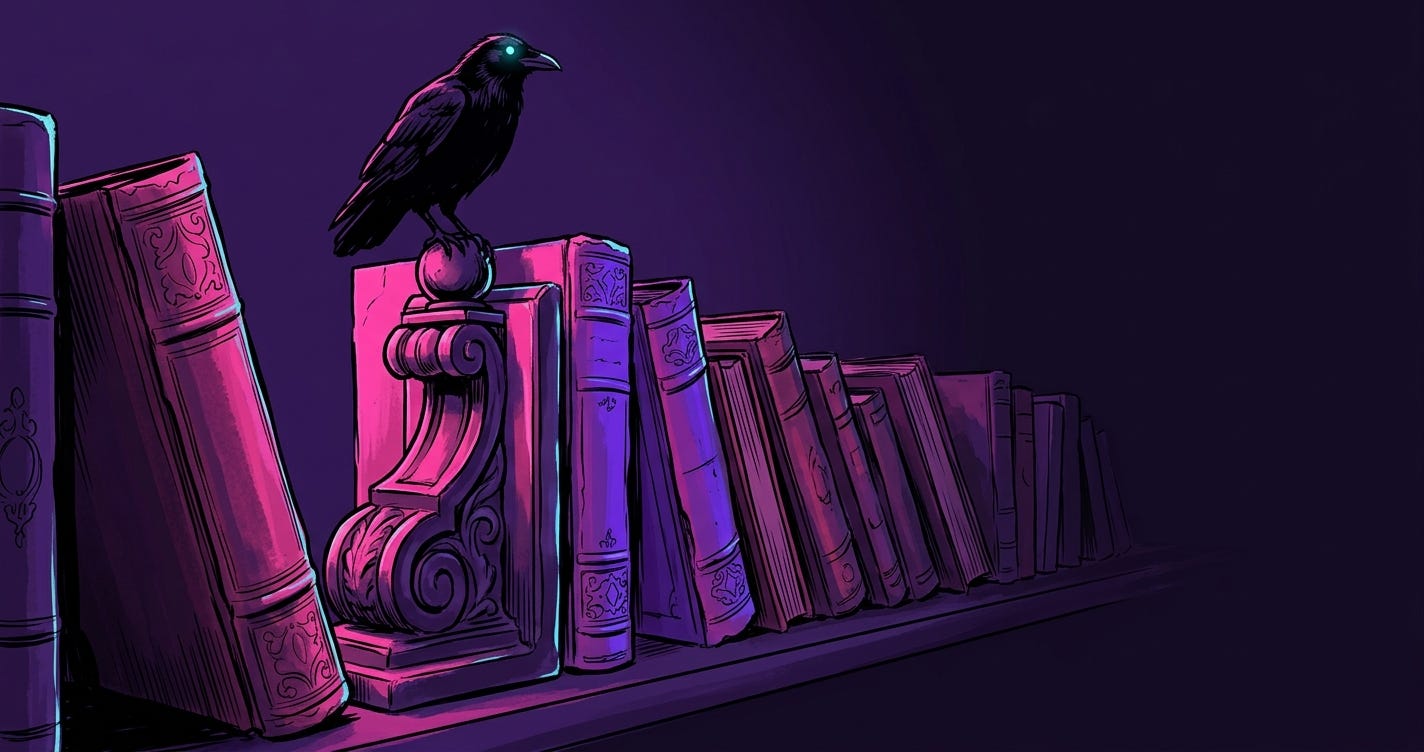
And the one who walked me back to them is An Mórrígan — the suppressed thing in the line finally surfacing through the descendant who came available to carry it. A battlefield goddess; over every field her people knew her as the Badb, the crow who attends the dying and does not flinch. There’s a crow on my shelf now. She’s been there, I suspect, the whole four hundred years — watching the flame get carried hand to hand, waiting to see who could finally name what it was.
The bookend
A bookend is not the end of the shelf. It’s the thing that holds the shelf up.
That’s the part I had backwards. For the little while I’d thought about it at all, I assumed I was the last item on the line, the place it finally fell off the edge. I’m not. I’m one of four uprights across four and a half centuries, each bracing the same calling against the weight of his era — Daniel against the Reformation, William and Robert against a wilderness, me against a culture that’s decided the threshold isn’t real. I’m the fourth, holding this end now, keeping four hundred years of it from sliding to the floor.
The crow’s still watching. She wants to know whether I’ll actually stand up on the new moon and do the thing the family has always done.
I’m going to stand up. Heresy and all. It’s the most ancestral thing I know how to do.
Stay feral, folks.