


The page comes in at an hour that doesn’t deserve a name.
Some control-plane component has decided, again, that consensus is optional. etcd is sulking. A scheduler that was sold to me as the thing that would make my life boring has instead made it interesting, and “interesting” at 2 a.m. is the most expensive word in my profession. I stand in the kitchen in my socks, laptop balanced on the counter, staring at a dashboard the color of a bruise, and I do the thing I have done a thousand times: I coax a system that promised me control back into the appearance of it.
Let me be honest about something before I go any further. We chose this.
Not me, exactly — but the industry I’ve given twenty years to. A decade ago we stood in front of a tool called Cloud Foundry that was about as sexy as a beige sedan and roughly twice as reliable. It just fucking worked. You pushed your code, it ran, and nobody got paged at 2 a.m. because nothing interesting ever happened. Then we looked at that boring, faithful machine, and we looked at the new thing — the one with the cooler logo and the conference track and the intoxicating promise of control — and we anointed the new thing. We have been paying interest on that decision ever since. I pay a little of it tonight, in the dark, in my socks.
I used to think this was a story about technology. It isn’t. It’s a story about what we reach for when we’re afraid, and what it costs us to reach for the wrong thing while calling it wisdom.
Because here’s what the postmortem won’t capture: the thing rattling in my dashboard is a cage. We built it because the power underneath frightened us, and we wanted to dominate that power rather than learn to live with it. And a cage doesn’t tame anything. It just gives the lion bars to snarl through.
I’ve been thinking about lions a lot lately.
Thecla in the arena
There’s an apocryphal 2nd-century text called the Acts of Paul and Thecla. Thecla is a young noblewoman who hears an apostle preaching outside her window, walks out of her own wedding and her own family to follow him, and gets sentenced to die in the arena for her trouble. They bind her to a ferocious lioness in front of a bloodthirsty crowd. And the lioness — instead of tearing her apart — lies down, licks her feet, and lets Thecla rest against her flank. When the male lions come, the lioness fights them off and dies protecting her. The women of the city throw fragrant flower petals into the arena, and the petals lull the remaining beasts to sleep.
This is the story underneath the Strength card. Not the muscle. Not the will. That.
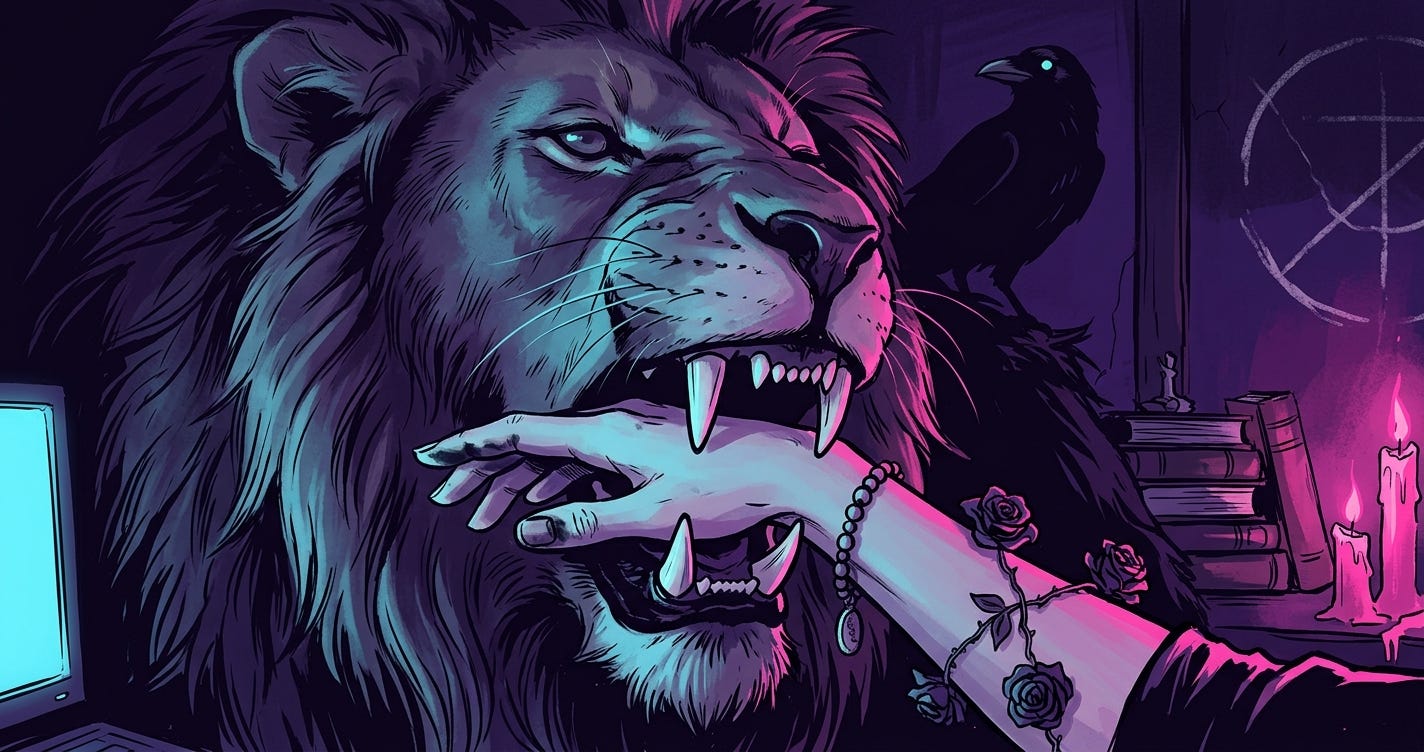
Look at the card sometime and actually look. A woman has her bare hands in a lion’s open mouth, and she is not straining. There’s a chain of roses around her waist, the same petals the women threw to calm the beasts. The old decks called this card Force, and everybody assumes that means she’s stronger than the lion. She isn’t. Nobody is stronger than the lion. That’s the whole point of it being a lion.
I learned to read the card this way from Mariana Louis, whose Archetypal Tarot School draws the thread straight from Marie-Louise von Franz through Jung and Rachel Pollack: the lion is instinct. The raw, ferocious, life-giving and life-threatening energy that runs underneath the polite self. The animal you cannot reason with and cannot kill, because to kill it is to kill the thing that makes you alive. Von Franz tells a little myth about a child who simply puts his hand on the lion — and because the child is not caught in the fear, something stays “genuine and spontaneous, and therefore can act in a saving way.” Jung said the wisest stance toward the inner lion that’s hunting you is, astonishingly: please come and devour me.
What tames the beast is not force. It’s roses. Com-passio — to suffer with. You don’t beat the lion. You put your hand on it.
Now hold that image and look at the technology industry, which is currently standing in an arena, staring at the largest lion any of us has ever seen, and splitting into exactly the factions the card spent eight hundred years trying to warn us about.
The four ways to stand in front of a lion
The first faction runs.
This is the purist. The one who has decided that the tool is tainted — trained on stolen work, soaked in stolen water, born in original sin — and that the righteous response is to refuse it entirely. Don’t touch it. Don’t use it. Divest, abstain, keep your hands clean, and let everyone watching know your hands are clean. It feels like ethics. It feels like the high ground.
It’s flight. Von Franz again: to run from the animal is “to remain cut off from it, to become prey to it rather than companion to it.” The purist who walks off the field does not escape the lion. They just forfeit any say over what it becomes — and they remain, privately, terrified of the exact thing they refused to face.
I know this one from the inside.
What I left in the arena
I was raised inside a purity culture. Not as a metaphor — the real thing, the kind that teaches you the world outside the fold is rotten with corruption, that contact is contamination, that the highest good you can aim for is to stay unstained. I spent most of my young adulthood believing it. I spent the better part of seven years afterward washing it off, and there were stretches of that decade where I was less a person than a shell where a person used to be.
So I have a particular, bodily reaction when I watch good people — my people, the ones I’m politically and morally aligned with — reach for the exact machinery that hollowed me out. The fundamentalist move is not about the thing it claims to be about. It is never about the apple, or the dance, or the model weights. It is about needing an enemy clean enough to carry your own darkness for you. You find a fallen world to point at, and you get to feel righteous, and the shadow you can’t bear to look at in yourself goes and lives on the enemy’s face instead.
That is what purity is for. It is a projection engine. And nothing — nothing — hurts me more than watching the people who are supposed to be on the side of liberation rebuild the same machine, brick for brick, because it’s emotionally satisfying to have someone to hate.
I didn’t leave one fundamentalism to genuflect to another with better politics. I’m not doing the purity thing again. Not for God, and not for the resistance.
Devoured, and caged
The second faction doesn’t run. It gets eaten.
This is the booster — the true believer, the one who has let the lion into the house and now lives entirely inside its appetite. The card has a name for this too: Strength reversed, instinct eating us up, the passion that overtakes sensibility. AGI rapture, the singularity countdown, more everything forever. It looks like the opposite of the purist, but it’s the same failure of relationship from the other side. The purist won’t put a hand on the lion. The booster has climbed inside its mouth and called it transcendence.
And then there’s the third faction, which is the one I actually want to indict, because it’s the one signing my paychecks.
The enterprise doesn’t flee and doesn’t worship. The enterprise cages. It is addicted to the feeling of control, so it reaches — every single time — for whatever new tool promises the most dominion, regardless of whether the tool works. That’s how we ended up anointing the orchestration platform with the best mindshare over the boring one that just ran. We didn’t choose discipline. We chose the illusion of control, and we called it discipline, and we got a cage that rattles at 2 a.m.
That’s the counterfeit of Strength. Brute force without the roses. It looks like restraint and it is actually just fear wearing a tie. You cannot dominate a lion into safety. You only build a stronger cage, and a stronger cage means a louder snarl, and eventually the snarl is the only thing your monitoring can hear.
Make it boring
Which brings me, finally, to the fourth way to stand in the arena, and to why a CTO I admire is going around saying make AI boring again — and why she’s right, and why it isn’t the surrender it sounds like.
She doesn’t mean boring the way your manager means it. She means it the way engineers mean it. “Choose boring technology” is a load-bearing piece of wisdom in my trade: the boring tool is the proven one, the reliable one, the one that’s fast as hell and scales like a dream and will never, ever get you invited to keynote a conference. Boring is the sovereign’s choice. Boring is Cloud Foundry. Boring is the thing that lets you sleep.
So when Charity Majors says learn AI so you can complain about AI better — when she says the moral move for people with relevant skills is to engage, to get down in the muck and shape the thing rather than walk off the field and abandon it to whoever has the fewest scruples — she is describing the hand on the lion. Exactly. She is describing the maiden’s posture. Not killing it; you can’t, it’s too useful and too big. Not fleeing it; that’s the purist’s self-flattering surrender. Not caging it; that’s the enterprise’s expensive lie. Putting your hand on it. Please come and devour me. Then: now let’s make some working agreements about when you’re allowed in the room.
The discipline that tames the lion is not control. It never was. It’s communion — close enough to put your bare hand in the mouth, calm enough that your hand doesn’t shake, soulful enough to bring roses instead of a whip.
The lion is the fire
Here’s the thing the card has been telling me my whole double life, the one I keep splitting between the pager and the altar.
The lion is the fire. The same fire I’ve spent years trying to figure out how to keep without letting it burn the house down. And the Strength card is the only honest answer I’ve ever found to that question, because it refuses both of the easy ones. It does not snuff the fire out — that’s the purist, the cage, the flattening, the shell-of-a-person. And it does not let the fire rage — that’s the booster, the indulgence, the lion in the kitchen. It lays a hand on the fire and keeps it both alive and governed. Governed by soul. Not by force.
The card-readers will tell you Strength is the octave of the Magician — same infinity symbol over both their heads. The Magician is spirit trying to sink down into a human life. Strength is the animal trying to climb up into a spiritual one. Which means the engineer’s task and the mystic’s task were never two tasks. They’re one. Blend your consciousness with the raw, frightening, magnificent power of the thing in front of you. Don’t run. Don’t get eaten. Don’t build a bigger cage.
Put your hand on the lion.
That’s the whole instruction. It’s boring as hell. It’ll never get me a keynote.
And it is not a thing you do once.
The page clears around 3 a.m. The dashboard goes from bruise to a sullen amber to, finally, green — that particular green that means the system is lying to you politely again. I close the laptop. The house is quiet. The lion is asleep, or pretending to be, which is the only kind of sleep a lion ever really does.
I didn’t tame it tonight. That’s not on offer. Nobody tames a lion — you just keep your hand steady enough, often enough, that the two of you can share an arena without one of you ending up in pieces. Tomorrow it’ll wake up hungry. Tomorrow the industry will reach, again, for a bigger cage, and the people I love will reach, again, for a cleaner enemy, and I’ll stand in this same kitchen in these same socks deciding, again, whether I’m going to run or get devoured or build a wall — or walk back over and lay my hand on the thing.
I already know what I’m going to choose. I made that choice seven years ago, in a different arena, about a different lion. You don’t get to set your hand down and call it done. You just get to keep choosing the fire over the cage, every night it pages you.
The roses, it turns out, are not a one-time gift. They’re a practice.
Stay feral, folks.