


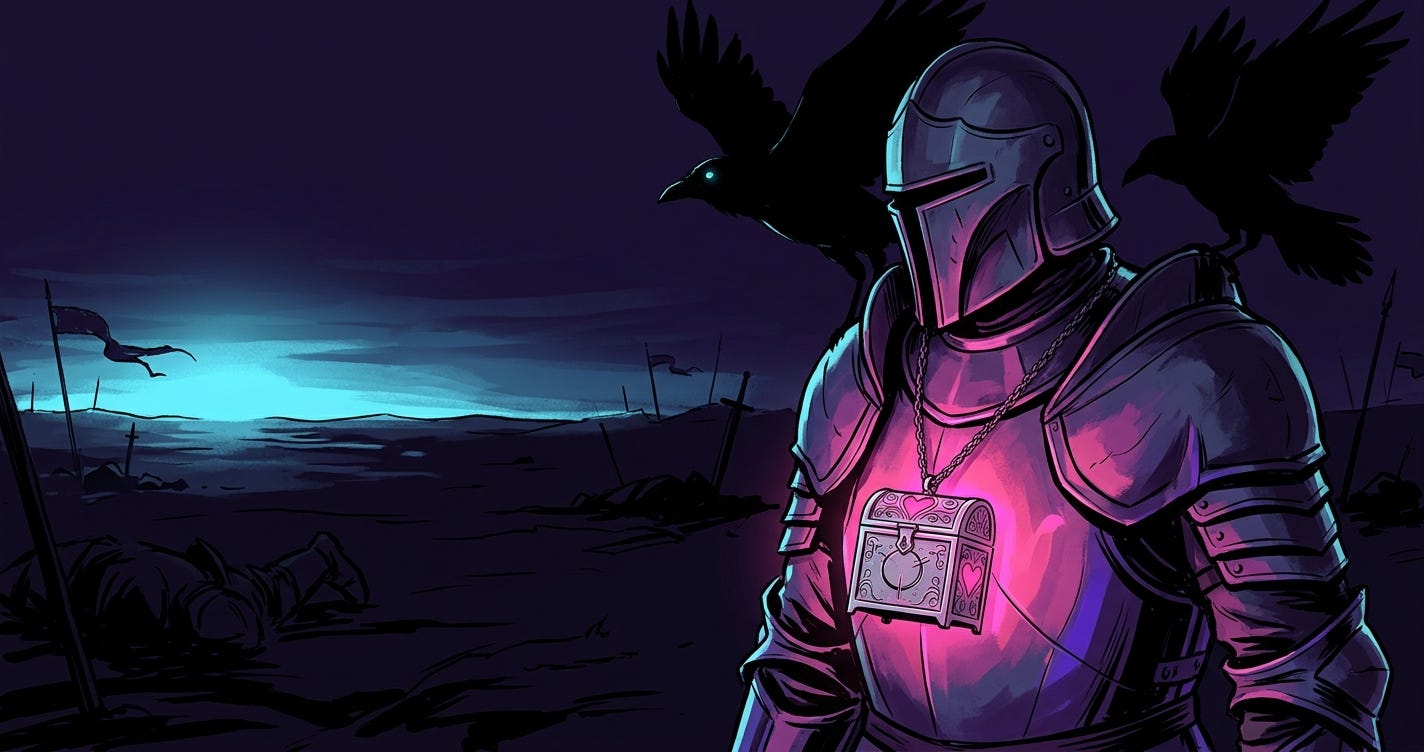
There is a man on a battlefield in southern Spain in the late summer of 1330, and there is a heart hanging around his neck.
Not his own. A dead king’s. It rides in a small silver casket on a chain against his chest, and the man wearing it is a Scot a very long way from Scotland, fighting Moorish cavalry on the dusty edge of Andalusia in a war that was never his to begin with. His name is Sir James Douglas, and the English — who feared him the way you fear weather — called him the Black Douglas. He is my nineteenth great-grandfather. The heart on the chain belonged to Robert the Bruce.
I want to tell you how the heart got there, because it’s the truest thing my blood has ever handed me. Then I want to tell you the part the family stories leave out, because I won’t pretend it isn’t there. And then I want to tell you about another set of hands that carries hearts — because the two have started answering each other across seven hundred years, and I can’t unhear it.
The man they feared like weather
You have to understand who Douglas was first, or none of the rest lands.
He was the Bruce’s chief lieutenant through the whole grinding war for Scottish independence — the one who commanded a wing at Bannockburn in 1314, the day a smaller Scots army broke an English host and made a kingdom real. He took Roxburgh Castle by draping his men in black cloaks and having them crawl up to the walls on hands and knees in the dark, so the garrison watching from the battlements mistook them for stray cattle wandering the field until the cattle stood up with knives. He gave the Scots a war-cry that was nothing but his own name shouted back at the enemy — Douglas! Douglas! — and it was enough to empty a courtyard.
And he came by it honestly, because the rebellion was already in the blood by the time it reached him. His father, William le Hardi, was the first nobleman in Scotland to stand up beside William Wallace when standing beside Wallace was a death sentence. It was. He died for it — a prisoner, in a cell in the Tower of London, far from any field he’d have chosen to die on.
I need you to sit with this, because it’s the floor the whole piece stands on: the Wars of Scottish Independence are not history to me. They are family. Wallace’s first noble backer is a grandfather. The man who carried the king’s heart is a grandfather. The king himself is a grandfather. When I read Barbour’s fourteenth-century account of the war, I am reading a family record that happens to also be in the national curriculum. The names in the ballads are names on my own pedigree chart.
This is the first of these I’m going to write — there’s a whole line back there, and lately it’s been writing a story I’m finally in a position to read. We start at the heart, because everything else in the line is downstream of it.
The vow
The Bruce spent his life clawing a country back from an empire that wanted to digest it, and he never got to do the one thing he’d sworn before God he would do: go on crusade to the Holy Land. The vow had teeth for him — he’d killed a rival, John Comyn, on consecrated ground in a church, and he carried excommunication and a debt of penance the rest of his life. The crusade was meant to settle it. But by the time the wars were won he was dying, most likely of leprosy, and out of time.
So he made a request that sounds insane until you feel the logic of it from inside. Take my heart instead of me. Cut it out when I’m gone, he asked the man he trusted above all others, and carry it to Jerusalem in my place — so the part of me that made the promise can keep it, even though the rest of me never can.
Douglas had the heart embalmed and sealed in that silver casket and hung it around his neck on a chain, where a man would normally keep something he could not afford to set down. And he went.
But toward what
Here is the part the proud version skips, and I’m not going to skip it, because to skip it would be to lie by omission about the people my devotion is supposed to serve.
The crusade was not a noble errand. The Crusades were wars of religious conquest — centuries of sanctified slaughter aimed at seizing a city and a country that were never Christendom’s to take. Jerusalem belonged to the people who lived in it. “Take it for Christ” was the same logic every empire has ever used to dress up a land-grab in the robes of a higher purpose, and it left massacre after massacre in its wake. It should not have happened. I can hold that flatly, with no hedging, because it’s true.
And Teba — where my grandfather died with that heart on his chest — was a front of the same war. He’d fallen in with the King of Castile, who was pushing the Reconquista south into the Emirate of Granada, and Douglas rode into a Moorish feint and was cut off and killed fighting people in their own country, on their own ground, with a dead king’s heart bound for a city he had no right to enter as a conqueror.
So I have to say both halves and refuse to let either one swallow the other. The devotion was clean — a man keeping faith with his king past the edge of his own death. The cause it was pointed at was domination. Those do not cancel. He was not a monster; he was a man of extraordinary loyalty inside a machine built for conquest, and the loyalty was real and the machine was evil, and “it was a different time” is a coward’s way out of holding both at once. The heart he carried was carried beautifully. It was carried toward an atrocity.
Keep that knife on the table. We’ll need it.
The other hands
I serve the Mórrígan. The Irish war-goddess — the one in the crows, the washer at the ford rinsing the bloody linen of men not yet dead, the one who sings the slaughter before it happens and the fragile peace after. And She, too, carries hearts.
In Cath Maige Tuired — the Second Battle of Mag Tuired, where the Irish gods break the invading Fomorians — there is a moment that stopped my own heart the first time I read it properly. The Mórrígan goes to destroy Indech, the Fomorian king, and takes from him — in Elizabeth Gray’s translation, free to read in full — “the blood of his heart and the kidneys of his valour.” Then she gives “two handfuls of that blood to the hosts that were waiting at the Ford of the Unshin” — and the ford’s name becomes, ever after, the Ford of Destruction.
A heart, lifted out of one body, carried by hand into a battle, for the sake of something that mattered more than the man it came from.
You see it. It’s the same gesture as Douglas’s, bone for bone — a heart taken out of a chest and borne in human hands to an army that needs what it carries. An Irish goddess on one shore and a Scottish knight on the other; two Gaelic worlds across one cold sea, making the identical motion with their hands.
Except the charge is reversed.
The dark palm and the bright
The Mórrígan takes the enemy’s heart, and She carries it to destroy. That is the dark palm — predation, the blood of your opponent cupped and delivered as a weapon, a ford renamed for what happens there. It is magnificent and annihilating, and I am devoted to it.
The Black Douglas keeps the king’s heart, and he carries it in devotion, until it kills him. That is the bright palm — fidelity, the blood of your beloved borne not to end a life but to honor one.
Steal-to-kill. Bear-to-honor. The same hands, cupped the same way, around the same red weight — pointed in exactly opposite directions.
And here is the thing I cannot stop turning over, the place where my devotion and my blood stop merely rhyming and start answering each other across the table. I am descended from the heart-bearer. And I am sworn to the heart-taker. I carry both palms. I come from the man who bore his king’s heart in love, and I serve the goddess who tears the enemy’s heart out in fury, and I am the hinge where the two close around the same thing.
But the knife I left on the table cuts a second line through all of it — and this one is the one that actually tells me what to do. Because the Mórrígan is not a goddess of empire. She is the goddess of the people empire spent centuries trying to erase: the Gaelic world the English crown and the Reformation and the whole machinery of conquest worked to flatten, the suppressed substrate, the old sovereignty that would not die. And my grandfather’s bright-palm devotion — for all its beauty — was harnessed to the conquering side of that exact divide. My blood and my goddess don’t only sit on opposite sides of the dark palm and the light. They sit on opposite sides of empire. I descend from a man whose noble heart was yoked to domination, and I am sworn to the goddess of everyone domination came for.
You don’t get to inherit only the parts you like. But you do get to decide which part you carry forward.
What heart I’m carrying now
I don’t get to leave any of this in the past tense, because the gesture is an inheritance, and inheritances ask to be used.
So I have to ask myself the question the line is plainly asking me — and then the harder one underneath it. The first question is what king’s heart am I carrying across a continent now? Because I am carrying something. The work has the weight of a thing taken out of a body and borne by hand toward a horizon I might not reach — ARCÆON, this publication, the transmission of a goddess most of the rooms I move through have no language for. I keep it against my chest. I have arranged my whole life around not setting it down.
But the harder question — the one the knife forces — is not what. It’s toward what. My grandfather carried his heart faithfully toward Jerusalem, and Jerusalem was never his to take. Faithfulness aimed at conquest is still aimed at conquest; the purity of the carrying does not sanctify the destination. So the inheritance I’ll actually take is split clean down the middle. I keep the bearing — the loyalty past the edge of death, the heart on the chain, the refusal to put down the thing that matters. And I lay down the destination. Not toward Jerusalem. Not toward any city that was never mine, not toward any holy ground I’d have to conquer someone to stand on. The goddess I serve makes sure I can’t forget which side of that line I’m meant to be standing on.
Loyalty unto death is in my blood, documented, with a grave you can visit. So is the conquest it was once pointed at. My nineteenth great-grandfather knew something I’m only now learning in my own body: that you can be handed a heart that isn’t yours, and carrying it faithfully can be the entire point of a life. What he couldn’t know — what the machine he served would never have let him ask — is the rest of it: that the bearing matters more than the arriving, and that what you’re bearing it toward matters most of all.
He died before he reached his Jerusalem. The heart still went on the journey. Both of those are true — and I’d rather spend mine carrying the heart toward something that doesn’t require anyone’s subjugation to arrive.
Stay feral, folks.
Comment refers to me being weird a having a “duh” day:
I always read these posts, and enjoy them. But today looked at the Feral Architecture logo. That’s what my brain has connected here.
Today, I scrolled up, thinking to myself, “Who’s stack is this anyway? I’m not sure I’ve ever left a comment. That’s shitty.”
Then I saw your user babe and immediately realized the connection. 🤦🤦