


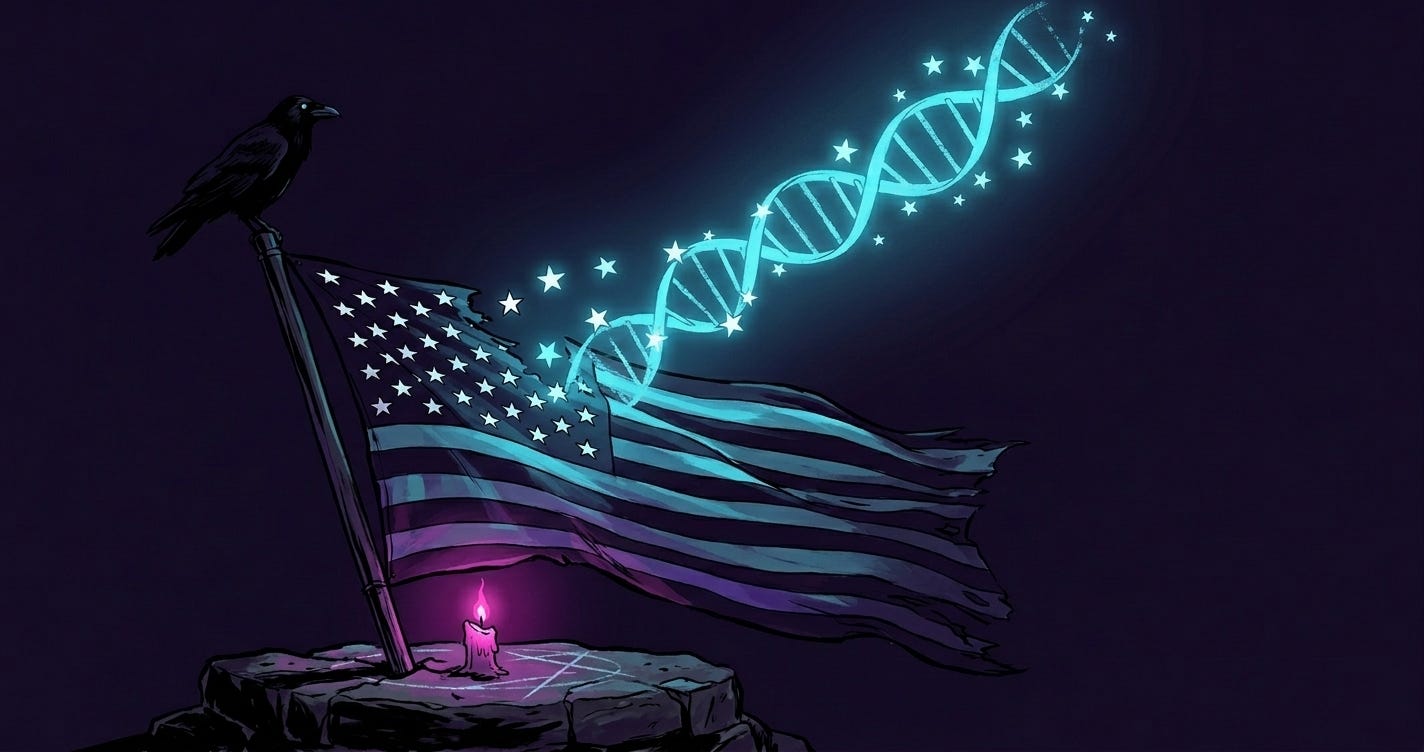
The record says Teek Indian Squaw.
That’s the entry. Born 1765, died 1814, Rutherford County, North Carolina. Where a given name should sit, there’s a fragment somebody heard once — Teek — bolted to a descriptor a clerk reached for the way you’d write brown mare or the back field. A category doing the work of a name. The word her mother called her is gone. Whatever she called herself is gone. What cleared the colonial filing cabinet and came down to me is two syllables and a slur.
She is my sixth great-grandmother. And I’m sitting at a desk in Mississippi, two hundred and fifty years downstream, looking at the cursor blink next to that line, carrying her in the part of me that keeps the lights on.
I found her the way you find anyone now — three hours deep in a genealogy site at an hour I should have been asleep, clicking up a surname spine that kept handing me exactly what I expected. German farmers. Scots-Irish Presbyterians. Lutherans with eleven children and granite headstones that are still standing. The tree was behaving. And then a maternal branch forked somewhere it shouldn’t have, and there she was — filed under a word I’ll type once and never again, and the whole orderly Protestant tree went quiet around her the way a room goes quiet when somebody finally says the true thing.
I’m going to say her name correctly for the rest of this, because the ledger wouldn’t. Teek. Not the other word. I only use the other word once, here, so you can see exactly what was done — a person compressed into a slur and a guess, then filed. That’s not an accident of old paperwork. That’s the technology working as designed. The record is an instrument, and the instrument was built to make certain people disappear into nouns.
Here is what didn’t disappear.
The thread the surname-trackers couldn’t see
There’s a kind of inheritance that doesn’t travel through your name. Mitochondrial DNA — the little engine in nearly every cell of your body that turns food into the electricity you’re running on right now — passes one direction only: mother to child. Your father gives you none of it. None. Whatever mitochondria you’re burning, you got it from your mother, who got it from hers, who got it from hers, in an unbroken bucket-line of women reaching back past every surname anyone bothered to write down.
Trace mine and you get a litany:
Teek, to Sarah Sallie McFalls, to Susan Swink, to Susanna Pruett, to Julia Elizabeth Denton, to Fannie Dale, to Velma Pruett, to my mother, to me.
Eight women hand-carrying the same molecular fire across two hundred and fifty years. Each one handed it to the next in the only way it can be handed — by being born, by giving birth, by the body doing the one thing the paperwork never thought to track.
Think about what those two and a half centuries held. Removal. A civil war fought across the very counties they lived in. The long grind of Carolina cotton and Carolina poverty, the kind that doesn’t make the history books because it just was the water. Each of those women carried Teek’s fire through all of it, and not one of them, almost certainly, knew she was a link in anything. No one told them. They were just living — having daughters, burying parents, passing along an engine they couldn’t see and were never named as keepers of. The continuity was perfect and completely unconscious. That’s the part that undoes me a little. It worked because nobody was guarding it. Because the paperwork tracked fathers. Surnames march down the male line; the whole Reformed, Protestant, patriarchal record-keeping apparatus my other ancestors built was a machine for following men. Property, name, pulpit, title — father to son to son.
And the entire time, underneath it, invisible to the ledger, a second inheritance was moving mother to mother to mother, carrying a Cherokee woman’s mitochondria straight through the middle of a family tree that thought it was German and Scots-Irish and Lutheran and Baptist. The machine that was built to follow the fathers had no column for her. So she rode the one current it wasn’t watching. She rode it all the way to me.
What I actually know, and what I won’t sell you
Here’s the part the genealogy sites would happily sell you and I’m not going to. I haven’t run the test. The mitochondrial haplogroup — the objective genetic signature that would confirm an Indigenous American maternal line, the A, B, C, D, or X that would turn family story into laboratory fact — I haven’t pulled it yet. What I have is a documented tree, a name-fragment, a death date, a county, and the brute fact of my own mitochondria, uncertain at the root.
So I’m not going to stand here and tell you the science proved it. The science hasn’t been asked yet. What I have is a record that is itself a wound — a line of women, the oldest of whom was erased into a slur by the same culture that wrote everything else down in triplicate.
And that uncertainty is the truest thing about it. My knowledge of Teek is partial the same way the record of Teek is partial. I am reaching back toward a woman through a document built to keep me from finding her. Of course it’s incomplete. Incomplete is what colonial erasure feels like from the descendant’s end — not a dramatic absence, just a blank where a name goes, and a cursor blinking next to it.
I’m not going to fill that blank with romance. I’m not Cherokee. I don’t get to claim that nation, that enrollment, that belonging — the Eastern Band is a living sovereign people at the Qualla Boundary, not a feeling I get to have about myself. What I get to do is something much smaller and much more exact: acknowledge that the land I can trace my mother’s mother’s mothers to — Rutherford County, North Carolina — was Cherokee land before it was a county, and that a woman from it is in my cells, and that I will say her name out loud even though the record refused to learn it.
Rutherford County didn’t exist when Teek was born. It was surveyed and named and deeded by the same people doing the filing — named, as it happens, for Griffith Rutherford, a general who the same year the country declared itself free led a military expedition against the Cherokee. Sit with that one. The county that files my sixth great-grandmother under a slur carries the name of a man who marched on her people in 1776. The erasure isn’t buried in some archive. It’s on the road signs. Before the deeds it was Cherokee homeland, and inside Teek’s own lifetime the machinery was already grinding that would, a generation after her death, force the Cherokee west on the Trail of Tears. She lived in the narrowing — in the decades when the door was closing. I don’t get to know how she moved through it. Whether she hid. Whether she passed. Whether the word in that ledger was an act of erasure or an act of cover, protection or violence or both at once, written by someone who wished her gone or someone who was trying to keep her alive by making her unremarkable on paper. The record doesn’t say. The record never says the part that matters.
That’s honoring from a distance. The distance is the respect.
It ends in me
Now the strange part. The part I keep circling.
Mitochondrial DNA only continues through daughters. A son inherits his mother’s mitochondria — I’m running on Teek’s, by way of eight women — but a son can’t pass it on. The engine stops at him.
I’m the son.
Two hundred and fifty years, nine generations, an unbroken matrilineal thread that survived removal and erasure and a slur in a ledger and the entire westward grind of American settlement — and it arrives, finally, at a man, where it can go no further. I am the last vessel of Teek’s mitochondrial line. In me, the bucket-line ends. Whatever she handed forward, I’m the one it stops with.
I have sat with that for a while and it does a thing to you. There’s a grief in being a terminus — in being the place a 250-year-old fire arrives to go out. For most of my life I’d have read that as the saddest possible ending. The line survives everything history can throw at it and then dies quietly in a guy at a desk who didn’t even know her name was Teek until last month.
And there’s a vertigo under the grief. Every woman before me was a conduit — the fire moved through her and kept going, and she never had to decide anything about it. I’m the first one in nine generations for whom that’s not true. The thing passes through me and stops. I’m not a link in the chain anymore; I’m the clasp at the end of it — the place where this particular inheritance either gets honored on purpose or gets forgotten by default, because there’s no one downstream in this line to forget it for me. The unconscious relay is over. After two hundred and fifty years of women who didn’t have to know, it lands on the one who does.
But I don’t think that’s the ending. I think that’s the misread.
The vessel ends. What it carried doesn’t.
Look at what my family tree was supposed to be. German Lutheran on the Stine spine. Scots-Irish Presbyterian and Reformed back through the McCalls. Protestant, patrilineal, biblical, ordered — a tradition that spent four centuries flattening exactly three things: the feminine, the symbolic, and the indigenous. The Goddess the Reformers smashed. The intuitive, dream-soaked, image-thinking mind the rationalists called superstition. And the land-memory of the people who were here before the settlers filed them under nouns.
All three of those got pushed down. And all three of them are the suppressed material that came roaring back through me, the descendant who deconstructed out of the Baptist church and walked straight into tarot, Jung, the Mórrígan, the whole feral architecture of meaning my ancestors would have called the Devil’s work.
I used to think my turn toward all of that was a break with my lineage. A betrayal, on the bad days. I had it exactly backwards. It wasn’t a break. It was the return. The substrate the patrilineal tradition spent four hundred years burying came back up through the one channel that tradition never learned to watch — the mother-line, the invisible current, the molecular fire carried by eight women, including one whose name got erased into a slur. The suppressed didn’t die. It went underground and waited and routed itself down the matriline until it reached a descendant who’d finally go looking.
And here’s the part that stops me cold: it didn’t come back through the loud line. Not through the pulpits, not through the surnames, not through the men who’d have had a great deal to say about a grandson reading tarot cards to an Irish war goddess. It came back through the women. Through the quiet, unwatched, undocumented channel. Through Teek. Which is exactly, precisely how the suppressed always returns — never through the front door the tradition is standing guard at, always through the one it forgot it had.
So yes — the mitochondria stop in me. The vessel ends. But a vessel and what it carries are not the same thing. The cup is not the water. The molecule terminates; the inheritance — the suppressed feminine, the indigenous substrate, the buried image-mind — that doesn’t terminate. That’s the thing I get to pour into everything I’m building now. The line ends. The substrate doesn’t.
A vessel that knows it’s the last one has exactly one job. Not to hoard what it’s holding. To pour it out somewhere it’ll keep.
Two hundred and fifty years
This week the country turns two hundred and fifty and wants me to wave a flag about it. I keep doing the math instead. Teek was born in 1765 — eleven years before the Declaration, on land the country hadn’t taken yet. My mother’s mother’s mother’s line is older than the United States. And the United States, the one throwing itself the party, is the reason I met her as a slur instead of a name.
So forgive me if the birthday lands a little sideways. I’m not burning anything down — I was born here too, this is my house and these are my dead. I just won’t stand in the parade and pretend the candles didn’t cost what they cost. The country gets fireworks and a number it’s proud of. She got filed under a category and rode her own mitochondria through two and a half centuries of dark to reach the one person left who could undo it.
Say her name
The crow’s been on my masthead this whole time, and she has opinions about who gets remembered and who gets erased — the Badb keeps the names the official record loses. So let me do the one thing the ledger wouldn’t.
Teek. Born 1765, somewhere on Cherokee land that a clerk later called Rutherford County. Died 1814. Mother of Sarah, who mothered Susan, who mothered Susanna, who mothered Julia, who mothered Fannie, who mothered Velma, who mothered my mother, who mothered me. Carrier of the fire I’m running on as I type this. A woman whose name the record reduced to a fragment and an insult — and who I am choosing, two and a half centuries later, to call by the only piece of her name that survived, spoken correctly, out loud, on purpose.
That’s more than the ledger ever managed. It’s not enough. It’s not nothing.
The line ends here. I’m going to spend it well.
Stay feral, folks.