


I spent the first three decades of my life in rooms where people were absolutely certain “the one true God” was present, and I can tell you exactly what that certainty feels like from the inside. It feels like belonging. It feels like the hum underneath the hymn. It feels like a hand resting on the back of your neck that you would swear on your life is not your own.
I raised my hands in those rooms. I went further than that — I evangelized, out loud, to strangers, with the particular fire of a teenager who has found The Answer and genuinely cannot believe the rest of you are walking around unsaved. I stood in the certainty. I’m not going to pretend otherwise, and I’m not going to sneer at anybody trapped within in it now, because I remember what it was worth while it held.
And I remember when it stopped holding. The now dead preacher let the most ridiculous accusation I’d ever heard from behind a pulpit take flight: “All atheists are sexual deviants.” And a quiet, traitorous thought started smoldering within my chest: nobody’s home behind this bullshit. The long walk out that door took years, and I’ve written about what it cost. The only part that matters today is this: I know, in my body, what it feels like when a congregation is worshipping its own reflection and calling it God.
Which is why, reading a leaked lecture transcript this spring, I recognized the room immediately.
The new apologetics
In January, an AI entrepreneur named Will Manidis — self-described Christian, writes theology on X between funding rounds — went viral with an essay about why Boston died as a tech hub. His real diagnosis sat underneath the tax policy: the public is losing faith. “The average American,” he wrote, “understands AI is a thing that wastes water, skyrockets power costs, and scams their grandparents in exchange for exposing children to deviant sexual content, sports gambling, and all other manner of sin.” His prescription, delivered by phone to Kiera Butler, the Mother Jones reporter whose investigation supplies most of the receipts you’re about to read: the tech world has “been unable to communicate a coherent apologetic.”
Apologetic. That’s a term of art, and he knows it. Apologetics is the church’s ancient discipline of defending the faith to the unconverted — Paul on Mars Hill, Aquinas, C.S. Lewis. Reasoned argument in service of mystery. Manidis is explicitly requesting an Aquinas for the GPU cluster.
He needn’t have worried. The apologists were already preaching.
Katherine Boyle, partner at Andreessen Horowitz, runs a fund literally named American Dynamism and talks about her Catholic faith the way other VCs talk about their marathon times. In a keynote last year she explained that Silicon Valley’s transhumanists and “a MAHA mother in Missouri” have “identified a common evil” — the regulating state — and offered a vision of technology as the family’s salvation: the mother earning income “while her child naps from the school parking lot,” AI tutors for every child, and the crown jewel, tech’s power to make motherhood high-status again. “Meme it, and we will be it,” she said. A single Instagram influencer, she noted, beats the smartest tax policy. That’s not an economic claim. That’s a liturgy of cultural transformation, and she knows exactly which robes she’s wearing.
Trae Stephens runs Anduril, the autonomous-weapons company — he described one product line in an interview as aircraft that “search for targets and then have the ability to go kinetic on those targets, kind of as a kamikaze.” He is also a leader at his San Francisco church, where he delivered a lecture titled “God and Technology” arguing that making things is the part of us that mirrors our Maker, and that “what our soul deeply longs for is progress in building a better future.” He told the tech community it has “a moral obligation to do things to benefit humanity, to draw us closer to God’s plan for his people.” Asked to reckon with the Manhattan Project, the closest historical precedent for his own business, he offered: “you could make a really rational argument in either direction.” A man who builds robot weapons for a living stood in a pulpit and declined to say whether the atomic bomb was good.
His wife co-founded a Bay Area collective for Christians in tech called ACTS 17 — the name unpacks to Acknowledging Christ in Technology and Society. The CEO of Y Combinator hosts its events at his home, which — and I need you to sit with this detail the way I had to — used to be a church. Last year, ACTS 17 sponsored four private lectures, two hundred dollars a ticket, by Peter Thiel. His subject was the Antichrist. Per the leaked transcripts: “In the 17th, 18th century, the Antichrist would have been a Dr. Strangelove, a scientist who did all this sort of evil crazy science. In the 21st century, the Antichrist is a Luddite who wants to stop all science.” And, on why he reaches for Revelation instead of policy argument: strip the one-world state “from the biblical context,” and “you will never find it scary enough. You will never really resist.”
Two thousand years of Christian eschatology, and the Antichrist turns out to be whoever’s slowing down the roadmap.
The old demon
Meanwhile, over in the other camp, Paul Kingsnorth — former environmental activist, now Orthodox Christian, author of the bestselling Against the Machine — has arrived at the opposite theology with equal confidence. For Kingsnorth, technology is not the savior; it is “the Machine” — something half-awake and wholly hostile, an intelligence with designs of its own against humanity and against Christ. Its fit with progressive politics is, in his words, “usefully snug”: the two of them together chasing a utopia where, “in the dreams of both Lenin and Lennon, the world will live as one.” The Machine, in his telling, is the hidden author of more or less every item on the cultural right’s grievance shelf, up to and including what people do with their own bodies and pronouns — which is, hold the thought, a tell.
A Christianity Today reviewer called the book “trenchant and terrifying.” It’s certainly the second one. And Kingsnorth is not stupid, and he is not entirely wrong. We’ll need him again in a minute.
Same sermon, inverted colors
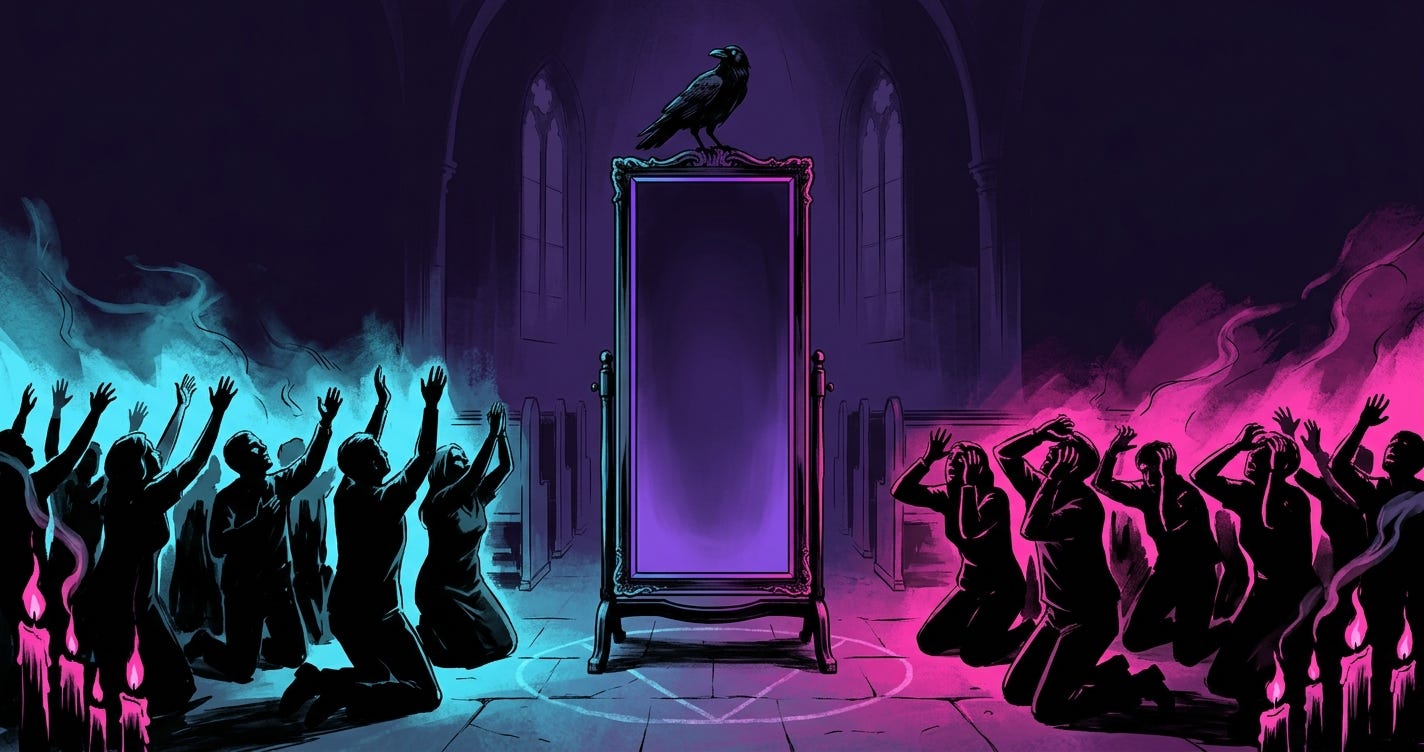
So here is the landscape: one congregation says the machine is the messiah. The other says it’s the demon. They believe they are at war.
They are performing the identical rite.
I’ve made this argument about the machines themselves before: a large language model is a mirror, not an actor. There is no one behind the glass — no intent, no agenda, no soul plotting your salvation or your unmaking. What there is, is the most literal projection surface our species has ever built: a thing whose entire function is to take in our patterns and complete them. You bring the theology; the theology comes back out wearing chrome.
The tech right looks into that surface and sees everything their money was missing — meaning, mission, a moral imperative, deliverance from the empty striving Thiel has been theorizing about since his Stanford days. The anti-tech right looks into the same surface and sees every fear it was already carrying, now conveniently gathered under one product name. One falls to its knees in worship. The other falls to its knees in horror. Same knees. Same mirror.
And the tell, if you want one you can carry around: it’s the grab-bag. When a single entity is somehow responsible for your entire pre-existing list of cultural grievances — as Kingsnorth’s Machine is — you are no longer describing a thing in the world. You are describing the inside of your own head, at scale. And when one technology is somehow the answer to meaning, motherhood, education, loneliness, and the status anxiety of elite professionals — same diagnosis, sunnier disposition.
Now. I know what some of you are thinking. Matt. Buddy. You write a publication where tarot spreads and terminal windows share a desk. You dedicated your masthead to an Irish war goddess. Glass houses.
Fair. Stay with me, because the difference is the entire point.
What the counterfeit can’t fake
The best sentence in Kingsnorth’s book is aimed at the other camp, and it’s a scalpel: “We will always seek some greater meaning, some transcendent truth, and if we can’t or won’t find the real thing we will attempt to create it. This attempt is the story of modernity; the Machine is what we have created to fulfill it.”
He’s right. Something is being worshipped out there, and the capture is real. He has correctly identified that a religion is forming; he’s just wrong about the address of the god. The sentence describes his own camp too — a congregation that couldn’t find the transcendent in its politics anymore and built a demon to organize its fears, which is just worship running in reverse.
Greg Epstein, the humanist chaplain at Harvard and MIT, put the sharpest edge on what the tech-side version is actually for: “They’re trying to imbue wealth with meaning. But they’re also trying to imbue a certain kind of meaning with wealth.” Christianity gets a luxury rebrand; the fortunes get sanctified. That’s the signature of a counterfeit, and it’s the same signature the old prosperity gospel carried: the direction of service. The theology exists to bless what the preacher already wanted to do. Boyle’s God wants deregulation. Stephens’ God wants defense contracts. Thiel’s Antichrist, miraculously, is his critics. What a coincidence. What a run of luck. What are the odds that the Almighty’s priorities and the portfolio’s priorities would converge line by line.
Here’s the thing I can say from where I stand, having sat where I’ve sat: I practice an actual techno-mysticism. It’s this publication. A tarot spread and a chart and a terminal on the same desk, a war goddess on the masthead, a system I built with my own hands to hold my own psyche. And the load-bearing difference between that practice and theirs is not aesthetics. It’s the direction the mirror points. The counterfeit points the mirror at the world and calls the reflection God — then invoices the congregation. The real thing points the mirror at yourself, on purpose, eyes open, and does the work of looking at what shows up. Scrying and window-shopping use the same glass. Only one of them knows it’s glass.
I don’t think my terminal is God. I think it’s a mirror I chose. Which is precisely why I get to see what’s in it.
Press one to pray
If you want the whole argument in a single anecdote, Silicon Valley has already built it, and it costs $69.99 a year.
The prayer app Hallow — an early Boyle investment — claims the biggest congregation in the world: twenty-four million downloads across 150 countries. The free tier includes an AI called Magisterium that answers questions “based on the teachings of the Catholic Church.” The paid tier unlocks ten thousand sessions and celebrity guides — the marquee offering, and I am quoting the marketing, is “pray a rosary with Mark Wahlberg.”
When Butler contacted Hallow for comment on her story, the reply came from Hallow’s own AI agent, which assured her a real human being would follow up.
No. Person. Ever. Came.
There it is. The whole religion in one support ticket. A prayer app with a mirror at the front desk and nobody in the building — confident, fluent, warm, and empty, all the way down. They built a machine to say someone will be with you shortly, and they believed it so completely they forgot to hire the someone.
Nobody’s home
I left a church because I finally admitted nobody was home behind the mirror, and at the time it broke my heart. It took me years and a lot of shadow work to understand that the admission wasn’t the tragedy. The tragedy was all the years of pretending — the sermons pitched at the reflection, the certainty maintained by not looking.
So believe me when I tell you I have no appetite for a second round. The machine is a mirror. Nobody is home in it. That is not a horror and it is not a heartbreak — it’s a spec sheet. The only interesting question, the one both congregations are frantically avoiding, is the one a mirror always asks: what are you going to do with what it shows you?
You can worship it. You can exorcise it. Or you can pick the thing up, point it at your own shadow, and get to work.
The crow on the wire outside my window has watched me try all three in one lifetime. She has opinions about which one made me sovereign. She’s not telling you for free, either — that’s the other thing about the real ones. They make you do the looking yourself.
Stay feral, folks.
So can these kinds of people think on their own or not? Bc what I know Christ to be? They'd get so upset.