


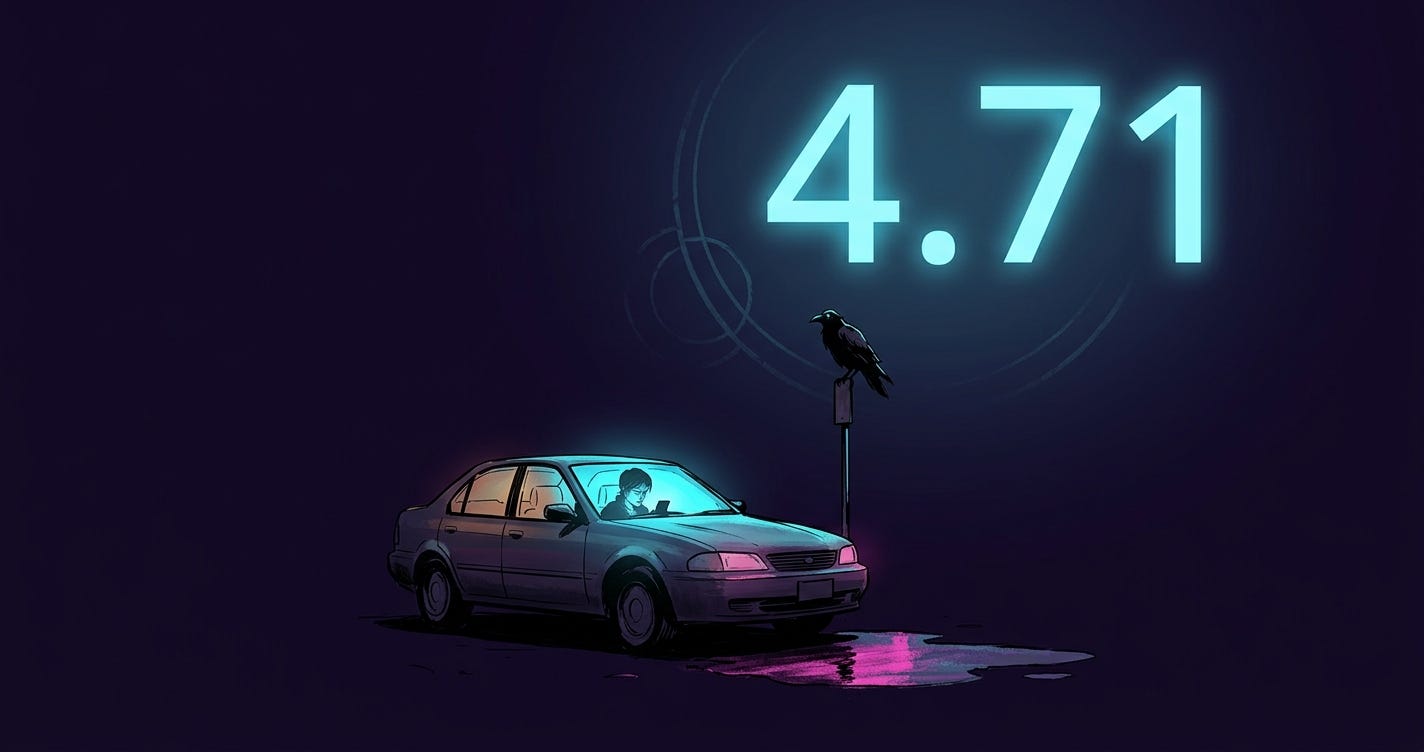
There’s a man parked outside a gas station in a city he’d rather not be in, looking at the number 4.71.
He’s looked at it before. He’ll look at it again at the next red light, and the one after that — the way you press a bruise to confirm it still hurts. 4.71. It used to be 4.83. He knows exactly which week it started sliding: the week his kid had the ear infection and he drove tired and short, took the wrong turns, let the silence in the car go on a beat too long. Three bad nights. The number remembers all of them, and the number does not care why.
Here’s the part that does the real damage. He can’t get it back. The rating is an average stretched across thousands of trips, and thousands of trips is a lot of ballast. One good night moves it nothing. One good month, barely. The math is built so that a human being having a hard stretch — which is the only kind of stretch human beings reliably have — cannot outrun it. Dip under the line the company won’t say out loud and the app just stops handing you work. No conversation. No manager who watched you show up for two years straight. No appeal that reaches anyone with a pulse. The trips simply stop coming, and you sit there refreshing a screen that decided about you hours ago.
I want to sit in that parking lot for a minute, because that parking lot is the whole essay.
I told you it was light. I wasn’t lying. I just wasn’t finished.
A couple of weeks ago I wrote that technology is light. That it doesn’t create the rot — it reveals it. The AI on your desk isn’t the disease; it’s the lamp somebody finally flipped on in a room that was already filthy. I still believe every word of that. Visibility is the precondition for any real work — you cannot integrate what you cannot see, and for a long time we couldn’t see, and now we can, and there is genuine mercy in that.
It was true. It was also half the story.
I know what you’re going to say, because I said it to myself: fine, the light’s uncomfortable, but discomfort is the price of finally looking. Sure. But light does two things in a room. It shows you what’s there. And it takes away the shadows you used to live in.
I only wrote about the first one.
The cover and the latency
The first removal — call it the cover. The cover was epistemic. It was the comfortable facade that let us pretend the problem wasn’t there: the story that the team was fine, the architecture was sound, the marriage was working, the system was just. Technology stripped the cover off. Painful. Good. That’s the piece I already wrote.
The second removal is a different animal, and nobody’s naming it, and it’s the one that man in the parking lot is living inside right now. Call it the latency.
Latency is the lag. The slack in the rope. The gap between the rule and the enforcement of the rule. Every system you have ever lived under had latency built into it, and you survived inside that slack whether or not you ever noticed it was there. The boss who could technically write you up for the long lunch but didn’t, because he wasn’t watching at 1:40 on a Tuesday. The metric that technically tracked your output but got tallied once a quarter, so a slow week dissolved into the average before anyone looked twice. The library book three days late that nobody fined you for. The gap between what the system was allowed to do to you and what it actually got around to doing.
You lived in that gap. We all did. The gap is where you got to be a person instead of a throughput number.
Nobody was being kind
Here’s the brutal little hinge the whole thing turns on.
We told ourselves that gap was mercy. That the boss who didn’t write you up was a decent guy. That the company gave you room because it valued you. We built whole identities on being trusted, on being given slack, on the warm sense that someone upstairs had decided to go easy.
It wasn’t kindness. It was a budget.
Nobody let you slack because they loved you. They let you slack because watching you every second of every shift was expensive, and the juice was not worth the squeeze. Surveillance cost money — a human supervisor, a manager’s finite attention, somebody’s actual eyeballs and salary and lunch break. And money runs out. So the watching was always partial, and the partial watching left gaps, and you lived in the gaps. The relief was real. The relief you felt in those unwatched hours was not imaginary. But it was never granted to you. It was the accounting department quietly deciding you weren’t worth the cost of total observation.
The relief valve was a line item. It wore the costume of grace, and we fell for the costume completely — because the alternative is unbearable to look at straight on. The alternative is that the only thing standing between you and total enforcement, your whole working life, was that you were too cheap to fully watch.
Now. Look at what it costs to watch the man in the parking lot.
It rounds to zero.
The tower with nobody in it
That’s the actual event. Not “AI is a new villain” — I’m so tired of that essay, and so are you. The event is the de-costing of the watcher. The thing that used to need a supervisor and a clipboard and a paycheck now needs a model that runs for fractions of a cent, never blinks, never takes 1:40 on a Tuesday off, and never once feels the small human reluctance to be the asshole. The rating recalculates itself. The threshold enforces itself. The discarding happens with no hand on it at all.
There’s an old idea about a prison built so the guard tower can see into every cell, but the prisoners can never tell when they’re actually being watched — so they behave as if they always are. The horror of it was the maybe. You internalized the guard because you might be seen, and that gap between might-be and actually-is was the last scrap of freedom in the building: you could gamble. And most of the time, statistically, nobody was up in the tower. The tower was expensive to staff too.
The gig rating is that tower with the guard taken out and replaced by something that costs nothing to run and is therefore always, actually, continuously there. There is no maybe left to gamble against. “If you can’t keep up, you’ll be discarded” stops being a threat you manage with a couple of good weeks and becomes the weather. The steady state. The 4.71 that will not move no matter how he drives tonight.
That’s the inversion, and it’s the part that’s mine to say, not the dead Frenchman’s. The nightmare was never being watched. The nightmare is being watched so cheaply that the watching never stops — and there’s nothing left to internalize, because there’s no gap left to hide the internalizing in.
Where your worth is kept
Notice the thing people keep getting wrong, because it matters more than anything else here.
The rating doesn’t steal that man’s attention. This is not a doomscrolling essay. The app isn’t hijacking his focus or farming his dopamine. It’s holding his worth. His standing as a person who can feed his kid lives inside a number that an algorithm administers and he is not allowed to touch. The thing that got relocated isn’t his attention — it’s where his value is kept. It used to be kept somewhere inside him, or at least somewhere with a human face attached to it, a dispatcher who knew his name. Now it’s kept in the cloud, recalculated continuously, and rented back to him one trip at a time.
I came at this sideways, listening to Blindboy talk about medieval glass and self-esteem — the old distinction between worth that’s contingent (granted from outside, revocable, scored) and worth that’s intrinsic (yours, unrepeatable, not for sale). And it landed on me that something had started shoveling everyone’s worth into the contingent column at industrial scale. That’s the uncapping. Not a new attacker. The removal of the one constraint — expense — that kept the old attacker part-time.
You’ve already met the consumer-grade version of this — the streak that breaks and the little app that mourns you. Same thesis, smaller instrument: a latency-killer you carry in your pocket and agree to call a habit.
The dark was the mercy
So far this is just a bleak diagnosis, and bleak diagnoses are cheap. Here’s the turn, and here’s why this is a piece about your soul and not just your job.
Go back to the gap. I said the gap was where you got to be a person. I want to be more exact than that, because it’s the most important sentence in this whole thing.
The unwatched interior is where the work happens. Not the work that shows up on a dashboard — the other work. Integration. Metabolizing. The slow private digestion of everything the light just showed you. You cannot do that in the spotlight. Nobody in the history of the species has become more whole while being continuously observed and scored. Growth needs a green room. The psyche composts in the dark — the way a seed does, the way grief does, the way every real change you have ever made happened in some quiet, unaccounted-for stretch where nobody was taking attendance.
And that is the trap the two removals spring together. The light showed you the rot — necessary, true, the bridge holds. But integrating what the light showed you requires latency. Requires the gap. Requires the exact dark that the same technology just abolished. Total illumination is not individuation. Total illumination is exposure with no recovery cycle: seeing everything, all the time, with nowhere to carry it and turn it into something you can live with.
Visibility is necessary. The container is also necessary. And the single technology that hands you the first takes away the second with its other hand.
(There’s a far end of this loop — what happens to a mind that has no unwatched interior left at all. But that’s a different mechanism and its own essay. I’ll come back to it.)
Build the dark back by hand
Which means the first task — the actual first task of “the work” I keep promising you the light makes possible — is not what I told you it was. It is not looking honestly at what’s finally visible. You can’t even do that yet. The first task is older and stranger and more manual than that.
You have to build the dark back by hand.
Manufacture the latency the system will no longer hand you for free. Make the gap on purpose, because nobody is going to leave you one — the budget that used to leave you one has gone to zero, and the gaps are all closing at once. The unwatched hour. The unmeasured practice. The room with no score in it. The walk with the phone left on the counter. The deliberate, defended, slightly feral refusal to let every last quadrant of your life be continuously rated. Not as self-care — God, not that. As a precondition for being a person at all. The dark is not where you hide from the work. The dark is where the work gets done.
The man in the parking lot can’t manufacture his — his worth is locked in someone else’s cloud, and that’s a fight bigger than a green room, one I’m not going to insult him by pretending a paragraph solves. But you, reading this, with whatever slack you’ve still got: that slack is not leftover. It is not the part of your life that doesn’t count. It is the only part where you get to become someone. Defend it like it’s worth the Philosopher’s Stone...because it is.
The light was a mercy. I meant that. But the dark was never the absence of mercy.
The dark was the mercy. And it’s the one they just took away — so now you’re going to have to make your own.
Stay feral, folks.