


I have so much to say and I can’t get any of it out.
That sentence has been true for longer than I want to admit. Not because the ideas aren’t there — they are, constantly, relentlessly, at 3am and in the shower and halfway through a meeting about quarterly OKRs. The ideas are not the problem. The writing is not the problem. The pipeline is the problem.
Here’s what the pipeline looks like: I have a thought. It’s alive, it’s gripping me, it wants to exist in the world. So I sit down to write it. The writing feels great. And then.
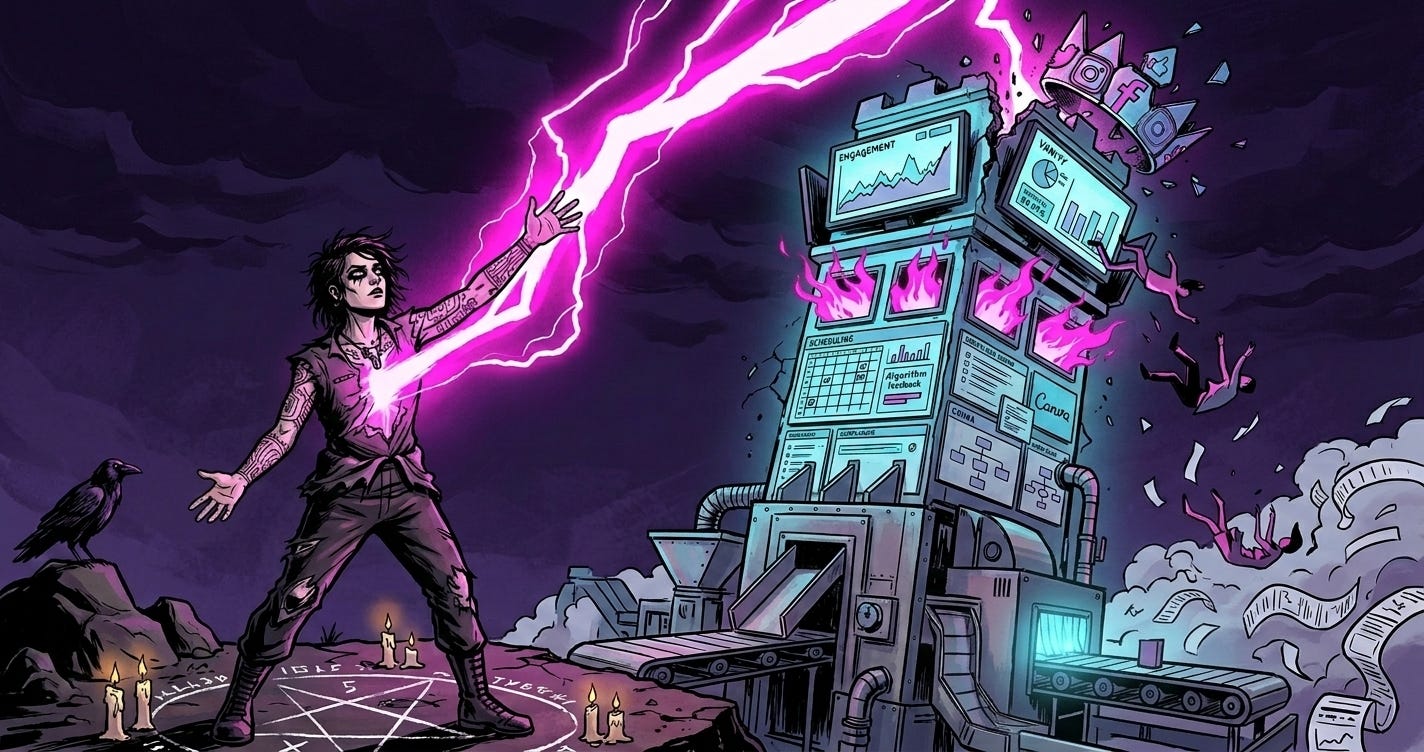
Then I need to figure out which platform. Then I need to format it for that platform’s algorithm. Then I need to open Canva and find a template that doesn’t make me want to set my laptop on fire. Then I need to rewrite the hook because Instagram wants something different than Substack wants something different than Threads. Then I need to schedule it. Then I need to remember to check if anyone responded. And by the time I’ve fought through all of that, the thing that was alive in me twenty minutes ago is a corpse on a content calendar.
This is not a discipline problem. This is a design problem.
The Burn Cycle
I’ve been running the same pattern for years. Sprint hard creating — sometimes for weeks, sometimes for a single manic weekend — then crash. Disappear for months. Feel shame about the gap. Find it harder to come back because now there’s a gap to explain. Eventually restart. Repeat.
If you know anything about natural cycles, you recognize this shape immediately. It’s a season pattern — creative summer into forced winter — except the winter isn’t rest. It’s shame. And a season spent in shame isn’t a season spent regenerating. It’s a season spent burning whatever reserves you had left.
Every productivity system I’ve tried addresses this by telling me to be more consistent. Build the habit. Show up every day. Batch your content. Create a content calendar and stick to it. None of them ask the obvious question: what if the pipeline between the idea and the published thing is what’s draining the energy, and removing it is the actual solution?
I know what you’re going to say: “Just push through it. Discipline equals freedom.”
I’ve pushed through it. Many times. Know what’s on the other side of pushing through it? Another pipeline. And then another one. And then a crash so thorough I don’t write for four months. The circuit breaker in this system doesn’t trip before the crash. It only trips after — which is another way of saying it doesn’t work at all.
The Spark That Doesn’t Need Permission
My best work has never come from a content calendar. It came from being pissed off.
The book I wrote — fifty-six pages, O’Reilly printed thousands of copies, companies used it as their playbook — I wrote it because I was tired of explaining the same thing over and over. The most viral tweet I ever posted came straight out of a meeting that made me furious. I typed it in thirty seconds and then the internet lost its mind for a week. The best podcast episodes were conversations where something gripped me and I followed it without knowing where it was going.
There’s a concept in Human Design called the Generator type. Generators don’t initiate well from nothing. They respond. Something in the world lights them up — agreement, outrage, curiosity, recognition — and the creative energy activates like a furnace kicking on. Trying to force creation without that spark is like trying to start a fire by staring at the wood and willing it to burn.
I’m a Generator. The spark is the whole game.
And the pipeline kills the spark. Every time. It takes a living thing — that furnace-kick of creative energy — and routes it through a series of operational decisions that have nothing to do with what I’m trying to say and everything to do with how the machine wants me to say it. By the time the machine is satisfied, the fire is out.
This is domestication. You take something wild and alive and you make it behave. You put it in the right format. You optimize it for the algorithm. You schedule it for peak engagement hours. And what comes out the other end is content — technically correct, appropriately formatted, algorithmically optimized, and completely fucking dead.
Doomscrolling Is a Broken Interface
Here’s the other side of the same problem.
I spend time on social media trying to find the sparks. Because they’re in there — a post that makes me think, an article that connects to something I’ve been chewing on, a person saying something I violently agree or disagree with. The sparks exist on these platforms. But they’re buried under an infinite scroll of content that exists to keep me scrolling, not to help me create.
Doomscrolling is a broken interface to valuable information. The signal I want is real. The delivery mechanism is hostile. What I actually need is the inverse: instead of me going to the feeds, the relevant stuff comes to me — filtered by what I’m working on, who I’m paying attention to, what I actually care about this week.
The current model is: wade into the river, hope you find a fish, drown a little, come out smelling like algorithm. The model I want is: the fish show up at my door, pre-sorted by whether they’re actually interesting.
What the System Has to Know
So what would it take to actually fix this?
Not a better content calendar. Not a social media scheduling tool. Not a course on batching your content creation process. I’ve tried all of those. They’re pipeline optimization, and the pipeline is the problem.
The system I need has to know things about me that no tool I’ve ever used has known. It has to know what I’m working on — not my task list, but the actual threads of thought I’m holding across six different domains. It has to know what lights me up and what drains me. It has to know that on some days I can synthesize across everything I’m thinking about and produce something that didn’t exist before breakfast, and on other days all I’ve got is potato time — and that both of those are valid operating states, not a performance problem to be corrected.
It has to know my voice. Not “casual and friendly” — my actual voice. The one that says “fuck” when something deserves it. The one that holds complexity without collapsing it into a tidy answer. The one that takes you the long way around because the scenic route is where the real insight lives.
And when the spark hits — when something grips me and I sit down to write — the system has to eat everything between the writing and the world. Format it. Design it. Optimize it for the platform. Post it. Track what worked. Learn. All of it invisible. All of it instant. So that the next time the furnace kicks on, the only thing between me and the published thing is the writing itself.
I still show up. I still think. I still write. I still make the judgment calls about what’s true and what’s mine and what’s ready. But the operational overhead — the pipeline that has been smothering the fire for years — becomes the system’s problem.
The Feral Version
There’s a word for what happens when you build a system that supports a living thing without domesticating it. I’ve been calling it feral architecture — structures that hold without caging, that support without flattening, that make the wild thing more possible instead of less.
The pipeline as it exists is the opposite of feral. It’s a feedlot. It takes creative energy and processes it into uniform units of content. Same shape. Same schedule. Same optimization targets. And just like a feedlot, it produces something that technically qualifies but has lost the thing that made it worth consuming.
The system I’m building is feral infrastructure for a creative life. It catches the spark. It holds the threads. It eats the scaffolding. It knows the difference between a day when I can run and a day when I need to lie in the grass and stare at the sky. It respects both, because both are part of the cycle — and the cycle is the point.
The pipeline is the problem. So I’m replacing the pipeline with something that has teeth.
Such is chaos of the moment. Stay feral, folks.
Omg this relates so much.