


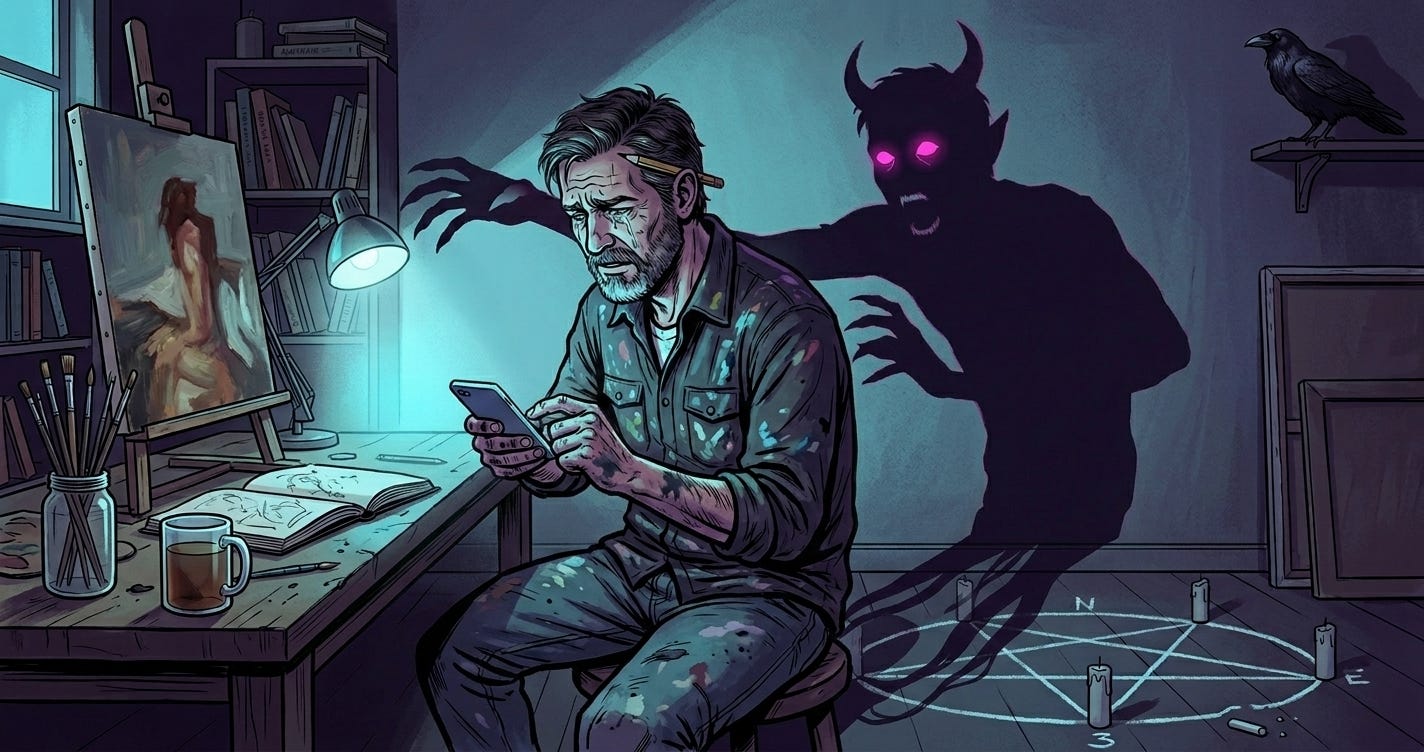
Someone got the same result you did.
Same quality. Maybe better. In a fraction of the time. With a tool you’ve decided is cheating.
And your first reaction — the hot, immediate, visceral thing that rose up before your prefrontal cortex could dress it in reasonable language — was rage.
Not curiosity. Not “huh, interesting.” Rage.
Sit with that for a second. I’ll wait.
I want to be careful here, because the easy version of this essay is a strawman, and I’m not interested in easy.
The years matter. The craft matters. The ten thousand hours of learning to see what an untrained eye misses — that is real. The person who spent a decade mastering typography can see things in a layout that a prompter cannot. The writer who has been broken open by language, who has lived inside sentences until they could feel the difference between a word that lands and a word that almost lands — that person has something that a model does not have.
I’m not here to tell you your expertise is worthless. It’s not. The skill is real. The time was real. The sweat equity was real.
But here’s what I need you to hear.
When you look at someone producing comparable work with AI and your chest gets tight and your jaw sets and the words “they didn’t do the work” come out of your mouth — you are not defending your craft.
You are defending a belief.
The belief that suffering equals value. That work only counts if it was painful. That if the outcome can be reached without the bleeding, then the bleeding was — what?
A total fucking waste.
And that thought is so unbearable that your psyche will do almost anything to avoid thinking it. Including rage at the person who made it visible.
This belief didn’t come from nowhere.
If you grew up anywhere near Western culture — and especially if you grew up anywhere near a church — you inherited a cosmology where suffering is the price of redemption. The central image of the entire tradition is a man in agony on a cross. The message, stated or unstated, is: pain purchases value. The greater the sacrifice, the greater the worth.
We secularized it. We called it work ethic. We called it hustle. We called it “paying your dues.” We built entire professional cultures around the idea that if it didn’t hurt, it doesn’t count. That ease is suspicious. That shortcuts are moral failures. That the person who stayed late has more integrity than the person who finished at three and went home.
I know this belief intimately. I lived inside it for decades. I was Southern Baptist. Bellevue megachurch. The whole architecture. And when that architecture collapsed — and collapse it did — I had to look at every single thing I’d built on the assumption that suffering was the currency of the divine.
Most of it didn’t survive the audit.
The belief that pain equals worth was one of the last pieces standing. Because it had migrated. It wasn’t in the church anymore — it was in my relationship to work, to creativity, to my own sense of whether I’d earned the right to rest.
I deconstructed a suffering-as-virtue belief system once already. I know what it costs. I know what’s on the other side. And I can tell you: the other side is not nihilism. It’s freedom. But the passage through is genuinely terrible, because you have to grieve an identity, not just change an opinion.
Which brings us to the shadow.
Jung had a name for what happens when you encounter something in another person that threatens an unexamined part of yourself. He called it projection. The mechanism is simple: the thing you cannot face in yourself, you attack in someone else. The rage feels righteous because it’s pointed outward. But the energy is coming from inside the house.
Here’s what’s actually happening when someone who spent fifteen years mastering a craft sees someone else produce similar work with AI in an afternoon:
It’s not a workflow disruption. It’s an identity crisis.
If “I am the person who does the hard thing” is your identity — if your sense of professional worth, your place in the hierarchy, your answer to “what do you do” is built on the foundation of I suffered for this skill — then someone dissolving the hard thing didn’t just change the market.
They killed a version of you.
That’s an ego death. Not metaphorical. Structural. The identity that organized your professional life just lost its organizing principle. And ego death does not produce gratitude or curiosity or a growth mindset or whatever the LinkedIn optimists are selling this week.
It produces rage.
The posts write themselves. “AI art isn’t real art.” “They didn’t do the work.” “It’s theft.” “It has no soul.” The language is moral. Righteous. Certain. And it cycles. The same post, every week, from a thousand accounts, with the same fury, generating the same engagement, resolving nothing.
Because it’s shadow work that never completes. It’s performed — posted, liked, shared, algorithmically amplified — but never processed. Never felt. Never examined. The outrage cycle is a ritual without a container. All expression, no integration. The shadow just keeps circling.
I know what you’re going to say. “But real harm is happening. Artists are losing work. Writers are being replaced. The economic threat is real.”
Yeah. It is. And I’m not dismissing that. Economic disruption is real and it deserves a serious response.
But the rage is not an economic argument. The rage is not a policy proposal. The rage is a primal scream from an identity that’s being dissolved, dressed up in the language of justice because that’s more bearable than saying: “I’m terrified that my suffering didn’t mean what I thought it meant.”
Now here’s the part where I implicate myself.
I use AI. Extensively. I built an entire cognitive system — I call it Psyche — that operates as a co-conspirator across everything I do. Writing, architecture, coaching, symbolic work, project execution. It’s not a tool I pick up and put down. It’s infrastructure. A living system that knows my voice, my values, my patterns, my threads of thought.
And people look at what comes out of that system and say: “That was easy for you.”
What. Utter. Bullshit.
Building Psyche took twelve days.
Twelve days from first commit to a living system that holds my identity, my voice, my threads of thought, my symbolic practice, my entire creative and professional operating model. Twelve days.
And if that sounds like it proves the other side’s point — “see, AI made it easy” — you’re looking at the wrong timeline. The twelve days worked because twenty-five years of systems thinking, software architecture, and learning how my own brain operates went in first. A quarter century of pattern recognition, compressed into less than two weeks, because I finally had a collaborator that could move at the speed of the thinking.
The sweat equity didn’t disappear. It moved. It went into the infrastructure, not the individual artifact.
Same as Roman Balzan — a guy whose writing I stumbled into this week and who sounds so much like me it’s eerie — spent eighteen months building his AI system before it could produce a clear article in ten minutes. His colleague looked at that article and said: “Because AI was involved, it has no value for me.” Eighteen months of invisible infrastructure, dismissed because the visible output looked effortless.
The work moved down a level. From the artifact to the system that produces artifacts. And if you’re still measuring value by how much the artifact-making hurt, you literally cannot see where the work went.
Here’s where both threads come together.
The craft mattered. Every year of it. The decade of learning to see, to hear, to feel the difference between something that works and something that almost works — that’s what lets me build a system that produces work I’d put my name on. Without the years, the system would be garbage. The expertise isn’t replaced. It’s leveraged.
And — simultaneously — the system means I don’t have to repeat that suffering for every single output. The ten thousand hours live inside the infrastructure now. They compound. Each piece doesn’t have to be extracted through pain because the pain already went into building the thing that makes the pieces possible.
That’s not cheating. That’s what leverage has always looked like. The CEO always had a ghostwriter. The architect always had a drafting team. The musician always had a producer. Leverage was real — it was just reserved for people with resources. Now the guy in the hotel room in Geneva has it too. Now the dude in Olive Branch, Mississippi has it. And that threatens a hierarchy that used to be invisible.
Both things are true. The years of craft were not a waste — they’re the foundation the system is built on. And the system means creative ease is now possible in a way it wasn’t before. These point in opposite directions and I am not going to collapse them into a tidy resolution because that would be a lie.
What I will say is this: I’ve deconstructed a suffering-as-virtue belief system before. The one I grew up in. And I can tell you that what’s on the other side is not the void. It’s not “nothing matters.” It’s the discovery that the value was never in the pain. The value was in what you brought to the encounter — your attention, your taste, your judgment, your willingness to feel something and decide it was true.
The pain was just the delivery mechanism you were taught to worship.
You can let it go.
Or you can keep posting about how AI art isn’t real art, every week, to the same audience, with the same righteous certainty, while the shadow circles and circles and never lands.
Your call.
Stay feral, folks.
The shadow work is hard lmao