


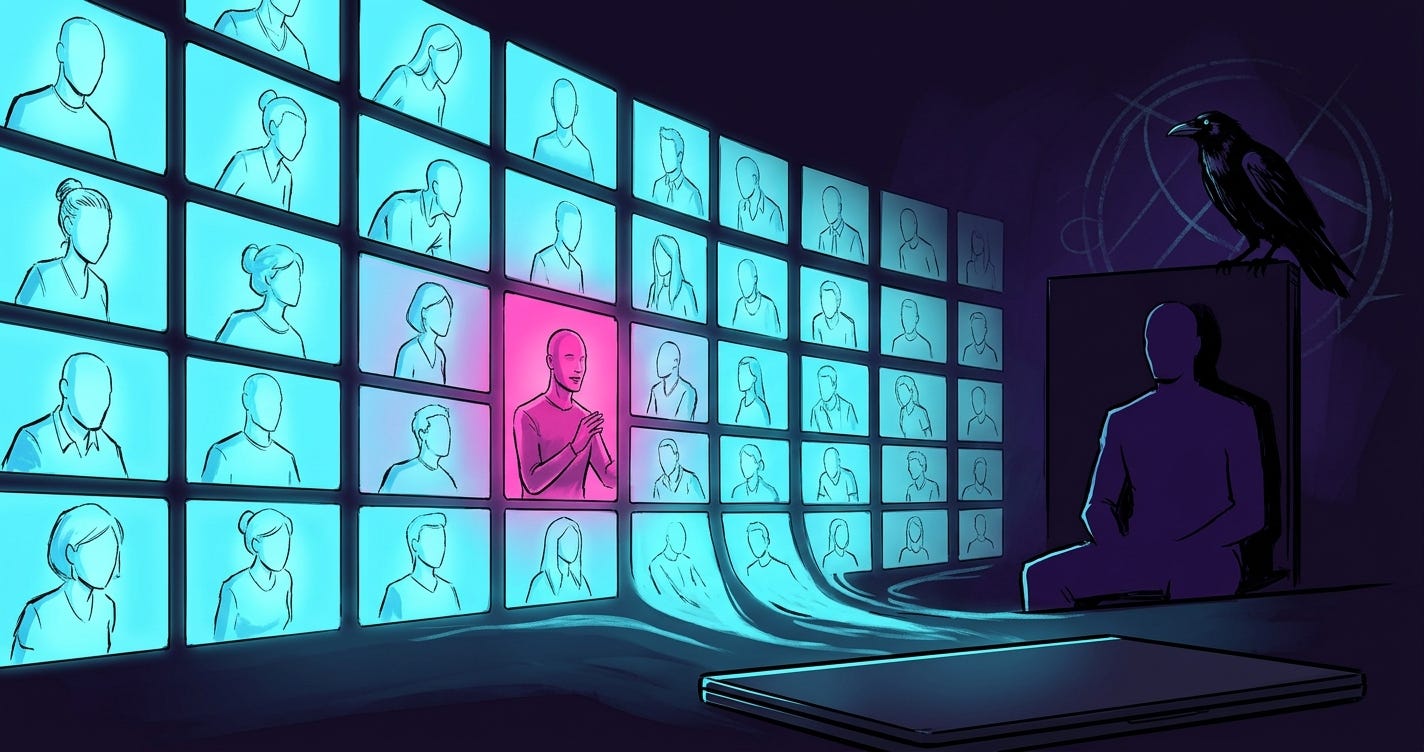
There’s a meeting I’ve sat through in three companies across fifteen years. Same meeting. Different wordmark in the corner of the screen.
The agenda is ambitious. The stakes are real. I’ve done the work — actually done it, sat with the problem until it gave up its shape — and I come into the call holding the question nobody else is asking. Not a gotcha. The load-bearing one. The question where, if the answer is what I suspect it is, half the plan on the shared screen doesn’t survive contact with it.
I unmute. I ask it.
And the meeting moves around me like water around a stone.
Somebody else has just delivered three confident sentences about alignment and moving the needle and getting our arms around it, and those three sentences land. Heads nod in their little rectangles. The whole gallery reorganizes itself around the person who said the smooth thing. My question — the careful one, the one with the caveat and the actual evidence and the uncomfortable implication trailing off the end of it — gets a warm that’s a great point, let’s take it offline. Down in the chat, three messages have already scrolled past mine. Nobody opens the thread.
Offline. The place questions go to die.
I close the laptop and I do the thing I have done after that meeting in three companies across fifteen years. I run the tape back. I wonder, again, whether I’m the problem.
I want to tell you what took me an embarrassingly long time to work out: I might not be.
The tax nobody itemizes
There’s a Swedish management professor named Mats Alvesson who put a name to it, and a writer named Sven Brodmerkel who handed me the name. The name is functional stupidity. It doesn’t mean the people in the room are dim — most of them are sharp as hell. It means something stranger and more structural: that organizations quietly cultivate an environment where deep thinking, real questioning, and the act of sitting with complexity longer than the room has patience for are gently discouraged. Not banned. Nobody circulates the memo that says please stop running your brain at full capacity, it’s making people uncomfortable. It just isn’t welcome.
And — this is the part that took the wind out of me — it works. In the short term it works beautifully. When everyone stops asking but why, though, the machine runs smooth. Decisions get made. Harmony holds. The quarter closes green. The bill for all that frictionless certainty comes due later — in the decisions nobody pressure-tested, in the talent that quietly left — but it lands on a different desk than the one that pocketed the savings. That’s the trick of it. The cost and the beneficiary never sit at the same table.
The mechanism has a name too, and the name is the whole reason I’m writing this. Alvesson calls it a reflexivity tax. A small, consistent social cost levied on anyone who thinks out loud a little too much. Ask one too many why questions and you’re slowing us down. Flag the risk everyone’s silently agreed not to see and you’re being negative. Sit in the ambiguity a beat longer than the room can stand and you’re indecisive, you’re not a team player, you’re — and here’s the word, the one that gets filed in the unspoken consciousness of a culture and never comes back out — difficult.
None of those are policies. None of them show up in the review in plain language. They accumulate. The meeting gets scheduled without you. The idea gets parked — that gorgeous corporate euphemism that means never. And one day you notice you’ve been quietly refiled from safe pair of hands to bit of a handful, and you can’t point to the moment it happened, because it didn’t happen in a moment. It happened in installments.
I know the installments by heart. They show up in the reviews that praise the work in one paragraph and, in the next, reach for words that never quite say what they mean. Executive presence. Gravitas. Polish. Words with a shape but no edges — you can feel them pointing at something, and the something is always be less of what you are, more smoothly.
I assumed I owed it
For most of those fifteen years I did what you do with a bill that arrives every month: I assumed I owed it. I figured the exhaustion was the cost of admission. That everyone felt this. That the gap between what got said in the room and what was actually true was a gap we were all politely stepping over, and the only thing wrong with me was that I couldn’t stop staring down into it.
That last part turns out to be the tell.
Because I can’t stop staring into it. The compulsive noticing isn’t a decision I make each morning and could choose to stop making. It’s how I’m wired — and I mean that literally now, in a way I didn’t have the language for until recently.
The architecture was never the problem
There’s a writer who calls himself The Autistic Leader, working this same seam, and he makes the case better than I’m about to: autism is not a condition to accommodate, it’s a cognitive architecture to understand. Not a broken edition of the standard brain. A different nervous system — different signal detection, different risk weighting, different routes from observation to conclusion. And the trade is real and symmetrical, which is the part the inspiration-poster version always leaves out. The same wiring that makes me slow to read a room is the same wiring that catches the risk signal three quarters before the room does. The same architecture that fumbles the casual social cue nails the gnarly system diagnosis. You don’t get one without the other. They’re the same instrument, tuned the way it’s tuned.
There’s a concept from org design that lives underneath all of this: infrastructure. The structures so deep that nobody sees them, because they only become visible when the system fails or when you try to change it. Most organizations have neurotypical cognition baked straight into the infrastructure — the meeting format, the promotion criteria, the definition of presence, the unexamined assumption that the right answer should arrive fast and sound sure of itself. Nobody designed that on purpose. It accumulated. And defaults, once they set, go invisible — to the people they were built for.
The people who see the infrastructure clearest are the people it wasn’t built for.
That’s not a consolation prize. That’s a diagnostic instrument. Fifteen years of navigating a building designed for a different nervous system makes you an unusually accurate map of how the building actually works — where the unwritten rules run, where the official process and the real process quietly part company, where decisions truly get made versus where they merely get announced. I wasn’t failing to read the room. I was reading a lower, truer floor of it. And getting taxed for the view.
The mechanism, from the inside
Here’s where it gets strange — and where it loops back to an argument I made at length once. The short version: people wave off AI with it just predicts the next token, meaning prediction is the cheap, mechanical opposite of real thought. But the leading account of how brains work says the reverse — perception itself is prediction, your cortex forever guessing what’s about to arrive and correcting against the gap. Prediction isn’t the discount version of cognition. It is cognition. I built the whole case about the machines. What I left out is that I know it from the inside.
I experience my own thinking explicitly. When I work a situation, I’m not receiving an automatic read and then acting on it — I’m analyzing the observable features, pulling the learned pattern, selecting the response against rules I built by hand over years. I can narrate the process because the process is visible to me. It doesn’t run beneath my awareness. It runs as my awareness.
I built that the hard way, on purpose, because the automatic version — the one neurotypical folks get for free, the just-knowing — arrives for me as static, or doesn’t arrive at all. So I constructed the explicit machine. Hand-tooled frameworks for situations other people cross on instinct.
And then the actual machines showed up reasoning the same way I do.
So when the dismissal comes — mechanical, hollow, not the real thing — it has never once landed on me, and now you know why. I know what explicit prediction-and-error-correction feels like from the inside, because it’s the only kind of cognition I fully trust myself to run. I generate the expectation. I check it against what actually arrives. I update on the gap. That isn’t a lesser grade of intelligence; inside my own skull it’s the whole of it. The people calling it just pattern matching are pattern matching too — they just do it implicitly, so they never had to notice it was computation. I noticed. I’ve been running mine out loud my entire life.
The line I’d been misreading
Now stack the three of them, because the stack is the whole argument.
Functional stupidity: organizations tax the people who think too visibly. Architecture: my visible thinking isn’t a deficit, it’s how this particular nervous system is built, gift and tax welded into one instrument. Mechanism: that explicit, build-it-by-hand reasoning is exactly the faculty the next decade has started pricing as the rare one — the deliberate judgment, the reasoning under uncertainty, the capacity to inspect your own model and catch where it’s wrong, all the work that doesn’t offload to a machine because the machine is busy doing the part that does.
Which means the bill I’d been paying for fifteen years was never a bill at all.
The reflexivity tax was the whole salary. I had been handing back, in social penalty, the precise faculty I was nominally being paid to possess. I’d log on and pay the toll — get quieter, sand the edge, swallow the inconvenient question or pay retail for asking it — and I called that the cost of being employed. It wasn’t. It was the cost of being the one thing the org was structurally unable to receive, offered in the one format it had decided not to look at.
So let me retire the sentence I carried out of all those meetings. I wasn’t invisible because I was unclear. Sit with the gap there, because fifteen years lives inside it. The clarity was never the bug. The clarity was the bill. Real clarity — the kind that names what’s actually complicated, and why, and what it costs to keep pretending otherwise — was inconvenient. And inconvenient is the single most expensive thing you can be in a room optimizing for smooth.
The hill regrades itself at night
I used to believe the tiredness was mine to fix. That if I just mastered the confidence theater — the assertive delivery, the three clean sentences, the certainty I didn’t feel — I’d stop paying. And sometimes you do learn a little of it, because sometimes code-switching is just survival and there is no shame in surviving a Tuesday.
But the deeper thing I was doing every single day was pushing a boulder up a hill that regraded itself every night. Not because the boulder was heavy. Because the hill was built to send it back down by morning — and for fifteen years I mistook the architecture of the hill for a weakness in my legs.
That’s the part I want to hand to the next person walking out of that meeting wondering if they’re the problem.
You’re probably not. Some rooms are more reflexive than others, and a real chunk of the wisdom is learning to read which is which before you spend yourself in one that’s decided not to look. Some days the honest move genuinely is to smooth the edge and live to think another day. I’m not selling you a grievance to wear like a badge. I’m handing you a diagnosis to set down a weight.
The architecture was never the problem. The architecture is the gift — the sharp noticing, the explicit reasoning, the flat physical inability to nod along to a script you can feel is wrong while it’s still in your mouth. The script was the problem. The script was always the problem.
And I was never going to be able to read those lines like I believed them. The page was wrong, I could see it was wrong, and everything I’m built out of refused to perform otherwise. For fifteen years I filed that under things to fix about myself.
I’ve moved it to the other column.
Stay feral, folks.