


A few weeks back I sat on my couch and watched one of my favorite thinkers announce, with the particular dignity of a man trying not to make a scene, that he was lost at sea.
Erik Davis has been writing about media, music, drugs, spirituality, and technoculture for forty years. TechGnosis is a load-bearing wall in this house I’ve built — if Feral Architecture has a patron saint, he’s it. And in a recent edition of his newsletter, Burning Shore, tucked between an essay on existential risk and the event listings, he said this: “The AI invasion of culture and particularly writing has left me confused and rudderless... I know I have things to say, and readers to read them, but there is a disturbance in the force that I cannot avoid, a rupture in the pact between writer and reader, and between writer and text.” He said, of the craft he’s practiced for four decades: “I don’t know what it means to do this anymore.” He confessed he’d considered suspending the newsletter entirely, and settled instead for letting “the form of the thing unravel.”
And the cut that actually drew blood — the sentence I’ve been carrying around since I read it — came earlier, when he set up a riff on the existentialists who shaped him, Nietzsche and Kierkegaard and the hep-cat Beats, and then dropped it mid-wind-up: “But hey, you can punch all that in to an LLM field and probably come up with a reasonable facsimile of something you probably don’t have time for anyway. I just didn’t have the heart to crank it out the old-fashioned way.”
The theorist of techno-mysticism, disheartened out of writing by the machines. If you want a portrait of this exact cultural minute, that’s it. Frame it.
The accusation I’m not going to duck
Now here’s where I have to stop being a sympathetic reader and start being honest, because the naive read of my own operation says: I’m the problem he’s describing.
I write this newsletter with a machine. Not as a dirty secret — I’ve written about the system on this very masthead, cast its chart, told you how it surfaced the beam running under two years of my own notes. There is an AI in this house, and it is in the room where the writing happens. Pangram eat your heart out. By the categorical version of the critique — AI touched it, therefore slop — Feral Architecture is exactly the invasive species choking the ecosystem Davis is drowning in. Same phylum as the listicle farms. Same order as the engagement-hacked facsimiles.
I could dodge this three ways, and you’ve seen all three dodges performed elsewhere: the definitional shuffle (”it’s just a tool, like spellcheck!”), the disclosure theater (”I disclose, therefore absolved”), the tu-quoque (”everything is technology, your pen is technology, checkmate”). I’m not doing any of them. The critique deserves better, because the thing Davis is grieving is real. Substack genuinely is filling with text nobody wrote — he calls it a platform “now choked with the sort of LLM texts and attention-hacking stratagems that are already subsuming the Internet,” and he’s right, and I’ve waded through enough of it to know the smell. The pact he says is ruptured — the reader’s background faith that a human being meant this, that attention given will be met by attention paid — really is ruptured. When you open an essay in 2026, you are doing something you never had to do before: wondering if anyone is in there.
So no dodge. Straight through the middle.
What the slop actually is
Look closely at a piece of genuine slop — actually look, the way you’d examine a counterfeit bill — and ask what’s missing. It’s not grammar. The grammar is immaculate. It’s not structure; the structure is textbook, intro-body-conclusion, hooks in all the regulation places. It’s not even information, exactly — the facts are usually roughly there.
What’s missing is a stake. Nobody in that text needs anything. Nobody risked anything to say it. No particular person’s particular history is pressing against any particular sentence, which is why every sentence could be swapped for its neighbor from any of ten thousand sibling essays and no one would notice, least of all the “author.” Slop isn’t machine-made text. Slop is unclaimed text — writing with no one home in it, produced by pointing an engine at a topic and walking away. The prompt was “write me a newsletter about X.” The soul had left the building before the first token landed.
And here’s the thing the categorical critique misses: you don’t need an LLM for that. The content mills were producing hand-typed slop for decades — SEO farms, ghost-blogged thought leadership, the airport-book industry. I personally produced artisanal, free-range, human-generated slop for years, back in my careful era, running every sentence with teeth through three filters until what emerged was appropriate and dead. The machine didn’t invent absence. It just industrialized it.
Whose soul is driving
Davis’s own essay — and this is the part I find almost unbearably poignant — contains the exact key he seems too tired to turn. In the same edition, riffing on transhumanism, he reaches for Pico della Mirandola’s Adam, whose essence is not fixed: we may “trace for yourself the lineaments of your own nature.” He writes: “If there is a human essence, the essence is fundamentally open and subject to creative intention.” He invokes Sloterdijk’s anthropotechnics — the millennia of practices by which humans have made and remade themselves — and then names his real fear, the one under the AI grief: that it is “actual technologies (and the corporations that ruthlessly implement them) that have come to dominate the productive potentials of the open.”
Read that fear precisely. It is not the machine exists. It is someone else’s machine is doing your self-making — the feed shaping your attention, the recommendation engine shaping your taste, the corporate loop running your open-ended essence toward its quarterly targets. Capture. That’s the nightmare, and it’s the right nightmare.
But capture has an opposite, and the opposite isn’t abstinence. It’s sovereignty.
The system I write with is not a content engine pointed at a topic. It is an apparatus I’ve spent nearly a year building out of my own substance — my voice, documented by hand across months of samples and anti-patterns; my values, written out at essay length; my archetypes, my cognitive profile, two years of captured notes, dreams, readings, and half-thoughts. It knows the difference between how I sound and how a newsletter sounds. And every draft passes through my hands, gets rewritten in my nervous system, ships only when it rings true against a tuning fork no machine holds — because the machine holds the corpus, and I hold the fire. That’s not the feed doing me. That’s me, doing me, with better scaffolding — anthropotechnics in the oldest sense Davis means, the workshop where a self gets made, except I own the workshop and every tool in it answers to the work instead of to a landlord.
The slop is what happens when the driver’s seat is empty. This is what happens when there’s more of you at the wheel than your bare hands could ever hold at once.
And I have receipts, because the proposition got tested in the open. This publication grew the only way I’d let it grow: no ads, no growth hacks, no algorithm courtship — a piece at a time, forwarded hand to hand, picking up the exact readers you’d predict a Mórrígan-and-grep house would pick up. People who write back. People who argue, who push, who bring their own libraries and their own ghosts to the reading. That is not slop behavior, and more to the point, that is not a slop audience — you cannot attention-hack your way to readers who bring their own fire. If the machine were flattening the soul out of this work, those readers would have smelled it before I did and left without a note. They’re the canary I trust more than my own self-assessment. The canary keeps singing.
The part that stays uncomfortable
I’d love to end there. Clean turn, flags planted. But this house doesn’t do tidy, so here’s the splinter I can’t remove: from the outside, you can’t tell.
The reader holding a sovereign text and the reader holding slop are in the same epistemic position on page one. Davis’s rupture doesn’t heal just because my particular practice is honest — his skepticism, and yours, is rational in an ocean where most of what floats is facsimile. I can’t argue you out of that. Nobody can. The pact doesn’t get repaired by disclosure statements or purity badges. It gets repaired — if it gets repaired — the slow way: by a body of work, accumulating across months and years, that only one particular soul could have produced. Voice as fingerprint. Consistency as receipt. The reader learns whether somebody’s home the same way you learn it about a neighbor: not from the sign on the door, but from living next to them through enough seasons.
Which means writers like me carry a debt writers like Davis never owed. He earned his trust in a world where the pact held by default. I have to earn mine in a world where it doesn’t — where every paragraph is auditioning against the null hypothesis that nobody meant it. Honestly? Fair. That’s the tax for the tools, and I’ll pay it in public for as long as this house stands.
A hand for the elder at sea
So this ends as homage, because that’s what it’s been the whole time.
Erik Davis mapped this territory before there was a territory — wrote the book on the electric spirit in the wires back when the wires were copper and the mystics were on Usenet. That a quarter century later the machines finally arrived in force and knocked the wind out of him, of all people, isn’t an irony to smirk at. It’s a grief to witness. The cartographer is allowed to get lost in the country he mapped. It doesn’t invalidate the maps. I built my whole practice on those maps.
And if I could send one thing back up the lineage, it would be his own sentence, returned with the heat still in it: the essence is fundamentally open and subject to creative intention. That was true when Pico said it, true when Davis quoted it, and it’s true of writing itself — the essence of the craft is open, and what fills it is decided by whoever shows up with intention. The slop-merchants have shown up with theirs. The only counter-move that has ever worked is sovereigns showing up with more.
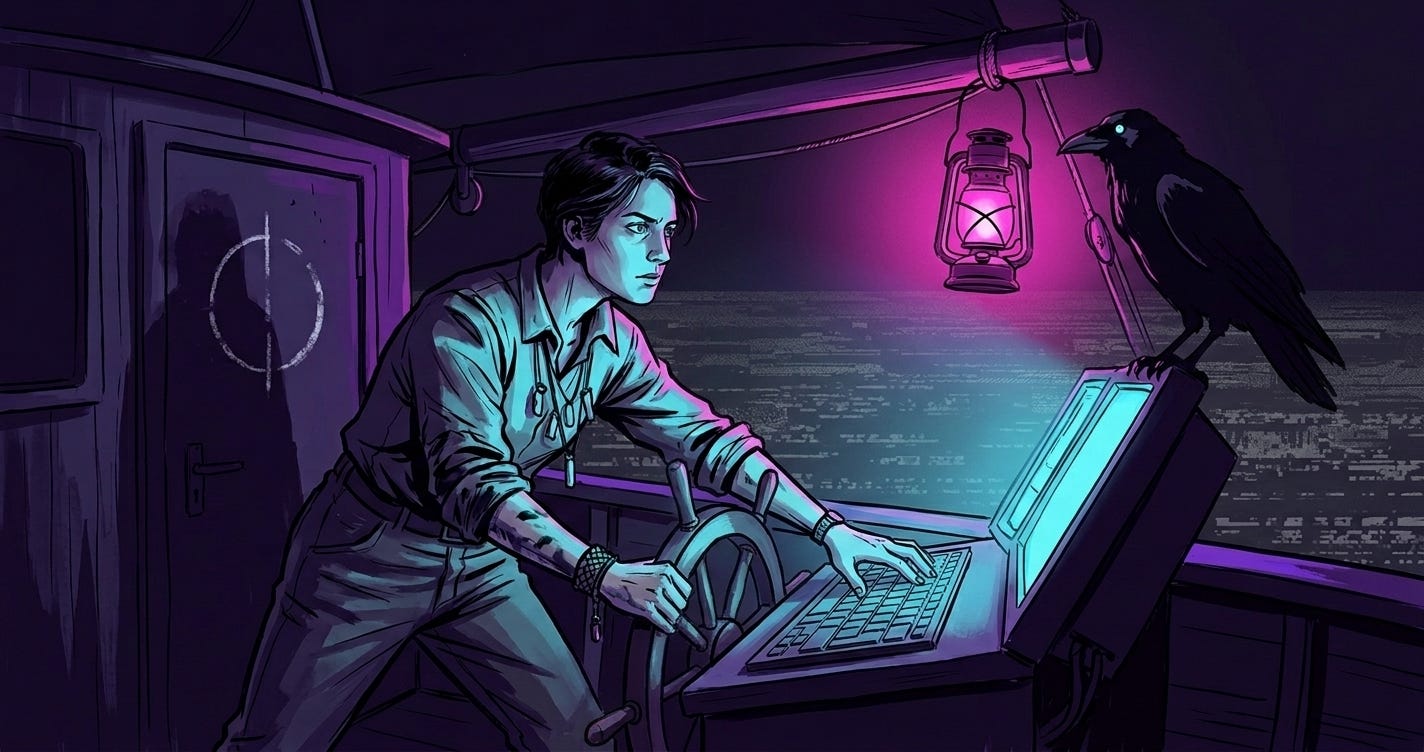
The crow’s been on the bookshelf this whole essay, next to a copy of TechGnosis with the spine cracked from rereading. She doesn’t look at the machine. She looks at me — because she knows exactly where the soul in this operation is required to live, and she checks.
Stay feral, folks.
"When you open an essay in 2026, you are doing something you never had to do before: wondering if anyone is in there." -- I actually do not do this. I read the words. if they bang, that's all I care about. and I find it odd that someone who was in the 'technoculture' space is scared.. was he ever really in it? I don't know this guy from anyone but this screams tourist to me.
Very good