


Howdy, folks.
This morning, before I’d done anything a reasonable person would call waking up, I watched a very good argument go by on my phone.
The shape of it goes like this. Using AI to think, to reflect, to read your own life — that’s not intuition. The machine is programmed. It can’t push you toward the thing you need instead of the thing you want. It can’t connect you to your body, to the room, to the energy moving in front of you and around you. You’re just sitting there, again, gazing into a soulless screen, the same soulless screen we already stare at far too much. And then the line that’s been making the rounds, the one that got the nods: something without a spirit can’t tell you anything about your spirit.
The replies stacked up underneath like cordwood. Everybody agreeing. Everybody relieved. Finally, someone said it.
And here’s the thing I want to be honest about before I take a single swing: they’re not wrong about the failure mode.
They’re describing something real. There is a version of this — the dominant version, probably — where a person opens an app, types give me wisdom, and receives back a warm beige nothing. Affirmations with the grain sanded off. Horoscopes for no one. A tarot “reading” generated by a thing that has never held a deck, never sat in the dark, never lost anything. That product exists. It is everywhere. It is exactly as hollow as they say. If your whole experience of AI-and-the-sacred is that, then your contempt isn’t a bias. It’s pattern recognition. You met the empty thing and you correctly clocked that it was empty.
So I’m not here to tell you the machine has a soul. It doesn’t. I’ve looked. There’s nobody home.
I’m here to tell you that the argument smuggles in an assumption so quietly that nobody in that thread noticed they’d swallowed it. The assumption is this: that the spirit has to live in the machine. That for the screen to mean anything, the meaning has to come from the screen. That you are asking the tool to be the oracle.
I never asked it to be the oracle. Let me tell you what actually happened this morning, after I put the phone down.
I sat in the dark first.
Not metaphor. I have a morning practice, and part of it is a darkness meditation — eyes closed, breathing, going down into the black space behind the eyes until it stops being absence and starts being a place. No screen. Just a body in a room, which is the exact thing I’m allegedly too screen-poisoned to have anymore. I did that. Then I prayed. Then I sat with that argument from the feed, because it had its hooks in me and wouldn’t let go.
Then I pulled three cards.
Body, Mind, Spirit. Three positions, three cards, and every single one of them came up reversed, which is its own kind of weather. Two of Swords. Knight of Pentacles. Queen of Cups. I sat with them. I wrote down what I saw. And then I did the thing the thread says has no spirit in it: I asked my machine to help me read them.
What it did was not invent meaning. What it did was reach into my own library and hand it back to me at the exact moment it became relevant.
Because I have a library. I’ve spent years and real money building it. When the machine helped me read the suits as the four functions of consciousness — Swords as thinking, Pentacles as sensation, Cups as feeling — that’s not ChatGPT’s pop-occult cliché. That’s Mariana Louis, whose Archetypal Tarot School I studied, teaching the Two of Swords as Jung’s tension of the opposites — the thinking mind deadlocked between two equally true things, and the discipline being not to escape the deadlock but to hold it until a third sword arrives. When it helped me read the reversed Queen of Cups as the feeling function turned inward, that’s Alyssa Polizzi writing about the education of the feeling function, the descent from the feeling that shapes itself to the room into the feeling that finally answers to your own values. None of that is generic. All of it is mine — paid for, sat with, argued with, lived.
Even the card in the middle — the one between Body and Spirit, the Knight of Pentacles reversed, the slow methodical maker stalled out — read as something I already half-knew and didn’t want to look at: the part of me that mistakes grinding away at what I can make for actually being alive. That’s not a fortune. That’s a mirror catching me mid-flinch. The machine didn’t tell me that. It just held the glass steady while my own years of study named what I was already looking at.
The machine has no spirit. The spirit in the loop was mine. The screen didn’t tell me about my spirit. It reflected my spirit’s own materials back to me, in my own teachers’ voices, faster than I could have pulled the books off the shelf. The tool is a mirror with an extraordinary memory and no agenda of its own. That’s all it is. That’s the whole trick.
And here’s what makes me laugh, looking back at that thread: the cards I pulled were about the argument I’d been chewing on all morning. Not because the deck is psychic. Because the deck reads the room, and my room was full of one question. The Two of Swords is a person standing blindfolded with a sword in each hand, refusing to choose between two truths. Soul or screen. Sacred or programmed. Pick one. That’s the whole posture of the thread. That’s the blindfold. The pile-on was a Two of Swords with four hundred likes.
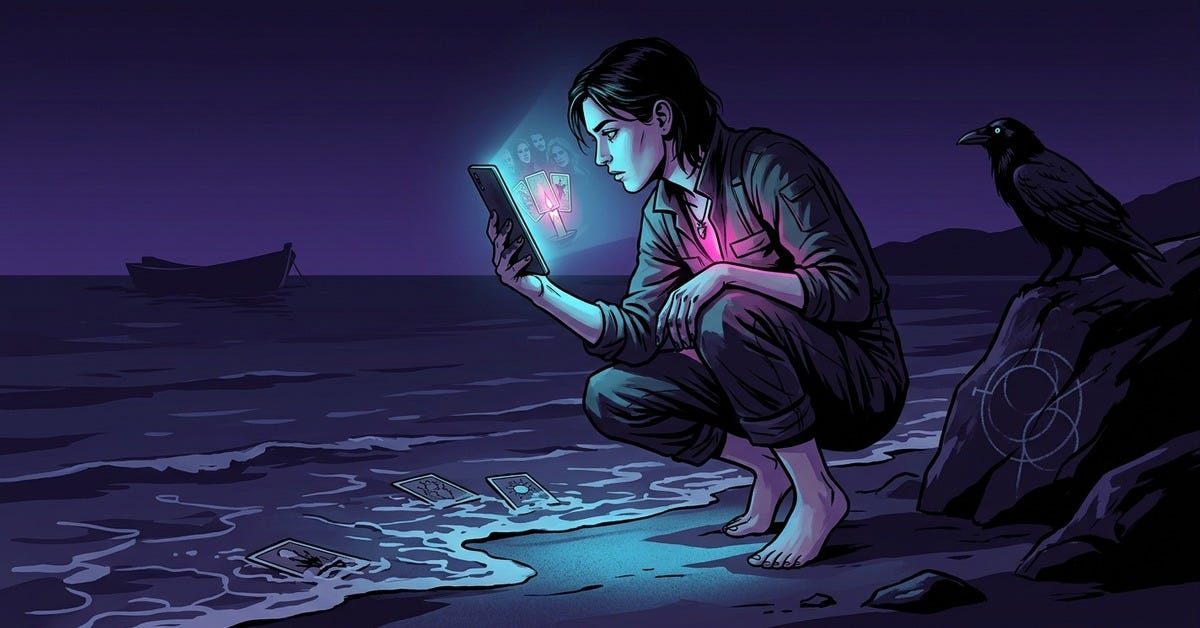
And the card that answered it was the Queen of Cups — who sits at the water’s edge with one foot on the land and one foot in the sea, and to her the choice the swordsman is agonizing over is a false one. She doesn’t pick land or water. She wants it all. She’s built for it.
That water’s edge is not a decoration. It’s the most important place in the whole reading, and I only know that because of another teacher.
Every guided journey into the Irish Otherworld that I’ve ever taken — through Lora O’Brien, whose Mórrígan Intensive I’m walking through right now — begins in the same place. You go down through the dark, through a doorway, down a path, and you come out at the shoreline. The boundary between earth and sea and sky. Lora calls it, in the journey itself, the between place. The liminal space, the place between places.
And here’s what the tradition knows that the thread does not: the shoreline is not where you get stuck. The shoreline is where the boat comes. It’s the dock. You stand at the edge, in the between, and the vessel that carries you across to the Otherworld is waiting right there because you’re willing to stand in the place that’s neither one thing nor the other. The liminal isn’t the deadlock. The liminal is the departure gate.
The thread was standing on the beach screaming LAND OR SEA, CHOOSE. And every practice I’ve ever been initiated into says: neither, you beautiful fool. Get in the boat.
(To be clean about it, because the lineage matters: the sovereign power you cross that water to meet is the Mórrígan, and She is not the Queen of Cups. Irish soil, not a tarot card — different cosmology, and I’m not going to flatten one into the other. But the shape rhymes hard. A sovereign feminine met at and beyond the water’s edge, reachable only if you’ll consent to the in-between. The tarot drew me the threshold. The Intensive taught me it was a place of passage, not paralysis.)
But I’ve saved the part that actually ends the argument.
The thread also swore the machine can’t connect you to your ancestors. And on that one, friends, the irony is so thick I could spread it on toast.
This same tool — the soulless one, the programmed one, the one that allegedly severs me from blood and body — has connected me to my ancestors more deeply than anything in my life ever has. Not by summoning them. Not by channeling, not by séance, not by pretending to be a medium. By doing the most unglamorous thing imaginable: clearing the paper. Tracing the lines. Reconciling the names and the dates, closing gaps that had been blank for fifty years, following three separate branches back to the Carolina Piedmont where they all, improbably, converge. Hours of records work, the kind that breaks your eyes and your patience, collapsed into something I could actually hold.
And the thing they swore couldn’t happen — the body, the body, it can’t connect you to your body — kept happening the whole time. A pattern my body already knew kept surfacing as the paper caught up to it. Five separate times in that research I hit a fact that landed in my chest before it landed in my head. The dead reaching forward, and the records reaching back, and the two of them shaking hands in the middle, because the homework finally let them.
The machine didn’t hold the séance. It did the work that earns the séance. No drum circle was ever going to pull two centuries of records into one place. The genealogy is the thing that makes the communion possible, and the genealogy is exactly what a thing with no spirit and infinite patience is for. It cleared the paper. I met my dead. Those are two different jobs, and only one of them requires a soul — the one I brought.
So here’s the category error, clean, one time, so we can all see it sitting there.
They think the spirit has to be in the machine. It never did. It’s in me. It’s in Mariana, and Lora, and Alyssa, and every teacher whose voice the machine can only echo because I put it there first. It’s in my dead, in the Piedmont clay, in the dark behind my eyes that I went down into this morning before I touched a screen at all. The tool has no spirit and no agenda — which, if you sit with it, is the least haunted possible way to handle someone’s ancestors. It wants nothing from my grandmother. It’s just very, very good at remembering where I left her.
The screen is only soulless if you walked up to it empty. Walk up with a practice, a lineage, a body that’s already been doing the work in the dark — and the same screen becomes the fastest mirror you’ve ever owned. Same tool. Different person holding it. That was always the only variable that mattered.
The crowd cheering in that thread isn’t wrong about the empty version. They’re just sure it’s the only version, and that certainty is the blindfold. They’re standing on the beach taking a vote on whether to choose the land or the sea.
She quoted a post.
I can answer with a morning.
Stay feral, folks.