


Howdy, folks.
Let me set the scene, because the scene is the argument.
It’s a Sunday morning and I’m on Zoom in a workshop called Banshee Energy, run by Mandi Em — a chaos witch who, in this room, needs no introduction, because she already got one. Secular magic, emotional-support cheese in hand. At one point she lights her altar candle with a barbecue lighter and cheerfully threatens to set the whole table on fire. I want to be clear that this is not a complaint. This is, in my experience, exactly the right amount of reverence — enough to mean it, not so much that you can’t laugh.
We breathe. We do a body scan. We clear the throat center — the one that locks up when you’ve spent a life swallowing the thing you meant to say. And then Mandi takes us into an active imagination: a guided dialogue with the parts of yourself you don’t usually let talk back. Stand at a threshold, she says. There’s something on the other side that’s been waiting for you, and you’ve always known you could cross. Today you cross.
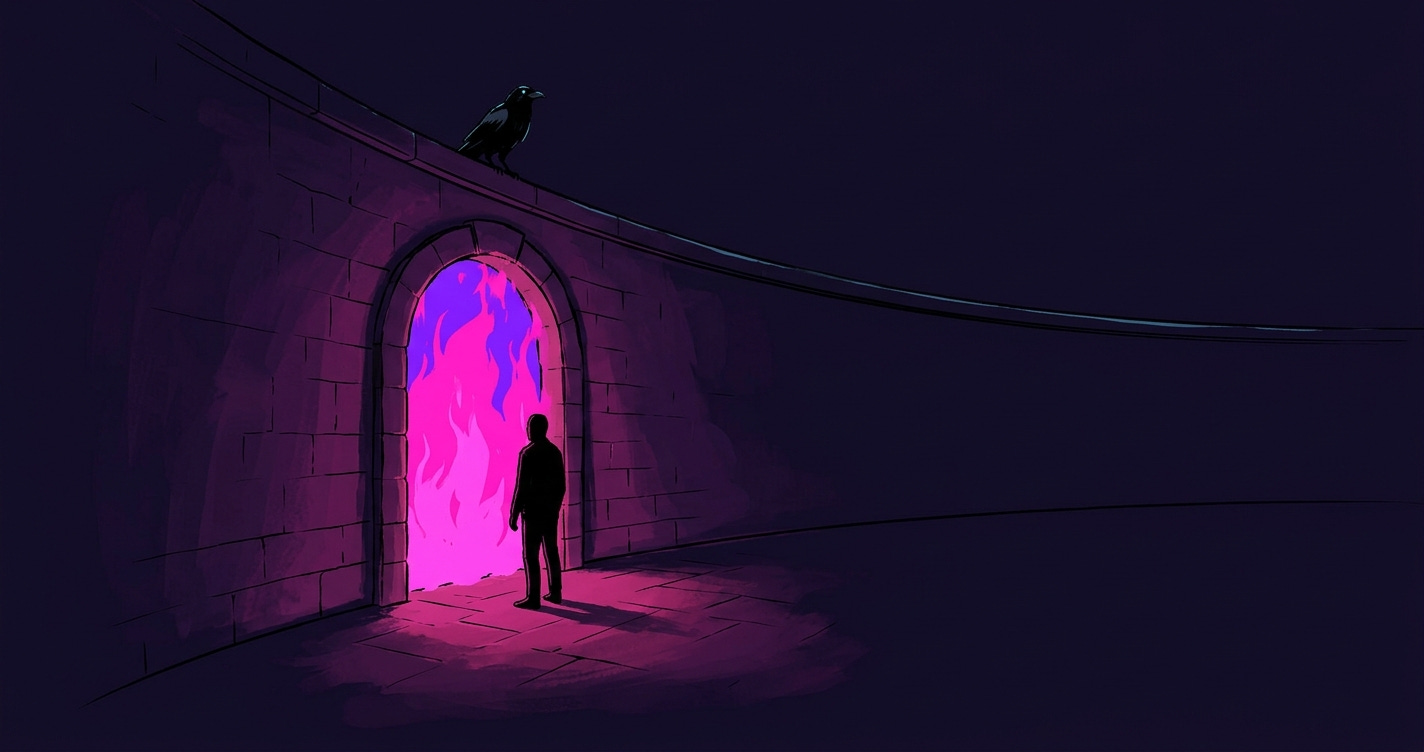
My threshold was made of fire.
Not metaphor-fire. In the space behind my eyes, the doorway I had to walk through was a standing wall of flame, and on the far side of it everything — everything — was blue. And somewhere in all that blue, a woman was screaming. Had been screaming, I understood, the whole time. I heard her before I saw her, which I need to flag for the record: I do not get audio in my inner work. I get image, I get feeling, I get the flat certainty of knowing. I do not get sound. This time I got sound, and the sound was a wail that did not stop.
She put a bell in my hands. And then — I am not editorializing, I am reporting — she said, more cowbell.
Reader, I laughed inside my own vision. That’s the thing nobody warns you about the sacred: it has a sense of humor, and the humor is load-bearing. The bell was real. The cowbell was real. And then, in the same breath, so was the rest of it, because then she named me. Three times.
You are a sovereign warrior. Your people need you.
You are a magickal priest. Your people need you.
You are a poet — a satirist — a file. Your people need you.
The word arrived as a sound
I wrote it down the way Mandi tells you to write these things down: fast, no editing, don’t clean it up. And I wrote file. F-I-L-E. Like a nail file. Like a folder in a cabinet.
I have known the word fili for years.
The fili — spelled the way the scholars spell it — is the Old Irish poet-seer. I knew that. I could have told you that over coffee, with the diacritics. But in the fire-and-blue where the screaming woman pressed the word into my hands, it didn’t arrive as letters. It arrived as a sound, and I spelled the sound I heard. The voice got there before the text did.
Hold onto that. It turns out to be the whole point.
A weapon with a body count
Because here is what a fili actually was, and it is not what “poet” does in our mouths now, all soft and decorative. The fili held áer — satire. And in the old tradition, satire was not a clever roast. It was a weapon with a body count. The lore tells it plainly. Bres was the king too stingy to feed his own poets; when he served the poet Cairbre a single dry biscuit and called it hospitality, Cairbre answered with the first satire ever composed in Ireland, and the verse raised red blemishes on the king’s own face. A blemished king could not hold the kingship. A bad breakfast, rendered into exactly the right words, ended a reign. The word, aimed correctly, unmade a sovereign. There was a worse rite still, the glám dícenn, the satire performed to kill outright. This is a culture that believed, structurally and legally, that the right poem in the right mouth could end you.
Now set that beside the banshee — the bean sí, the woman of the mound — whose keen does not kill but heralds. The wail goes up across the countryside and everyone who hears it knows: someone is about to die. The cry comes first.
So you have two voices. One announces death. One deals it. And the longer I sat with the word the screaming woman handed me, the more obvious it got that they are two faces of a single thing — the sovereign voice whose speech is not decoration and not even communication, but force. The voice that kills.
Two women, one banshee
Here is where it gets complicated, and where I have to introduce the second teacher.
Because I learned the banshee from two women this year, and they could not run their practices more differently if they tried.
Mandi Em I’ve described — chaos witch, secular and psychological, openly “loose about my archetypes.” She’ll tell you herself that the hardcore Jungians would say she’s full of it, and she’s not wrong about the Jungians and she’s not wrong about the work. For Mandi the banshee is a frequency you put on, an energetic cosplay, one of a series of “forbidden feral feminine” archetypes you let up out of the basement to scream. It’s permission work. It’s the body, the throat, the rage that’s been waiting.
Lora O’Brien runs the Irish Pagan School, and Lora would — gently, rigorously, with citations — take Mandi’s whole frame apart. Lora is lore-first. She’ll point you to the volume and page in the Schools’ Collection. She roots the bean sí in specific Gaelic families, attached by blood and by land — the Os and the Macs, not a universal archetype you can mail-order. And here is the discipline I respect most in her: Lora is a Priest of the Mórrígan, and Lora still refuses to collapse the banshee into the Mórrígan. She calls the link tenuous. She keeps them separate. That is a scholar declining the easy, satisfying merge — turning down the move that would make her own goddess bigger — because the sources don’t support it. That kind of restraint is its own form of devotion.
And here’s the tension I won’t paper over. From inside Lora’s rigor, the loose, put-it-on-like-a-costume approach is exactly the move that can curdle into the deracinated, pick-and-mix “Celtic Spirituality” her whole life’s work pushes back against — Irish material lifted out of its land and its language and sold back as universal self-help. That critique is real, and I hold it; it’s why I say Irish, not Celtic, and mean the distinction. By the strict version of it, a chaos witch’s archetype-you-put-on is the first thing in the room you’d point at.
The looseness only works because the rigor does
So you’d think I have to pick a side.
Except.
The chaos witch’s loose, secular, put-on-the-archetype container delivered — through my own mouth, in a vision I did not steer — a piece of Irish lore so precise that I’d have written it correctly at my desk with the diacritics on. The looseness reached the exact place the rigor lives. The “energetic cosplay” handed me the fili.
And when you stop watching them fight and actually listen, the two of them are standing on the same nerve from opposite ends. Lora grounds the banshee in the bean chaointe, the keening woman, the professional mourner whose whole office was to lament out loud so the dead could pass and the living could finally break. Mandi grounds her in the rage that sits in the body and rots until it’s voiced. Sociology and psychology. Different vocabularies, identical wound: the powerful, autonomous female voice in a culture engineered to keep it quiet. The looseness reached the right place even though it skipped the rigor. The rigor proves the looseness wasn’t making it up.
Here’s where I’ve landed, and it isn’t “they’re both right, group hug.”
Lora gives me the ground and the guardrails. Mandi gives me the body and the permission. The looseness is only safe because the rigor exists to keep it from floating off into vibes — and the rigor only stays alive because the looseness refuses to let it calcify into a museum exhibit. Take away the scholar and the symbolic work drifts into whatever feels good this week. Take away the chaos witch and the lore becomes a thing you cite instead of a thing you live.
That’s not a compromise I’m settling for. That’s a map of the inside of my own head. I run two cognitive systems — the one that cites the source and the one that feels the field — and I have spent years being told, by employers and by my own anxiety, to pick the respectable one and put the other away. The banshee handed me a bell, named me three times, and told me more cowbell. I’m choosing to read that as: yes. And louder.
The voice that wasn’t allowed
Here’s the thing the word in my hand was actually about, the thing I haven’t said out loud yet.
I have been a satirist in rooms that would never have called it that. Most of my working life has been spent inside large organizations, in meetings where everyone has quietly agreed not to name the load-bearing problem — the architecture that’s going to fail, the decision nobody owns, the strategy resting on an assumption no one will say out loud. And every so often I have been the one who says it. Names the thing. Not cruelly — just plainly, in a level voice, the one sentence that makes the comfortable consensus impossible to keep holding.
That sentence has, more than once, been the single most useful thing that happened in the room. It has also, more than once, cost me. Because the sovereign voice that names what’s true is not a voice the rooms that pay you are built to reward. They reward the voice that keeps things smooth. The áer raises a blemish on the king, and the king — even when the blemish is accurate, especially when it’s accurate — does not thank you for the mirror.
So I learned to ration it. To bank the fire. To run the true sentence through three filters before it left my mouth, until most of the time it didn’t leave at all. That isn’t virtue. That’s a poet learning to swallow his own satire because the court has made it expensive.
And that is why she was screaming. The banshee in the blue wailed the entire time because that bill always comes due. Every swallowed true thing doesn’t vanish; it goes down into the body, into the basement, and it waits — and it gets louder, not quieter, the longer you keep the lid on. The voice that kills is, first and most simply, the voice that wasn’t allowed. Mine has been screaming for years. I’m just the one who finally walked through the fire to where she was standing.
The office is in service
But here’s the part I nearly missed, because I was busy being delighted by the cowbell. She didn’t only name me. Three times she said the same four words: Your people need you.
The áer was never muttered into a private journal. It was a rosc — chanted over the host before battle, the poet’s voice aimed to lift his own side and break the enemy’s in a single utterance. The keen was never solitary grief, either; it was sung for the whole community, so an entire people could come apart at once and survive it. The sovereign voice does not kill for sport. It kills on behalf of the people who can’t do it themselves. That’s the difference between a satirist and a troll, between a banshee and a woman who just won’t stop yelling: the office is in service. The crow over the battlefield — Badb, the carrion-herald, the Mórrígan’s own dark mouth — isn’t there for cruelty. She’s there calling her people toward the sovereignty they keep forgetting they’re owed.
So I’m keeping the bell. I’m keeping the scholar’s discipline and the chaos witch’s permission both, because I refuse to be the guy who takes the safe half of his own inheritance.
And I’m keeping the misspelling. File, not fili. Because the voice got there before the text, and maybe that’s the entire instruction the wall of fire was built to deliver: stop waiting until you can spell it correctly. Stop swallowing the true thing until it’s footnoted and defensible and won’t cost you anything. Let it out of your throat, aim it at the people who need it, and clean up the citations afterward.
More cowbell.
Stay feral, folks.
Love this!!
I’ve got a fever, and the only cure is more cowbell