


Howdy, folks.
A couple weeks back I threw fourteen words on Threads:
If you like it, why do you care if it was made with AI?
I wrote a piece about the responses. Two waves were predictable: standard objections about training data and environmental cost (legitimate, separate conversation), and the ALIVE/EMOTION/BLOOD-SWEAT-TEARS argument (covered and dismantled there — go read it if you missed it).
There was a third wave. I left it out of the first piece because it deserved its own room. This is that room.
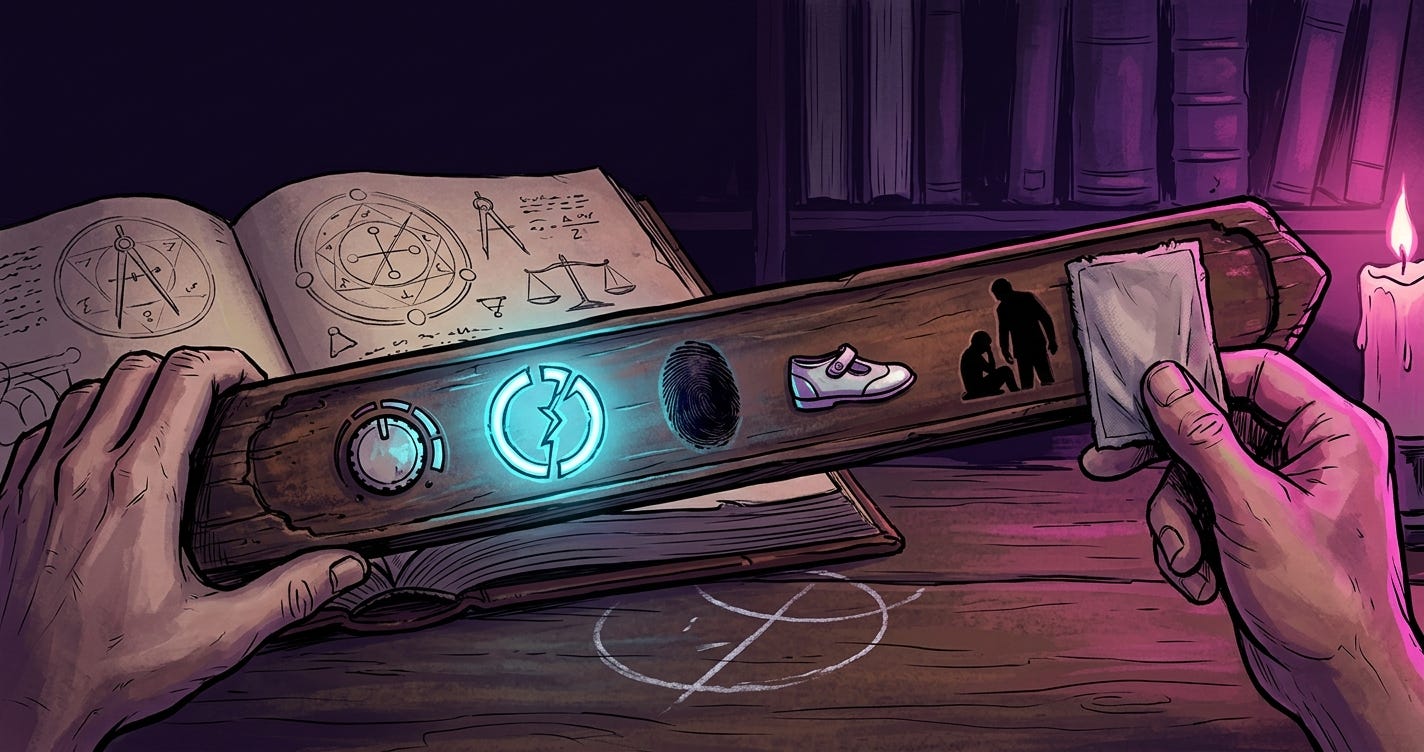
Wave three was the substitution move. People who didn’t like the question, didn’t want to answer it, so they reached for something else and slotted it in where “AI” had been. The format went something like:
“Oh yeah? Well — if you like the food, why do you care if it was MICROWAVED?”
“Oh yeah? Well — if you like the artwork, why do you care if it was made by RUBBING SHIT ON CARDBOARD?”
“Oh yeah? Well — if you like the shoes, why do you care if they were made by CHILDREN IN A SWEATSHOP?”
“Oh yeah? Well — if you like the book, why do you care if it was written by a PEDOPHILE?”
Real responses. Multiple instances of each. Reader, I am not making this up.
Let me explain why this works as a rhetorical move (it doesn’t), and let me explain what each substitution accidentally tells me about the person doing the substituting (a lot).
The microwave.
Let’s start with the gentlest one, because it’s the one that tries to be cute.
If I ask you a question about a piece of art and you answer with “well, what about microwaved food?” — you have, without meaning to, told me where AI-assisted creative output sits in your hierarchy. You think it is convenience food. You think it is the lazy version of the real thing. You think it has the same nutritional weight, the same texture, the same place in your moral universe as a Lean Cuisine.
OK. Let’s stay there. The microwaved meal exists because somebody, somewhere, decided that getting fed faster was worth a trade-off. Sometimes that trade is fine. Sometimes you actually wanted the slow-roasted thing. Both are true. Most people, on most days, are glad a microwave exists. Many of those same people will, on Thanksgiving, refuse to microwave the turkey, because the slow thing is the point.
That’s a mature relationship to a tool. You don’t see chefs forming vigilante mobs on Threads to identify which dinner parties reheated the green beans. You don’t see anyone insisting that microwave users have destroyed the sacred relationship between cook and meal.
So your own analogy already gives the game away. You are not mad that a tool exists. You are mad that a particular tool got used in a particular case where you wanted the slow-roasted output. Fine. Then say that. Don’t dress it up as a moral argument. It’s a preference about what got produced for whom, in what context. Different conversation.
The shit on cardboard.
This one gives up the entire game in the first sentence.
If you reach for “rubbing shit on cardboard” as your substitution, you have just told me, openly, in public, that you believe AI-generated creative output is excrement masquerading as art. You think the output is foul. You think it is contaminated. You think its presence in any conversation about art is offensive to art itself.
OK. Now. Gently. The original question was if you like it. You can’t get to shit on cardboard and keep the premise. Nobody likes shit on cardboard. The question was about output you already conceded was good enough to like. So either —
(a) you don’t actually believe AI output is shit on cardboard, and you’re using rhetorical hyperbole, in which case you have not made an argument, you have made a noise; or
(b) you actually believe AI output is shit on cardboard, in which case you can never have had the experience the question is asking about — because shit on cardboard, by your own framing, is a thing nobody can like.
Either way, you skipped the question. The performance landed. The point did not.
The sweatshop.
This is where the substitutions start handing me real information.
If you reach for “shoes made by children in a sweatshop,” you are no longer making an argument about aesthetics. You are making an argument about labor. About harm. About a global system that grinds bodies to make objects, and the moral compromise involved in benefitting from it.
That is a real argument. I am not dismissing it. There is a piece coming about it.
But.
You did not use it as an analogy. You used it as a substitution. You replaced “made with AI” with “made by exploited children” and then asked me, with a straight face, why I’m being a hypocrite. The substitution only works if the two things are morally equivalent. So tell me — is that what you believe? Do you genuinely think that someone using AI to draft a poem is morally equivalent to a multinational corporation profiting off the systematic exploitation of children?
If yes — make the argument cleanly. I think you’d lose. But I’d respect the attempt.
If no — then you have not made an argument. You have lobbed a moral hand grenade because the actual question was uncomfortable. That’s not rhetoric. That’s a tantrum dressed up as ethics.
The pedophile.
I almost left this one out. I’m including it because it actually happened, more than once, and because it’s the most useful one.
When someone reaches for pedophilia as the substituted variable in a question about art and AI — when they tell me, in public, with a straight face, that asking “if you like it, why do you care if it was made with AI” is structurally equivalent to “if you like it, why do you care if it was made by a child molester” — I have learned several important things.
I have learned that, in the moment, they cannot distinguish between a tool used by an adult to assist creative output and the systematic violation of a child. I have learned that AI and child sexual abuse occupy the same shelf in their moral library. I have learned that the rage they feel about AI is so out of proportion to anything AI actually does that pedophilia is the closest match they could find on their own emotional yardstick.
That is a tell. That is a confession. That is a person telling me, out loud, that the affect they are bringing to this conversation is the same affect they would bring to the worst thing a human can do to another human.
Friends. That is not about AI. That has never been about AI. Whatever is happening in that nervous system, the robot is not the cause. The robot is the projection screen.
What false equivalence is actually doing.
Here’s the structural point.
The substitution move works rhetorically — when it works — by smuggling the moral weight of one thing into a conversation about a different thing. You replace “AI” with “child abuse,” and now the original question feels indefensible — if you accept the substitution. The trick is in the swap. The argument hides inside an equivalence the substituter never explicitly defended.
That’s why false equivalence is a tell. The substituter has to reach for something to put in the slot. Whatever they reach for is the closest match in their moral library to what they think AI is. They didn’t think hard about it. They just grabbed. And the grab is honest in a way the argument never was.
Microwaved food. Shit on cardboard. Sweatshop labor. Child sexual abuse. Look at that range. Look at how confidently each of those was offered as though it were the same kind of thing. Notice how nobody, in any of those threads, paused to check whether the analogy held. The point was never to make an argument. The point was to push the question off the table by attaching it to something the responder didn’t want to defend.
That works in the short term. It does not work as thinking.
Back to the koan.
If you like it, why do you care if it was made with AI?
I called that question a koan two weeks ago and I meant it. A koan strips the performance and leaves the honest thing underneath. The substitution move is the performance trying to stay in place by sleight of hand. I can’t answer the question, so let me change the question, and hope nobody notices.
I noticed.
What you reached for is what you actually believe. About AI. About art. About the moral category these tools belong in. You can have any of those positions — the microwave one, the sweatshop one, the cardboard one, the unspeakable one. But you have to defend the position openly, because the substitution only works if you don’t.
Stand up and say it. Tell me, on the record, that you believe AI-assisted creative work is morally equivalent to child exploitation. Tell me that the act of using a language model to draft a sentence sits, in your hierarchy, where shit-smeared cardboard sits. Make the claim. Defend it.
I’ll wait.
That’s it for this week.
Stay feral, folks.
This is a fantastic one.