


The last piece handed you the cast. The Self, the shadow, the anima, the whole archetypal repertoire — the figures that live in the deep and run the show. But I left you holding a pile of nouns, and a pile of nouns is not a language. The Self. The shadow. The Mother. Three nouns sitting on a table, doing nothing. Nothing has happened yet.
Because here’s what Foundation II couldn’t give you on its own: archetypes are the nouns, and alchemy is the verbs. Archetype tells you who’s in the room. Alchemy tells you what they do — how they dissolve, congeal, blacken, burn, marry, die, and come back changed. You can’t have a working grammar with nouns alone. The shadow doesn’t just exist; it gets integrated — and “integrated” is a verb, an operation, a thing that happens over time and costs something. This piece is the verbs. It’s the part that turns a static map of your psyche into an actual process of becoming.
The two wrong rooms (it wouldn’t be a Foundation without them)
Room one, the history textbook: alchemists were failed proto-chemists — deluded medievals huffing mercury fumes, trying to literally turn lead bars into gold bricks, who accidentally invented a few lab techniques before real science showed up and put them out of business. A footnote. An embarrassment with a beard.
Room two, the manifestation aisle: alchemy means turn the lead of your life into the gold of your dreams! — transformation as a vending machine, “spiritual gold” meaning a better salary and clearer skin, solve et coagula printed on a candle you bought to get your ex back.
Both rooms are wrong, and Jung is the one who recovered what’s real. His whole late life was one enormous argument: the alchemists were never really talking about metal. They were bent over their furnaces watching a process and projecting their own souls onto it — describing, in the only language they had, the transformation of a human being into something whole. The lab was a mirror. Lead into gold was never about money; it was about taking the base, dense, unlived parts of yourself and transmuting them into the realized self. The technical name for that lifelong process is the one from the last piece — individuation — and alchemy is its operating manual, written in chemical metaphor centuries before psychology had the words. That’s the hinge the whole shelf turns on, and it’s why Celestial Alchemy, the Jungian work, and the witchcraft all rhyme: they’re describing one operation in different dialects.
The master verb: solve et coagula
If you learn one alchemical operation, learn this one, because every other verb is a special case of it: solve et coagula. Dissolve, and reconstitute.
Solve is the breakdown. You take something that has congealed — a rigid identity, a story you’ve hardened into, a persona that’s gone from costume to cage — and you let it dissolve. You stop holding it together. Coagula is the re-forming: out of the dissolved material, something truer crystallizes. That’s the whole rhythm of transformation, and it runs in exactly that order, which is the part nobody wants: you have to dissolve before you can re-form. There is no coagula without the solve. You cannot become the next version of yourself without letting the current one come apart. Every real change you’ve ever been through had this shape — the falling apart that you’d have done anything to avoid, followed by the reassembly into someone you couldn’t have designed on purpose.
That’s not motivational-poster talk. It’s the structural reason transformation hurts, and why the people who refuse to let anything dissolve stay exactly the same for decades.
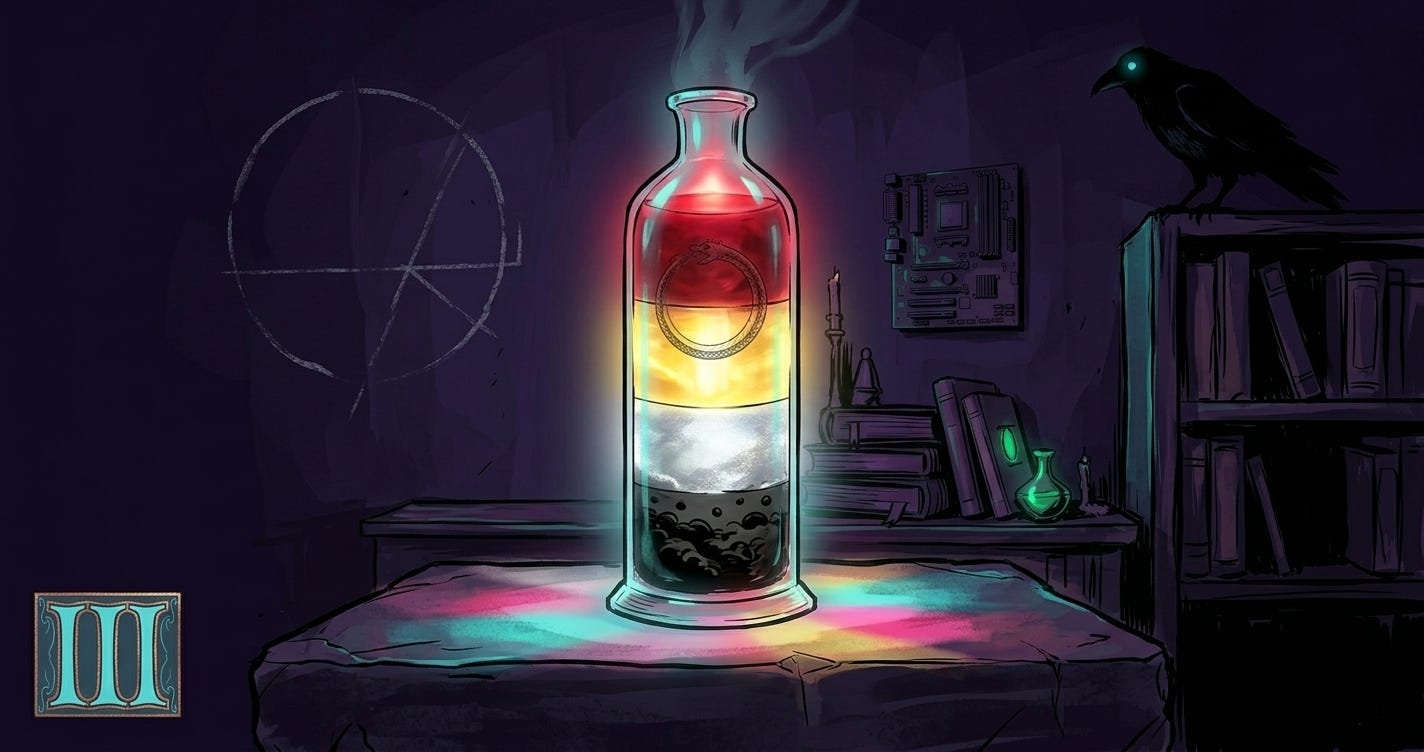
The four stages: nigredo → albedo → citrinitas → rubedo
The opus has a shape, and the classical alchemists mapped it in four colors. You’ll often see it told in three — black, white, red — because a later tradition folded the yellow stage into its neighbors and stopped counting it. I keep the four, because the dropped one names something real, and a place built on holding the divergence doesn’t get to quietly disappear a stage just because it’s inconvenient to count. This is the engine underneath the descent-and-return that haunts every system on this shelf.
Nigredo — the blackening. First the material rots. Putrefies. Goes dark. In a life this is the dark night, the collapse, the descent — the part where the old structure decays and you’re in the muck with no light and no map. Everyone wants to skip it. Nobody gets to. The nigredo is where the dissolving actually happens, and it feels exactly like dying because something is.
Albedo — the whitening. Then the washing. After the rot, a clarity: the dissolved material gets purified, the first light returns, you can see again — soberer, cleaner, quieter. Not healed. Washed. The albedo is the first grey light after the long dark, and its danger is thinking you’re finished, when really you’ve only been rinsed.
Citrinitas — the yellowing. Then the sun comes up inside the vessel. After the washing, the gold-ing: the clean material starts to glow with its own light, the way dawn goes from grey to gold. This is the stage the three-color version drops, and it’s a real loss, because there’s a difference between being rinsed and being lit. The albedo gives you clarity — you can see again. The citrinitas gives you heat — the seeing finally catches fire and becomes wisdom, the cool lunar reflection of the washing warming into solar knowing. It’s the difference between understanding a thing in your head and feeling it ignite into something you are. Still interior, not yet embodied — that’s the last stage — but no longer cold. The old texts sometimes called the threshold into it the cauda pavonis, the peacock’s tail: all the colors flashing at once, the iridescence right before the gold settles.
Rubedo — the reddening. Then the gold. The reddening is the return — the purified self brought back into life, embodied, full-blooded, no longer just insight but lived. This is the integration the last piece pointed at, now actually done — the Self not glimpsed in meditation but walking around in the world. Red is blood, is life, is the work made flesh.
Go down, rot, get washed, catch light, come back as gold. You’ve heard this before — it’s the katabasis, the descent into the underworld and the return changed. Alchemy is just the version that tells you it happens in stages, and that each stage has a job, and that you can’t trade the order.
Why it’s the throughline (and not just another piece)
Here’s why alchemy isn’t a sixth instrument but a verb-set that cuts through all of them — the reason it earns its place right next to the grammar instead of out with the practices.
Every practice you’re about to learn is reading the same operation. The tarot majors (next piece) are the alchemical stages dealt out as cards — the Tower and the Devil are nigredo, the Star and Temperance are albedo, the Sun is the citrinitas dawn, and the World is rubedo. The lunar cycle in astrology is solve et coagula on a twenty-nine-day loop — the dark moon dissolves, the full moon coagulates. Dreamwork’s nightmares and floods are the nigredo surfacing while you sleep. The instruments don’t each have their own private logic; they’re all gauges reading your position in the one opus. Archetype gave you the nouns. Alchemy gives you the verbs. Together they’re the grammar — and the three practices are just three ways of reading the sentence your life is currently writing in it.
The other door: the chart, the jar, and the soul
One divergence I won’t flatten, because it’s a real one and this place runs on holding those. Jung made alchemy psychological — the opus happens in the psyche, the gold is the integrated Self. And that reading is true. But it isn’t the only lineage on my shelf, and the older one was never only metaphor.
The witches kept the operative version alive. Heron Michelle’s Pentacle Path teaches the formularies as literal material alchemy — substance + intent + timing. You actually combine the herb, the oil, the candle, at the planetary hour, with the will focused — and something is worked, in matter, not only in mind. Tenae’s Celestial Alchemy reads it in the chart; the witch reads it in the jar; Jung reads it in the dream. Which one’s real? That’s the wrong question, and Foundation I already answered it: as above, so below. The same operation runs at every scale — in the beaker, in the chart, in the psyche, in the soul — because the correspondence is real. The psychological alchemist and the kitchen witch aren’t disagreeing. They’re working the same verb at two different altitudes. Hold both.
And I’ll own my own opus, because credit runs both ways: I rendered the whole arc as a record. ARCÆON — The Arcana: A Soul in Flames — is alchemy you can hear. The title isn’t decoration. A soul in flames is a soul in the crucible — the thing heated until it breaks down and re-forms. Twenty-two tracks of nigredo, albedo, citrinitas, rubedo, sung. I didn’t make it to be clever. I made it because I needed to put my own lead in the fire and listen to what came out gold.
Safe hands
Two warnings, and they matter more here than anywhere.
One: it’s not literal, and it’s not instant. The historical alchemists who took the lead-into-gold thing literally poisoned themselves — mercury and antimony don’t care about your intentions. And the manifestation-aisle version is the same error wearing nicer clothes: the belief that you can coagula without the solve, skip to the gold, get the rubedo without the rot. You can’t. Which leads to —
Two: you cannot skip the nigredo. Anyone selling you transformation without the descent — instant breakthrough, ten days to your best self, gold with no blackening — is selling spiritual bypassing, and it’s the most popular product in the wellness economy precisely because it promises the one thing the opus forbids. The dark is not an obstacle on the way to the work. The dark is the work’s first stage. Solve before coagula. Every time. The mercy in this is real, though: if you’re in the muck right now, the alchemist doesn’t say “fix it” or “stay positive.” The alchemist says “ah — nigredo,” and that single act of naming turns formless suffering into a recognizable stage of a process that has a known next step. Which is the whole practice.
The practice
Find one thing in your life that’s congealed — a story you’ve hardened into, an identity that’s gone stiff, a role that used to fit and now chafes. Then run the operation on it, on paper:
Name what wants to dissolve. What’s the solve here — what are you holding together by force that’s asking to come apart? (Naming it is not the same as doing it. But you can’t dissolve on purpose what you won’t admit is rigid.)
Name the stage you’re in. Be honest. Are you in a nigredo — something rotting, dark, no map? An albedo — recently washed, clearer but raw, tempted to call it done? A citrinitas — clear and warming, the insight starting to catch and become yours? A rubedo — bringing something hard-won back into daily life? Write the word. “I’m in the nigredo.”
Sit with the relief of the name. That’s the exercise. Notice what happens in your body when the thing you’ve been calling “I’m falling apart” becomes “I’m in the blackening, which has a next stage.” Suffering with a name on it is information. Suffering without one is just weather.
You don’t have to force the next stage. The opus runs on its own heat. Your only job is to stop interrupting the solve by frantically trying to glue the old thing back together.
Stay feral, folks.
Foundation III of VII. Next: Tarot as Pattern-Tech — the first of three practices, where the nouns and the verbs get dealt onto a table you can read. With gratitude to Jung, to Tenae / Celestial Alchemy, to Alyssa Polizzi, and to Heron Michelle, whose work this stands on — named throughout. The synthesis is mine; the lineage is theirs; credit is a feature.