


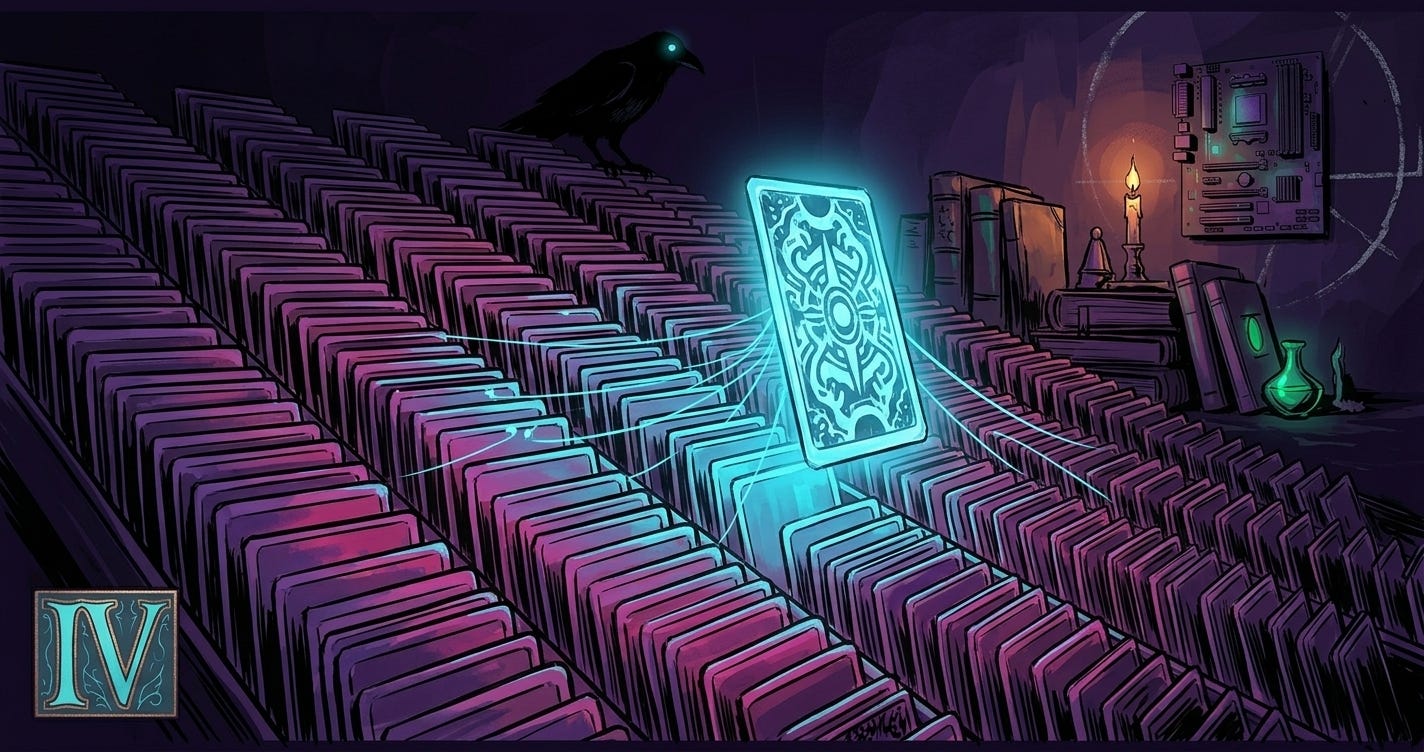
Back in the first one, I made a claim and kept walking before I paid it off. I said a tarot spread is a device that drops a fixed set of archetypal patterns onto the table in front of your priors and forces a re-read. Then the next two handed you the grammar — Archetype gave you the nouns, Alchemy the verbs. So now I owe you an instrument to actually read that grammar with — and this is the first of three practices that do it. Because here’s the thing the deck actually is, the thing nobody says at the carnival booth or in the skeptic’s takedown: tarot is a complete, portable, finite library of the human archetypal repertoire, and you query it the way you grep a codebase.
Seventy-eight cards. That’s the whole machine. Not a window into the future — a complete set of the patterns a human life runs on, rendered in pictures so the unconscious can read them.
The two wrong rooms, again
You already know this move, because it’s the same split from the first piece. Tarot gets handed to you in two bad rooms and you’re told to pick.
Room one, the carnival: tarot tells the future. A woman in scarves turns over Death and someone clutches their chest. The cards know what’s coming; the reader decodes the prophecy. It’s fortune-telling, and either you believe in the magic future-vision or you’re a rube.
Room two, the skeptic’s lab: tarot is the Barnum effect with art. Pretty pictures, vague statements, a brain desperate to find meaning, and confirmation bias doing the rest. It’s a Rorschach blot you’re projecting onto. Harmless, maybe useful as journaling, but let’s not pretend it knows anything.
And here’s what I want to say to both rooms, with love and a little contempt: you’re describing the same instrument from two ends, and you’ve both missed what it’s for. Tarot is not a future-decoder and it is not “just” a projection surface. It’s the third thing, the thing that makes both rooms look like children arguing — it’s a synchronicity instrument. Let me show you the mechanism, because there is one.
How it actually works (the mechanism nobody explains)
Here’s the engine, and I learned the clearest version of it from Mariana Louis — Persephone’s Sister, the Archetypal Tarot School — who built her whole method on Jung instead of on prediction.
You shuffle. The shuffle matters, and not for the reason the skeptic thinks. The randomness is the point — it’s what Mariana calls placing the archetype of chance at the center of the work. You’re deliberately removing your conscious ego’s grip so something else can speak. Then you draw, and the card greps your situation: it surfaces which archetypal pattern is live in you right now — including, and this is the whole value, the patterns your conscious mind is completely blind to. Mariana says it straight, and it rearranged how I read: seven out of ten times, you will not “get” the card when you pull it — because it’s showing you an unconscious reality, and the conscious ego can’t see the unconscious by definition. The cards you can’t make sense of are usually the ones doing the real work.
And here’s the part that dissolves the fortune-telling fight. The card is accurate but not literal. Marie-Louise von Franz — Jung’s closest collaborator — described what an oracle gives you as a list of expectations of psychological events. Pull Death and it almost never means a body. It means the archetype of death is now constellated in you, and over the next while it’ll show up as synchronicities: you’ll cry at a death in a film and not know why; you’ll catch yourself saying “I feel dead inside” in a conversation; you’ll pass roadkill and feel your own mortality lurch. The card didn’t predict an event. It named the pattern that’s now moving through your life — and then the pattern shows up everywhere, because you finally have eyes for it. That’s not prophecy. That’s not projection either. It’s the predictive brain from Foundation I, handed a new prior and suddenly seeing the thing it was filtering out.
The honest part, held open
Now — I run safe hands, so here’s the line. The supported claim is the one I just made: the draw forces a re-read, the re-read is real, and the re-read is the entire usable point. That works whether or not anything mystical is happening, because it works on the construction-engine that builds your experience.
But I’m not going to flatten the rest of it to make the skeptic comfortable, because that’s its own kind of dishonesty. Jung’s actual theory — synchronicity — was that matter responds to the energy of the psyche, that the fall of the cards and the state of your soul are connected through the unus mundus, the one world. Von Franz warned that the unconscious “knows things” — past, future, things about other people — and that sometimes, rarely, Death really does mean death. I don’t know if that part’s literally true. Neither did Jung, fully. So I hold it open: the rationalists in room two are right that the re-read mechanism is sufficient to explain the value, and the diviners in room one are pointing at a real mystery that doesn’t fully reduce. I’m not collapsing that tension into a tidy answer to make either room relax. I’m telling you to use the instrument and let the mystery stay a mystery. Radical faith in the draw, and — as Robert Johnson put it in Inner Work — the discipline of accepting not knowing.
The 22 that matter most (and why I set them on fire)
The deck splits. Fifty-six minor arcana — the daily textures, the small weather of a life. And twenty-two major arcana — and those twenty-two are not random. Laid in order, the majors are the map of individuation itself: the Fool steps off the cliff, meets the Magician and the High Priestess, descends through the Tower and Death and the Devil, and comes back through the Star and the Sun to the World, remade. It’s the exact spiral from Foundation II — the journey toward the Self — drawn as a sequence of twenty-two doors. And it’s the exact operation from Foundation III: the majors are the alchemical stages walked one card at a time — the nigredo of the Tower and the Devil, the albedo of the Star and Temperance, the citrinitas of the Sun, the rubedo of the World. The Archetypal Tarot School teaches the majors as the journey of individuation, and the moment that clicked for me I couldn’t unsee it: the deck is the grammar from the last piece, dealt out as a story you can hold in your hands.
That’s why I rendered all twenty-two as a rock opera. The Arcana: A Soul in Flames — ARCÆON — is me taking the major arcana and singing the descent and return, one track per card, the Fool’s whole journey through the fire and back. I didn’t set the majors to music because it was a cute concept. I did it because the majors are the soul’s own structure, and I wanted to feel that structure move at volume. That’s the synthesis this whole place is built on: take the instrument, learn what it actually is, and then make something out of it. (Foundation I told you we study to make, not to know. This is what that looks like.)
How to actually read (so it doesn’t go stale)
Technique, fast, all of it standing on Mariana’s archetypal method — and the through-line is: the card can’t solve your life. It can only enlarge it.
Pull few. One card, or a weekly cross. The instinct to throw down a ten-card spread is the ego wanting control. Resist it.
Don’t pull a clarifier. This is the discipline that separates readers from fidgeters. If two of three cards land and the third makes no sense — good. That third one is the unconscious reality. Sit with it. Pulling another card to “explain” it is you refusing the message because it won’t fit your story.
Work it with the grammar. Notice your gut reaction first (relief? dread? a shift in the body?). Then associate — what does this image connect to, personally and mythically? Then amplify — go read the myth behind the archetype (the Empress → Demeter, Gaia, Tiamat) until the card gets rich enough to reflect something back. Then, if it’s potent, animate it — re-enter the scene in active imagination, talk to the figure, let it surprise you.
Let it marinate. Pull, then watch the week. Notice the synchronicities that follow, the dreams, the slips of the tongue, the strange emotional flares. That’s the card alchemizing its meaning in real time.
The safe-hands warning that matters most
Two of them, actually.
One: burn the dream-dictionary instinct. There is no lookup table where Death equals X and the Empress equals Y. Mariana says it and I’ll repeat it — she can’t decipher your symbols; only you can. The app that spits out a paragraph of canned meaning is the cesspool. The card means what it constellates in you, read through your grammar, your myths, your life. Outsource that and you’ve got nothing.
Two: keep it sacred or it dies. Pull a card every single morning out of habit and within a month you’re immune to it — the High Priestess becomes wallpaper, the wonder leaks out, and you’ve turned an oracle into a tic. Mariana treats a pull like holy communion; I’ve gone months without touching the deck. Protect the shiver. An instrument you’ve gone numb to isn’t an instrument anymore.
And yes — a tension in my own house
The sharp-eyed among you already caught it: I built a daily tarot practice. TarotPulse runs on pulling damn near every day and logging it. So which is it — pull rarely and keep it sacred, or pull daily? Fair catch. I’m not going to dodge it.
Both. Because they’re two different practices, and only one of them is the oracle.
The oracle is what I described above: rare, sacred, a single numinous draw worked deep. Pull that every morning and yeah — it goes wallpaper. You can’t run holy communion on a daily cron job.
The almanac is the other mode entirely. You’re not asking “what does the divine say to me this morning” — you’re logging a data point. The meaning doesn’t live in any single pull; it lives in the pattern that surfaces across hundreds — which cards keep recurring, under which transits, around which themes. That’s not the altar. That’s grep run across a whole year’s corpus instead of one file — and it’s arguably the more literal pattern-tech, because the pattern only emerges at scale.
Notice what that is: the exact move from Foundation I. The oracle is the symbolic-synchronistic register; the almanac is the empirical-data register; the thesis says both are first-class and neither collapses into the other. I want it all. So here’s the honest line: TarotPulse is the almanac, not the altar — and it knows which one it is.
Does that fully resolve the tension? No — and I’m not going to pretend it does. There’s a real risk the daily-logging habit colonizes the sacred reflex: pull every day for data long enough and you might lose the capacity to be struck by a single card. The mitigation is intent — wall off a few pulls as sacred, no log, rare — and let the rest be data. But the tension stays a little warm. Good. This whole place runs on tensions that don’t close.
The practice
This week, one pull. A weekly cross if you’ve got the guidebook, or a single card on a live question if you don’t. Then:
Draw and don’t flinch. Whatever comes, it stays. No re-shuffles, no clarifiers, no “wrong pile.”
Run the grammar. Gut reaction → association (personal and mythic) → if it’s potent, talk to the figure. Write it down.
Sit with the one you don’t get. That’s the assignment. The card that makes no sense is
grepreturning a line you didn’t know was in your code.Watch the week. Note every synchronicity, dream, and weird emotional flare that rhymes with the card. At week’s end, read your notes. The accuracy shows up in the rearview, not the moment.
The cards won’t tell you what to do. They’ll show you the pattern you’re standing inside. The walk is still yours. It always was.
Stay feral, folks.
Foundation IV of VII. Next: Astrology — the Chart and the Clock — the second practice, the deck’s paired opposite: the instrument you don’t query but read. With gratitude to Mariana Louis, to Jung and von Franz, and to Robert Johnson, whose work this stands on — named throughout. The synthesis is mine; the lineage is theirs; credit is a feature.