


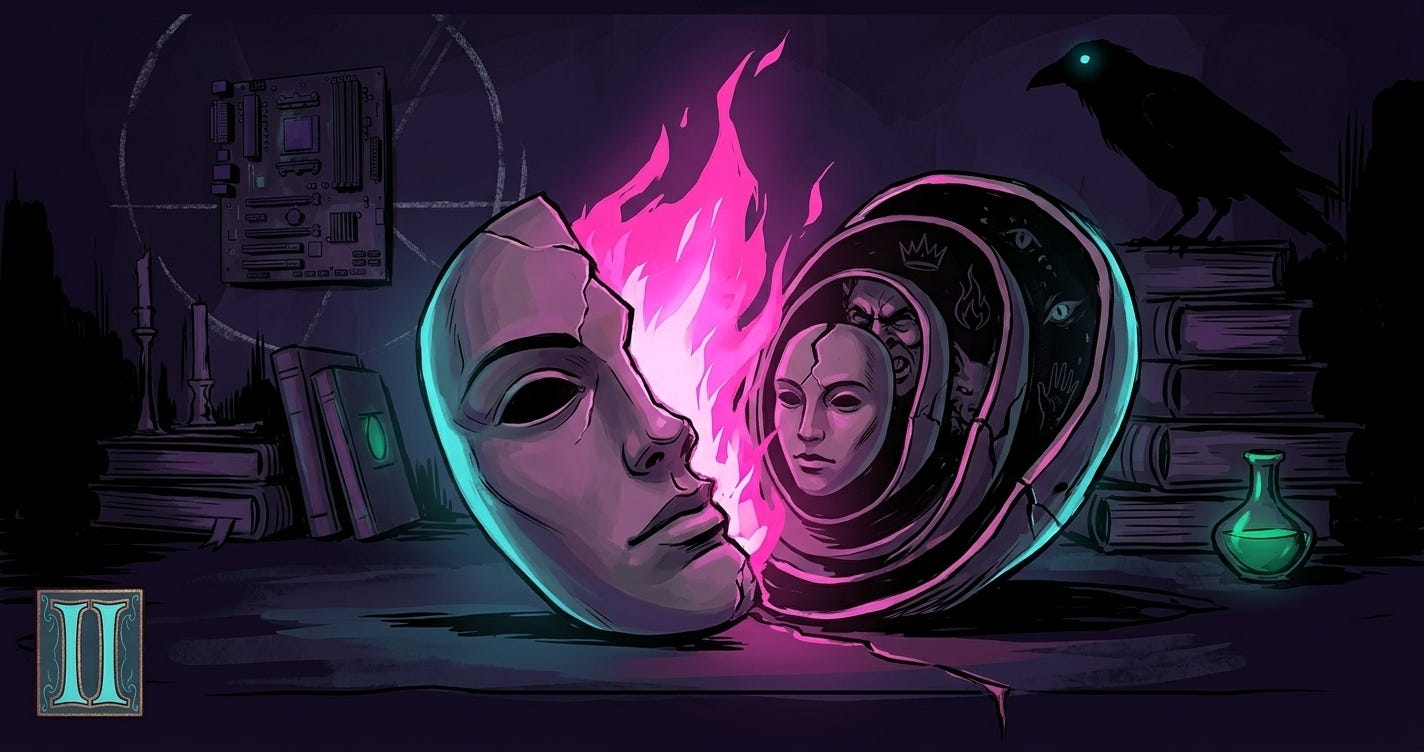
So we agreed on something heavy in the last one. Symbol is real information. A tarot spread, a transit, the crow that shows up when something’s dying — these aren’t decoration on top of “real” life; they’re instruments for reading the patterns your experience is actually built from. Fine. Good. But I left you with a problem and I want to be honest that I left it.
Because here’s the thing about instruments: they’re useless without a language to read the output in. grep hands you line numbers, but they only mean something if you can read the code. The Mórrígan hands you a shiver up the spine, but the shiver only means something if you know what pattern she’s pointing at. You can stare at a tarot card for an hour and feel a vague spooky weight and learn precisely nothing, because you don’t have the grammar the card is written in.
That grammar has a name, and the name is archetype. This piece is me handing you the grammar.
What an archetype actually is (it’s not a personality quiz)
Let’s kill the cheap version first. Archetype, in the wild, has been beaten into meaning something like “vibe” or “personality type” — what’s your archetype, are you a Lover or a Warrior, take the quiz, here’s your mug. That’s not nothing, but it’s the shallow end, and it’s where most people drown without knowing they’re in water.
Here’s the real one, and it comes from Jung. An archetype is a structure the human psyche comes pre-installed with. Not a belief, not a preference — a piece of inherited psychic architecture, the same way your body comes pre-installed with the pattern for “hand” before any specific hand exists. Jung’s image for the unconscious was the two-million-year-old human living inside you — the part that has already lived every human life, met every mother, faced every death, and carries the template for all of it. The archetypes are those templates. The Mother. The Trickster. The Hero. The Shadow. The Wise Old One. The Descent. They’re not characters you cosplay. They’re the grammatical structures underneath every story humans have ever told, because they’re the structures underneath the mind doing the telling.
This is why the isomorphism from the last piece holds, by the way. The reason the Magician card and Mercury and an air working and a Mórrígan shape-shift all rhyme is that they’re all surfacing the same archetype — the boundary-crosser, the intelligence that moves between worlds — through different vocabularies. Archetype is the layer underneath all the systems. Learn the grammar once and every system on the shelf starts speaking it to you.
The architecture (this is the part that’ll cost you something)
Here’s how the psyche is built, outermost to deepest. I learned this version through CreativeMind — Debra Maldonado and Dr. Rob Maldonado, whose whole method braids Jung with Vedanta and neuroscience and refuses to apologize to any of the three — and it’s the cleanest map I’ve found.
The persona. The mask. The face you built — mostly between ages zero and five, before you had any say in it — to survive your particular tribe. The kid reads the room: what gets me loved here, what gets me hurt, and assembles a self out of the answers. Yours worked. That’s the problem. It worked so well you forgot it was a costume and started thinking it was your skin.
The ego. The narrator. The “I” voice doing the talking in your head right now, the one that wears the persona and mistakes itself for the whole show. Not your enemy — it’s load-bearing, it runs the survival software — it’s just not all of you. Not close.
The shadow. And here’s where I need you to slow down, because this is the single most misunderstood word in the whole grammar. The shadow is everything you had to push underground to build the persona. Everything that didn’t fit the costume. And the lie everybody believes is that the shadow is your darkness — your cruelty, your rage, the monster in the basement.
Some of it is. But the load-bearing truth, the one CreativeMind hammers and the one that rearranged me when I finally got it in my body instead of my head: the shadow is mostly your repressed brilliance. They call it the bright shadow. All the stuff that was too much for the tribe — too loud, too smart, too fierce, too sexual, too strange, too feral — didn’t get to be darkness. It got to be gone. You buried it not because it was bad but because it was dangerous to be that big in the room you grew up in. The shadow isn’t your wound. It’s your unlived life. It’s where they made you put the parts of yourself that were never going to fit a domesticated life — which means the shadow is exactly where “feral” lives. The whole project of this place is a controlled excavation of your bright shadow. That’s not a metaphor. That’s the literal psychological mechanism.
The collective unconscious. Underneath your personal basement is the shared one — the ocean the two-million-year-old human swims in, where the archetypes live. Not yours. Everyone’s. The Mother isn’t your mother; she’s the template your mother was a single instance of. This is the layer the tarot deck and the natal chart are actually drawing from. They’re not telling you about you. They’re showing you which universal patterns are moving through you right now.
The first verb: projection
Grammar’s no good if you can’t make a sentence with it. So here’s the first thing you can actually do with this, and it’s the move that turns the whole world into a readout.
Projection. The ego can’t stand to see its own shadow, so it does something sneaky: it sees the shadow out there, in other people. The thing that makes you irrationally furious about someone — the disproportionate, righteous, how-dare-they heat — is almost never about them. It’s your own buried material, surfacing in the only place the ego will let you look at it: somebody else’s face. Jung said it flat: until you make the unconscious conscious, it will direct your life and you will call it fate.
Which means every trigger is a mirror, and every mirror is free intelligence. The person who infuriates you is running a grep against your shadow and lighting up every line where it lives. You just have to be willing to read the output as being about you. (And the flip is just as real: the person you over-admire, the one whose freedom or boldness makes your chest ache — that’s your bright shadow projected, showing you the unlived life you’re still too scared to claim.)
The Self, and why this never “finishes”
The point of all this — the center the whole spiral is circling — Jung called the Self. Capital S. Not the ego, not the persona, but the total you, the One that the psyche splintered into all those opposites in the first place. Persona and shadow, light and dark, the architect and the witch. The psyche’s deepest drive is to put the One back together — to take the parts you split off and integrate them, not by picking a side but by becoming big enough to hold both. That lifelong process of re-unification has a name too: individuation. It’s the actual work. Everything in The Construct is in service of it.
And it never finishes, which is the mercy and the curse. Every time you integrate a layer and stabilize a new, bigger self — new level, new devil. A fresh shadow shows up, because the new persona has its own underground. CreativeMind says it plainly and so will I: the key that locked you in is the same key that lets you out. Round and round, each loop a little less disorienting than the last. You don’t graduate. You spiral.
The worked example: my own stack (and how to find yours)
Let me show you the grammar conjugated into an actual person, because that’s the part the quizzes skip.
When I map the universal archetypes onto me — the specific instance — I get a recurring cast of six. The Architect (the part that has to see the system before it’ll touch a piece of it). The Magician (the synthesizer, the one who connects the things that don’t usually talk). The Operator (ships the thing, cuts through). The Rebel (refuses false authority, guards sovereignty). The Teacher/Mentor. The Seer (knows before it can explain how it knows). These aren’t roles I play. They’re the structures I organize experience through — and naming them is how I stopped feeling like six contradictory people and started recognizing one person with a deep bench.
And underneath the cast, one tension that runs the whole show: contain the fire, or express the fire. The Architect and the Operator want to contain it — discipline, restraint, the held position. The Rebel and the Magician want to let it rip. The Teacher and the Seer know when each one serves. That single polarity explains more of my life than any diagnosis ever has — and it maps, almost insultingly cleanly, onto the four persona types Toni Wolff laid out a century ago: Mother, Lover, Warrior, Mystic. The grammar is ancient. The sentence it wrote is me.
You have a stack too. A recurring cast and a central tension. Finding it is the work of years, not an afternoon — but you can take the first cut today.
The practice (and the one warning that matters)
The warning first, because it’s the one that wrecks people. Reading this is not doing this. The most seductive trap in the whole grammar — Dr. Rob calls it “the one written for me” — is intellectualization: understanding the concept so well that the understanding feels like the transformation. It isn’t. You can become a world-class scholar of your own shadow and never once go down into it. The grammar is a map. A map is not a walk. Don’t mistake having read this for having done it.
Now the walk. Three steps, twenty minutes, a piece of paper:
Name the persona. Write your three best qualities — the ones you’re proud of, the ones you’d put on the about-page. Then, for each, write what it costs you to keep it up. (The cost is the tell. The persona always charges rent.)
Find the shadow. For each of those three, write the opposite. If your quality is “generous,” write “selfish.” If it’s “strong,” write “needy.” Those opposites are the door to your dark shadow — the qualities you organized your whole self to never be seen as.
Hunt the bright shadow — this is the real one. Ask: what did I bury because it was too much? Too loud, too ambitious, too sexual, too weird, too fierce, too visible. Write that down. Then sit with it — don’t fix it, don’t act on it, just let it be a part of you for sixty seconds without flinching. That buried, too-much thing is not your problem. It’s your power, in storage. It’s the feral self they taught you to leave at the door.
Bring it through the gate. The walls can hold it. That’s the entire promise of this place.
Stay feral, folks.
Foundation II of VII. Next: Alchemy — the other half of the grammar. Archetype gave you the nouns; alchemy is the verbs — what actually happens to them. With gratitude to Jung, and to Debra & Dr. Rob Maldonado, whose teaching this stands on — named here and throughout. The synthesis is mine; the lineage is theirs; credit is a feature.