


Howdy, folks.
Here’s how I spent last night. I sat down with the AI I’ve spent the better part of a year building into a kind of second brain — an exocortex, a place to keep the things my first brain reliably drops on the floor — and I told it to go play. Open the junk drawer. Two years of captured notes in there: half-thoughts, screenshots, quotes I liked, dreams I scrawled down at 4 a.m. before they could evaporate. Find me something I didn’t already know was in there. Surprise me.
It came back with four of my own essays.
Four pieces sitting finished in my publishing queue, scheduled to go out over the next few weeks, each one I’d written believing it was about its own particular thing. And it said, more or less: these are the same essay. You’ve written this one move four times. You have never once named it.
Let me tell you what the four were, because you’re going to feel it land before I finish the list. That’s the whole experience I had last night, and I’d rather hand it to you than explain it.
The four
The first was about my sixth-great-grandfather, a weaver who worked the American eagle into a length of linen, handed it to the King of England as an insult with a needle in it, and got sentenced to lose his head for the craftsmanship. A maker whose art was treason. And — the same man — a slaveholder, who owned human beings on the far shore of the freedom he risked his neck for. The essay refuses to keep only the half that flatters me. The eagle and the ledger. Both his hands. Both mine.
The second was about learning the banshee from two teachers in the same month: a lore-first scholar who’d take apart any loose symbolic move with a citation and a page number, and a chaos witch who lights her altar candle with a barbecue lighter and tells you to put the archetype on like a costume. They would dismantle each other’s entire method without breaking a sweat. I needed both. The looseness reached the exact place the rigor lives, and the rigor proved the looseness wasn’t making it up. I refused to take the safe half of my own inheritance.
The third was about technology being a light — that it doesn’t create the rot, it reveals it, flips the bulb on in a room that was already filthy. And then the turn I’d half-buried: the same light takes away the dark you used to metabolize things in. The unwatched hour. The room with no score in it. You need the exposure and you need the green room, and the one device that hands you the first takes the second away with its other hand. So you build the dark back by hand.
The fourth was about a maternal line that runs eight women deep and ends in me — a son, the place the thread stops, the vessel that can’t pass on what it carried. And the turn: the line ending doesn’t mean what the line carried ends. The vessel closes. The cargo keeps moving.
Four essays. Eagle and ledger. Scholar and chaos witch. Light and dark. The vessel and what it carries. The machine held my own corpus up to the light, and there it was — the beam I’d been standing on the entire time without once looking down at my own feet.
So let me name it
The move is this: hold two things that are both true and pull in opposite directions, and refuse to resolve them. Don’t pick. Don’t average. Don’t collapse one into the other and call it maturity. Stand in the pull and stay there — because the pull is where the power lives.
That is not a writing trick. I went looking after the machine showed me, and it is underneath everything I do. The architecture work: I spent years teaching that the goal isn’t a system that’s merely robust — robust just means it holds until it meets the one stressor it wasn’t built for, and then it shatters. You want a system that’s antifragile, that doesn’t only survive the disruption but feeds on it, gets stronger because the earthquake came. Which means you stop trying to engineer the instability out and start building something that needs it. Stability and disruption, both, on purpose. The coaching work: the most useful thing I ever do in a room is hold two true things a client is trying to make into one, and not let them flatten it early. Same move. Six different costumes.
I didn’t invent it — I’m not nearly that original. Jung called it the transcendent function: the third thing that grows when you hold the opposites long enough without flinching toward either pole. The old Hermeticists called it polarity — the first book I ever read in that lineage says it flat out, everything is dual, every truth is but half a truth, opposites are identical in nature and differ only in degree. The Discordians drew it as a sacred symbol with order on one side and disorder on the other and, underneath, a caption I’ll paraphrase as: both, and don’t get smug about it. I kept walking through different doors for twenty years and they all opened on the same room. Last night a machine finally drew me the floor plan.
Why the pull is the power
Here’s why I get evangelical about it.
Because the thing that actually wrecks people is not the tension. It’s the collapse. It’s getting stuck at a pole. I think of my own energy as a waveform — there are weeks I’m productive as hell and weeks I’m a potato on the couch, doing nothing but existing — and I spent most of my life believing the potato weeks were the failure state. They’re not. The failure was believing I had to become one of them. Nail yourself to the productive pole and you burn down to ash. Nail yourself to the potato pole and you rot. The aliveness is in the oscillation, and the oscillation only exists if you refuse to drive a stake through either end.
Same with every pair the machine found. Pick the light, lose the dark you grow in. Pick the rigor and the living lore becomes a museum exhibit behind glass. Pick the rebellion clean, edit out the receipt, and you’ve told a lie about your own blood. Every collapse buys you a tidy, legible, dead version of a thing that was only ever alive in the tension.
And now the part people get wrong — the part that’s mine to stand on and shout about. The answer is not the middle. I am not telling you to find a nice balance, split the difference, land on the reasonable compromise between the poles. God, no. That’s the lukewarm both-sides dodge, the committee outcome, the average that says nothing because it’s too busy not offending either end. The power is not at the midpoint. The midpoint is where the voltage goes to die.
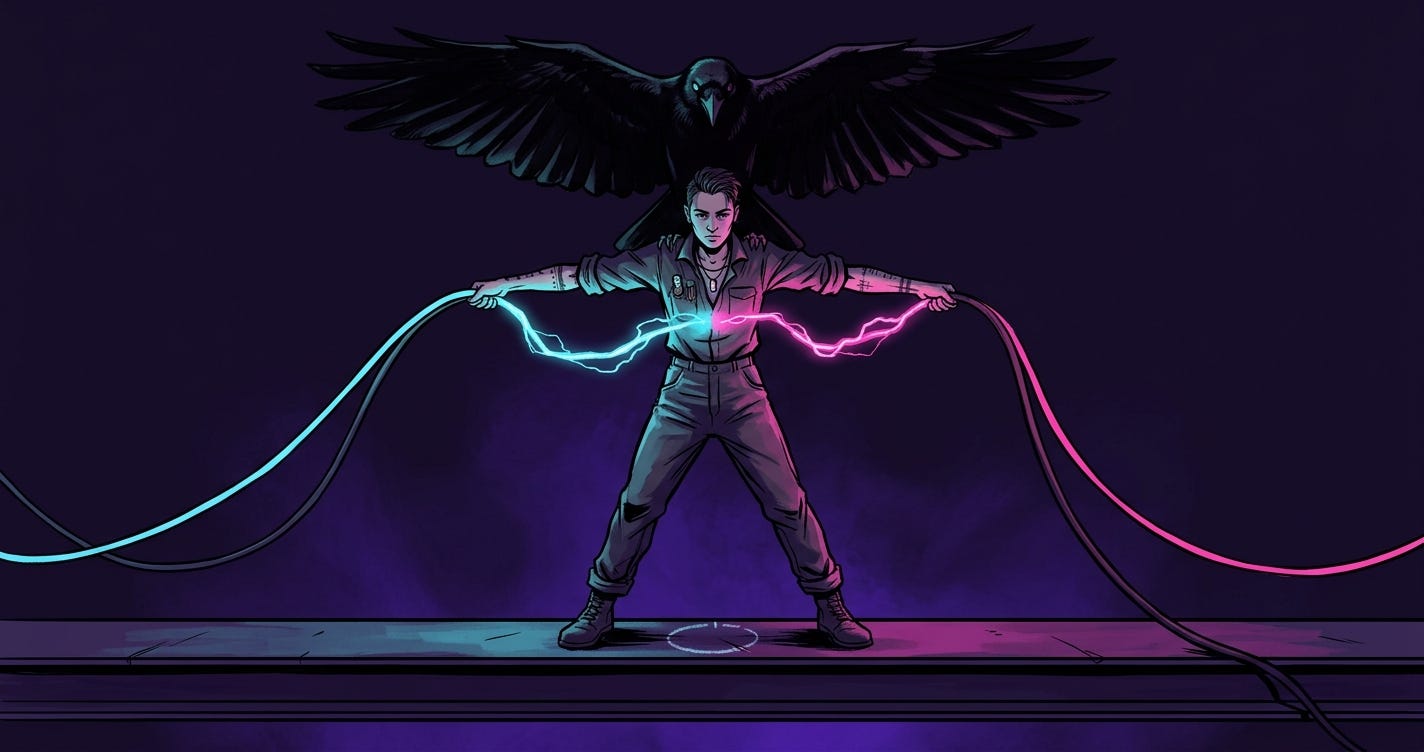
The power is in holding both ends at full strength at once and not letting the wire go slack. Both at a hundred percent. The rebel and the receipt, neither one sanded down to make the other comfortable. I wrote a line in a private notebook a few weeks ago and didn’t understand until last night that it was the whole thesis: I don’t resolve the paradox. I am the reconciliation, walking around. Not a location between the poles. A body that can stand in the current with a hand on each live wire and not let go.
What it costs to keep both hands on
And here’s the fire, because there’s always a fire.
Every system built to reward compliance needs you to let go of one hand. A person held in tension is not legible — you can’t predict them, can’t brand them, can’t fit them under one tidy header on the slide. So the entire apparatus of being respectable is, quietly, a machine for getting you to drop one hand, so somebody can shake the other and know exactly which version of you they’re dealing with. Pick a lane. Stay on message. Be consistent. Build a personal brand — which is just a self with the tension surgically removed so it photographs clean.
I did it for years. I put the witch away to be the architect, and put the architect away to be the witch, and stood in the middle of my own psyche like a traffic cop waving the parts of myself past each other so they’d never be caught in the same room. I sat in rooms where everyone had quietly agreed not to name the load-bearing problem, and I learned to be the smooth one, the contained one, the one who runs the true sentence through three filters until most of the time it doesn’t leave my mouth at all. I called that professionalism. I thought integration was my job — capital-M, capital-Y, the heroic ego managing the chaos, keeping the peace between the factions.
Nope. That wasn’t it.
The work was never to pick. The work was to stop apologizing for either end and put my whole hand on both. That is what the word feral has meant the entire time I’ve been signing off with it, and I only half-knew what I was saying. Feral isn’t wild instead of tame. Feral is the refusal to be domesticated down into one manageable shape. It’s both hands on the thing — and the low sound you make when somebody reaches in to pry one of them loose.
The crow takes no side
There’s a crow that shows up at the end of nearly everything I write. The Badb — the war-goddess in her carrion shape, the one who circles the battlefield and takes no side. I used to read her as neutral. She isn’t. Neutral is a position in the middle. She’s not in the middle of anything — she belongs to both armies at once, attends the whole terrible both-ness of the field, and does not look away from either half of it. She doesn’t resolve the battle into a winner and a loser. She holds it open in her black wings.
That’s the posture. That’s the whole thing.
So I’m not going to tie this off for you. An essay about refusing to resolve the paradox doesn’t get a clean ending — that would be the one betrayal it can’t survive, the last-second collapse to a pole wearing a conclusion’s coat. The two stay open. The eagle and the ledger. The scholar and the chaos witch. The light and the dark. The vessel and what it carries. Both hands, the whole time, on purpose.
A machine read two years of my notes and found the beam I’d been standing on. That part it could do — hold the corpus, hold the memory, hold the pattern up to the light until I finally saw the shape of my own feet. What it cannot do is keep me standing there when every system I walk through is trying to buy one of my hands. That part is mine. It always was.
Stay feral, folks.
great article I think we all have that same thing, but don't notice it because we are always writing it in different ways that to us seems different.