


There’s a stretch of the morning that belongs to nobody. Before the phone, before the first meeting, before the day starts filing its claims — I’m in my thinking chair in the dark running the same sequence I’ve been running for months. Slow breathing, long exhales, until the nervous system chills the fuck out. Then progressive relaxation, which is the most boring miracle available to a human being: tense a muscle group, release a muscle group, repeat, relax. Move on through each remaining muscle group until you eventually look and feel exactly like a ragdoll. Then darkness meditation — eyes closed, attention resting on the dark itself, not as an absence of something but as a substance with its own weather. Then prayers.
Then I got up, made coffee, and pulled a card.
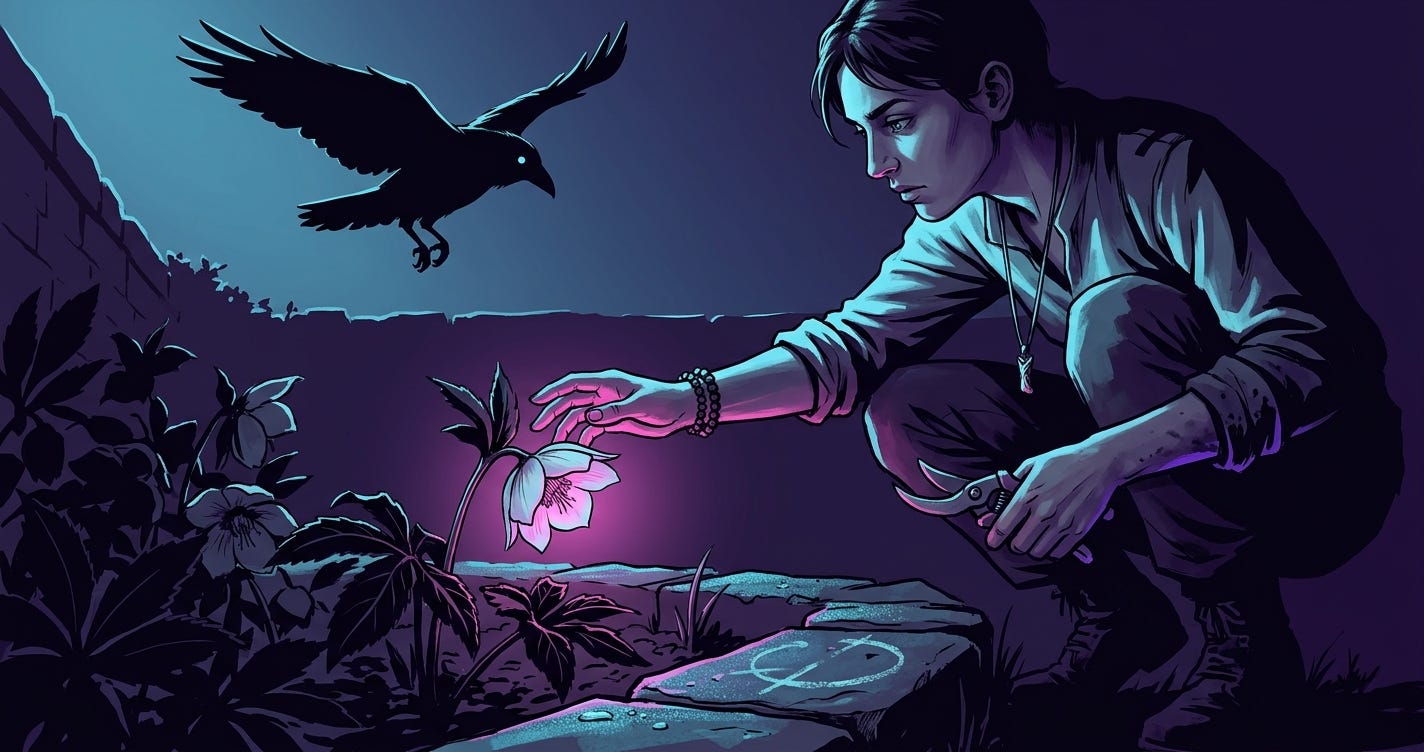
Hellebore. Thirty-six.
Temptation. Danger. Darkness. The dark feminine archetype.
And underneath, the guidance: “meditation during the dark moon phase, along with journaling, is a productive way to explore the dark. Focus on the inward aspects of the psyche.”
I laughed out loud at my altar. I had just done that. The card was prescribing — in the present tense, with the confidence of a physician — a practice I had finished twenty minutes earlier with my ass in the chair.
So much for the charming part.
The deck filed it under danger.
Hellebore is poisonous. In the worst cases it stops the heart. Medieval herbalists also used it to heal people. Both of those are true, at the same time, about the same plant. And there’s a bird-of-omen line attached: if an eagle flew overhead while you harvested the bloom, you’d be dead within the year.
Then the deck asks its question. The one it wants you to journal on:
What temptation or danger is pulling you off your true purpose?
I sat with that the way you sit with a question from someone who means well and has never met you.
Because my honest answer — the one that arrived before I had time to dress it up — was that nothing is pulling me off my path. The pull is the path. The pull toward the dark, toward withdrawal, toward the harsh cut, toward the quiet room and the closed eyes — that pull doesn’t feel like temptation. It never has.
It feels like being called home.
Three things stacked up that morning, in an order that matters.
One. I did the darkness meditation, and then drew the card that prescribes darkness meditation. The practice preceded the instruction. Whatever you believe about how cards work, that sequence has a shape: it isn’t guidance, it’s confirmation. The thing had already started.
Two. The Moon was at twenty-three degrees of Aquarius, waning gibbous, walking down toward the dark. I drew a go-inward card while the sky itself was going inward. I wasn’t swimming against anything. The current was already running that direction and I’d stepped into it without checking.
Three — and this is the one that made the hair on my arms stand up. The night before, a friend had pulled from a different botanical deck, for me, on a question I hadn’t asked her to ask: what medicine does Matt need?
The card she turned over was cannabis.
Two botanical decks. Two nights. Two readers. Neither of us coordinating, neither of us knowing what the other had drawn. And both of them came back with a plant.
There’s a divergence sitting in the middle of this.
The deck in my hand reads hellebore defensively. Danger, temptation, the thing pulling you off course. It is not a stupid deck. It’s a deck written for a general reader, and for a great many general readers that framing is exactly right and probably load-bearing.
The lineages I’ve studied read it completely differently.
There’s a body of work on the dark feminine that puts it plainly: she nourishes, she devours. The withdrawing pole, the life-cutting pole, is not the malfunction of the nurturing one — it’s equal to it, and a picture of the feminine that only contains the nurturing half isn’t merciful, it’s amputated. Jung, who spent his career on this, asked the question that ends the argument: how can I be substantial if I do not cast a shadow?
There’s another line of teaching I’ve done on shadow specifically, and its whole insistence is that shadow is met through dialogue, not war — that you build a container, a ritual, a bounded space, and then you go in and talk to it. Which, I noticed with delight, is precisely what I had built that morning without calling it that. Breath. Body. Darkness. Prayers. I’d constructed the container and walked in before I ever picked up the deck.
And then there’s the Irish material — years of intensive work on the Mórrígan — where the shadow She governs isn’t temptation at all. It’s sovereignty. Warrior-energy. Repressed anger. The terror of releasing control. The raven-mistress, the Great Queen, the one who tells you the truth in a voice you didn’t want it in. A poison flower blooming under an omen bird is not a warning in that grammar. That’s just Her handwriting.
One teacher in that tradition put it in a way I have never been able to put down. This is the dark space behind your eyes. Feel how it’s all around you. Inside you. It IS you.
And that line isn’t only Irish. The Jungian training I did runs on a Vedantic spine, and it arrives at the same place from the far side of the world — that under the persona, under the shadow, under the whole apparatus you call yourself, what’s actually there is awareness. Not something you have. Something you are. Two traditions, no shared border, one sentence.
Which reframes the entire question. The dark isn’t a destination I travel to and should be careful about visiting. It’s the substrate. It’s what I’m made of. You cannot warn a person about the danger of the room they live in.
The reframe that finally made it click isn’t that the deck is wrong.
The deck read the card correctly. It read it for a querent who isn’t me.
What danger is pulling you off your true purpose is a genuinely good question — if you’re someone for whom the descent is a hazard. If darkness for you means the depressive spiral, the isolation that eats the friendships, the withdrawal you can’t climb back out of. There are people for whom “go inward” is the worst available advice, and a deck sold to strangers has an obligation to those people.
But that frame was written from outside the dark, by and for people who experience it as weather that happens to them. I don’t live outside it. I’ve been down those stairs so many times I know where the creak is.
The danger the card warns about is only danger to someone who doesn’t belong there.
And I know exactly how that sounds. Convenient, Matt. The card says danger, you’ve decided it means welcome, and now you get to keep doing the thing you already wanted to do. Fair. It’s the same move anyone makes when they want permission badly enough.
So how do you tell the difference? How do you know when you’re reading the card and when the card is just reading your appetite back to you?
You check it against the body. Not the story you tell about the body — the body. Mine has been getting up before dawn to sit in the dark for months, without being asked, before any card said a word about it. That’s not appetite. That’s a practice that predates its own justification.
I need the Sun.
I’m not being cute. Give me four overcast days in a row and you can watch my energy drain out through the floor — motivation gone, executive function gone, the whole apparatus sliding toward genuinely depressed. The dark is home and too much of it will bury me. Both. Simultaneously. Anyone selling you darkness as a personality is selling you half a waveform and calling it a philosophy.
Because that’s what this is. A waveform. The same oscillation I’ve written about before as potato time — productive-as-hell on one end, fully fallow on the other, and the ride between them is not a bug in the machine. It’s how the machine runs.
My favorite tarot teacher handed me the proper name for this, and it’s older and better than anything I’d have come up with. Enantiodromia. Jung borrowed it from Heraclitus — enantios, opposite, plus dramein, to run a course. The running-toward-the-opposite. When one side of the psyche gets overdeveloped, overstimulated, overfed, a compensating force builds on the other side and eventually flips you. Jung’s read on it was that this is not a malfunction. It’s a regulating system. The psyche correcting its own steering.
You know this one already, by the way. Ever come off a stretch where you produced like a machine for three weeks and then couldn’t answer a text for four days? That’s not you failing at the fourth week. That’s the fourth week arriving on schedule.
Which means the suffering was never in the descent. It’s in getting stuck at a pole. Too long in the gloom with no light coming — that’s the pit. Never permitted to descend, always up, always producing, always facing the Sun with your teeth out — that’s a different pit, and it’s the one this culture will hand you an award for falling into.
Which brings me back to the two plants, and to what I think they were actually saying.
Hellebore will stop your heart. Herbalists healed with it. Cannabis is a weed that half this country is still imprisoning people over and the other half sells in a shop with bougie lighting. Neither of those facts is the interesting one. The interesting one is the structure they share, which the Greeks already had a word for: pharmakon. The thing that is poison and cure in the same substance, where the entire difference is dose and relationship.
Not which plant. How much, and what’s your relationship to it.
And both of them are descent medicines. Down-and-in. Parasympathetic. The loosened grip, the unclenched jaw, the hand coming off the wheel. Which is the identical register as the progressive relaxation and the darkness meditation I’d been doing in the chair at dawn — no plant required, same direction of travel.
So the three pulls all circle one answer. My friend’s deck asking what medicine I need. My deck handing me a poison flower. My own body, before either card was turned, already sitting down in the dark.
The medicine is permission to descend.
Not a tool to resist the pull toward home. The exact opposite. Permission to stop standing guard at the top of the stairs, checking the dark for threats, running security on a room I was born in.
One word here has been hollowed out. Shadow work has become something you announce on a Sunday between the matcha and the journaling — a self-care flavor, a weekend activity, a thing you complete. The lineage I trained in was blunt about this: that’s not what it is. Shadow work is the nigredo, the blackening, the first stage of the alchemical process — the stage of confession, where you finally say the true and unflattering thing out loud. It takes a lifetime. It is not a Sunday. And it breaks you open a little every time, which is why it deserves sober handling rather than a hashtag.
But that same training was blunt in the other direction, and this half indicts me rather than the matcha. You can get lost in the shadow. You can get so practiced at the excavation that it quietly becomes the entire life — get triggered, analyze it, descend, repeat — and never come back up carrying anything. The descent becomes its own hamster wheel. Its own samsara. The teaching: the clearing was never the destination. It’s preparation. Sooner or later the question stops being what’s down there and starts being what do I want to make.
Which means the permission I’m describing isn’t permission to move in. Integration never meant becoming the thing. It means the compulsion loses its grip — the guarding stops running me — so that going down and coming back up are both things I choose instead of things that happen to me.
I’m not doing shadow work. I’m doing something much less impressive and much more ordinary. I’m going home, in the dark, most mornings, in the chair, and calling it what it is.
And I come back up. That’s what a darkness-romance leaves out. I don’t descend in order to produce — the moment you make the dark an input to your output, you’ve turned home into a commute, and this culture will sell you that trade all day. But something does come back up the stairs with me. A lot of it ends up here, with you.
The deck asked what danger was pulling me off my true purpose.
Nothing is. The pull is the purpose. The descent isn’t the temptation that interrupts the devotion — the descent is the devotion. It always was. I just had it filed under the wrong heading, in a language written by people who were afraid of the room.
The card thought it was warning me.
It was welcoming me.
Stay feral, folks.