


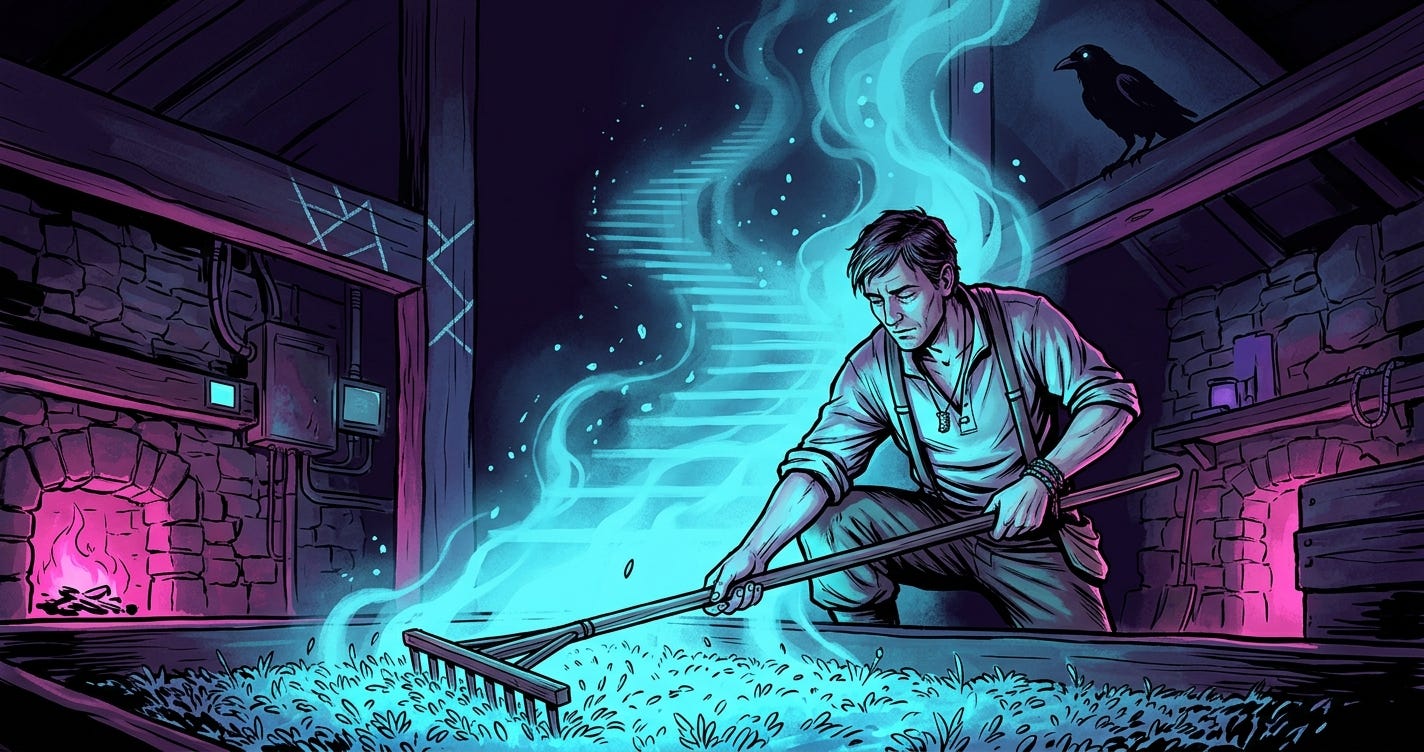
The record says Alexander Wilkie, maltman, burgess of Edinburgh. Recorded 10 January 1582.
A maltman. He soaked barley until it woke up, let it germinate just far enough, then dried it on a kiln floor before it could spend itself growing. That’s malting — you arrest the grain at the exact moment it has unlocked its own sugar and not yet eaten it. You make the substrate that something stronger will later ferment out of. A maltman doesn’t make beer or whisky. He makes the condition for them. He works one step upstream of the intoxication.
It is the least glamorous job in the whole chain. The brewer gets the craft, the distiller gets the romance, the drinker gets the night. The maltman gets up before dawn and turns wet grain with a wooden shovel so it dries even, and breathes barley dust, and is paid least of anyone the barley passes through. But nothing downstream happens without him. No malt, no fermentation, no spirit — he’s the invisible first cause of the whole intoxicated economy. And in 1582 Edinburgh he wasn’t some peasant: he was a member of an incorporated trade, a burgess, a man with a guild and a name in the civic register. Not poor. Just first, and low, and necessary.
He is my great-grandfather. Roughly a dozen greats deep — I’ll be honest about that in a minute — but for the length of this essay he’s the maltman, and I’m the maltman’s great-grandson, and the compression is the point.
Here’s what his family did in the sixty years after that record.
The staircase the Reformation cut
Alexander’s son was Daniel Wilkie, born around 1580, and Daniel did not make malt. Daniel became a minister. He took a Master’s at St Andrews, taught there as a college regent, was ordained in 1605, and the very next year was presented to his parish by King James the Sixth himself. Read that again: the maltman’s son, handed his living by the King of Scots. Dead by 1628. First minister in the family — and that leap, from a man who turned grain on a kiln floor to a man the crown installs in a pulpit, was no fluke of one clever boy. It was a door that had just been kicked open.
The Reformation didn’t only change what Scotland believed. It rebuilt the machinery of who gets to rise. The old church had been a closed aristocratic guild; the new Reformed Kirk suddenly needed an enormous number of literate ministers, fast, and it didn’t much care whose sons they were as long as they could read scripture and preach it. For exactly one or two generations, a literate burgess-class kid — a maltman’s boy — could walk through a door into a vocation that carried real status. Daniel walked through it. The whole first cohort of Reformed clergy is full of Daniels: craftsmen’s sons who became Reverends because the institution was new and hungry and the gate was briefly, structurally open.
And here’s the thing about kicked-open doors: they don’t stay open. Within a couple of generations the ministry would credential and professionalize and start preferring its own sons, the way every institution does the moment it stops being hungry. Daniel made it through in the window. Timing is most of what we later call merit.
Then his son closed the loop.
David Wilkie — the minister’s son, apprenticed to an Edinburgh merchant as a teenager and a burgess in his own right by his twenties — married Catharine Tod on the 17th of September, 1640, in Edinburgh parish. Catharine had been baptized in that same city on the 11th of June, 1620, the daughter of Sir Archibald Tod, who was Lord Provost of Edinburgh. The chief magistrate of the capital. David married into the civic elite while Catharine’s father held the highest office in the city. They had eleven children, and the line runs straight down through the eldest, Johnne Wilkie, born 1647 — and from him, name by documented name, through James and another Wilkie generation to the William Wilkie who would put the family on a boat to America in the seventeen-hundreds. The record doesn’t lose them. That’s the part that surprised me: they’re all right there, generation after generation, nothing underground about it.
Sit with the arc. Maltman, 1582. Minister ordained by 1605, installed by the King a year later. The Lord Provost’s son-in-law, 1640. Craft class to clergy to civic aristocracy in three generations and fifty-eight years. The grain-kiln to the Provost’s table inside a single great-grandfather’s memory.
That is not a fairy tale about a hardworking family. That is a structure. The Reformation cut a staircase into a class system that hadn’t had one, and the Wilkies — literate, burgess, positioned — ran straight up it before it could close again.
What the climb runs on, and what it costs
Every climb like this runs on the same fuel: the institution that happens to be opening at the exact moment you’re standing there. For the Wilkies it was the new Reformed ministry — the one growth industry of post-Reformation Scotland that took burgess-class sons and turned them into men with titles. You don’t climb on merit alone. You climb on merit plus a door, and the door is always some institution in its hungry, expanding, not-yet-credentialed youth.
It was true for the Reformed ministry in 1580. It was true for the railroads and the steel mills that hauled the next centuries of poor men’s sons up a rung. True for the trading houses, for the universities in the brief windows they cracked open, for the civil service. And it was true for the thing I walked into. Every era runs exactly one or two of these doors — institutions young enough to still be hungry, not yet old enough to gatekeep by pedigree — and the families that rise are the ones who happened to be standing in front of the right one during the right twenty years.
And here is the part the heritage-pride version leaves out. The door the Wilkies climbed through was the door of the church that was, in those same decades, busy burning the old world out of Scotland. The Reformed Kirk that gave Daniel his collar was the same Kirk prosecuting witches, smashing the folk-Catholic shrines, stripping the saints and the wells and the Goddess-haunted edges off the land, flattening every symbolic and magical practice it could reach into heresy. My family didn’t just survive the Reformation. They rode it. They climbed the machine that was doing the suppressing. The maltman’s grandson married into the civic class that signed the warrants.
I’m not ashamed of them. They did what you do — you take the open door. But I’m not going to pretend the door was clean, either. The receipt is part of the inheritance.
The maltman’s great-grandson, running it backwards
Now the rhyme, and the turn.
I ran the same climb. Working-class North Carolina — the family field was blue-collar and clergy, hard work for not a lot of money — to engineer, to whatever I am now: a writer, a practitioner, a builder of symbolic systems who gets paid for the synthesis. Craft origins, a vocational leap through the one institution that was open and hungry when I showed up to it (for the Wilkies, the Reformed ministry; for me, software, the late-century growth industry that took a kid with no pedigree and gave him a title and a salary), and then an arrival somewhere my grandparents couldn’t have placed on a map. Three moves. The same three moves. I re-ran a sixteenth-century Edinburgh class-rise, in one lifetime, in Mississippi, without knowing the Wilkie arc existed until this year. The shape was in my hands before it was in my notes.
Nobody in my family had done what I do. There was no template for it, no inherited contacts, no door held open because of the name — the name didn’t open doors, it meant church on Sunday and work on Monday. I climbed on the one thing that was open: a screen, a manual, a field that would hire anyone who could actually make the machine do the thing, pedigree be damned. Which is the exact same gate Daniel walked through. The Kirk took any literate boy who could preach scripture; my industry took any kid who could read the error and fix it. New hungry institution, low-born entrant, one rung up. Four hundred years apart, identical mechanism.
But here’s the inversion, and it’s the whole piece.
The maltman’s son climbed into the dominant structure. He rose by joining the church that was suppressing the old magical world. I ran the identical climb-shape and pointed it the opposite direction — I rose, and then I used the standing it gave me to walk out of the dominant structure and straight back toward everything it spent five centuries burning. The tarot. The Hermeticism. The Goddess my Reformed ancestors would have called the Devil’s business. The Mórrígan. I climbed the ladder my family built and then climbed it back down into the basement they’d bricked over.
Same genetic move. Opposite theology. The Wilkies rose by building the Protestant edifice. I rose, then spent the altitude deconstructing it. The maltman’s great-grandson breaks exactly the kind of institution the maltman’s son climbed into — and that is not a betrayal of the line. It’s the most Wilkie thing I could possibly do. They were always climbers who used the open door to get somewhere their fathers couldn’t. So am I. The door I found open led back the way they’d come.
And my door had its own suppression to answer for, same as Daniel’s church did. The industry that took me in has spent my whole career flattening the exact things this newsletter is about — the symbolic, the intuitive, the sacred, the parts of a person that don’t reduce to a ticket or a sprint. I climbed into a machine that also burns the old world; it just has cleaner branding and better dental. So walking back out of it isn’t nostalgia and it isn’t a tantrum. It’s Daniel’s move run in reverse, with the same clear eyes about what the institution actually is and what it costs to belong to it.
Distance, and honesty about it
Alexander the maltman is not my great-grandfather. He’s something like my twelfth-great, a dozen generations up, most of them names the record only half-remembers. “The Maltman’s Great-Grandson” is a compression — a way of standing close to a man four centuries dead because the shape he started is still running in me. I’d rather say it that way and be honest about the distance than pretend to a closeness the parish registers won’t support. And the registers support a lot — the Wilkies are documented name by name from Edinburgh down to me, no gap, no missing stretch. What actually happened isn’t that the line disappeared. It’s that it moved. The family climbed into the Edinburgh civic class and held there for generations, and then William Wilkie got on a boat, and the New World did what it does: it reset the board. Edinburgh civic standing meant nothing in colonial Carolina. The status the maltman’s family spent sixty years climbing to was gone in a single Atlantic crossing, and the climb had to start over from the floor. By the time the line reaches me it’s working-class North Carolina, beginning again. That’s the part nobody tells you about inheritance — it isn’t the money or the rank that passes down, because those evaporate. It’s the shape of the move. The reaching. The climb is the heirloom.
What came up in me was the climb-shape and the maltman’s actual trade, weirdly intact. Because look at what I do. He arrested grain at the moment it had unlocked its sugar and made the substrate spirit ferments out of. I take raw experience — a transcript, a tarot spread, a dead ancestor in a ledger — and arrest it at the moment it’s unlocked its meaning and not yet spent itself, and I make the substrate that something stronger ferments out of later. The Scots called whisky uisge beatha. The water of life. The maltman made the water of life one humble step upstream. So do I. Different spirit. Same trade.
The crow that sits on everything I publish — the Badb, who keeps the names the official record loses — would point out that the maltman’s name survived and Teek’s did not, and that this is not an accident but a map of who the record was built to remember. Both are mine. The climber whose name the city wrote down, and the woman it filed under a slur. I carry the whole staircase and the people it was built on top of.
Alexander made malt in Edinburgh in 1582 so something stronger could come of it later.
I’m the later. Stay feral, folks.