


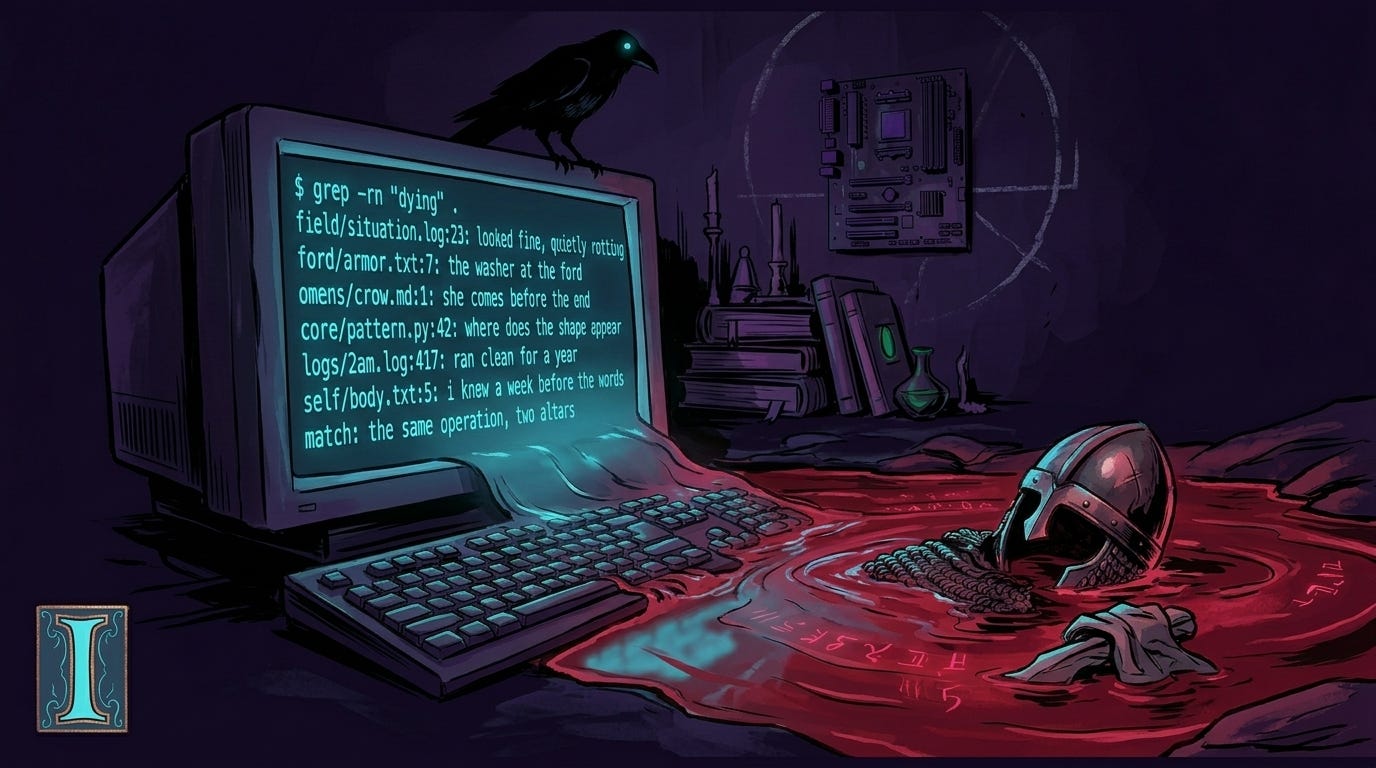
Here’s a thing I do at the muggle job. Something breaks — some process that ran clean for a year suddenly shits the bed at 2 a.m. — and the first move, before theories, before blame, before the panicked Slack message, is always the same. grep. You take a pattern and you drag it across a mountain of text — logs, source, config, ten thousand lines no human will ever read top to bottom — and you ask the machine one question. Where does this shape appear? And the machine, which has no opinions and no shame and no stake in being right, hands back every place the pattern lives. You didn’t read the mountain. You read the pattern through the mountain. That’s the whole trick. That’s the whole job, most days.
Here’s a thing I do at the other altar. Something’s off — some situation that looked fine is quietly rotting, and I can feel it in my body a week before I can say a word about it — and I pull cards. Or I don’t even pull cards; I just notice the crow. The Mórrígan has a way of showing up when something is dying that hasn’t admitted it’s dying yet. She’s the washer at the ford — in the old Irish telling, you come around a bend in the river and there’s a woman scrubbing the blood out of armor, and the armor is yours, and you don’t yet know you’re already dead. So I take that pattern — death, sovereignty, the thing that has to end before the thing that wants to be born can get a word in — and I drag it across the situation. Where does this shape appear?
I need you to sit with this, because the entire rest of this place is built on it: that is the same operation.
Not a metaphor for the same operation. Not “kind of like” the same operation. The same operation, run on two different instruments. You take a pattern. You pass it over a field of information too large to read directly. You see where the shape lands. grep does it to a codebase. The Mórrígan does it to a life. One returns line numbers; the other returns a shiver up your spine and the sudden knowledge of what you have to do. Different outputs. Identical move.
You were taught these were enemies
Here’s what I know about you, because it’s true of me. Somewhere along the way you got handed two rooms and told to pick.
In the first room, the real one — the one with the salary and the org chart and the people who matter — symbol is woo. Tarot is a party trick. Astrology is for people who can’t do math. Dreams are random neural exhaust. Intuition is a bias you should correct for. The currency in that room is data, rigor, the legible and the measurable, and you learned to speak it fluently because that’s where the rent came from.
In the second room — the one you only go into late, alone, with the door shut — the technical stuff is cold. Soulless. The reason everything’s so dead. Real knowing comes from the gut, the cards, the moon, the body; the spreadsheet is the enemy of the sacred; if you were really living from your intuition you wouldn’t need the system at all.
And both rooms agree on exactly one thing: you have to leave half of yourself at the door. The architect checks the witch at security. The witch rolls her eyes at the architect. You spend years being told the symbolic stuff is fluff in one room and the technical stuff is death in the other, and the cost of that — the actual, load-bearing, decades-long cost — is that you never get to be one person. You get to be a competent fragment, twice.
I did that for a long time. I was very good at it. It nearly killed me, in the slow way that doesn’t make a sound.
This is the room where you stop.
Why they’re actually one thing (the floor under the floor)
I’m not asking you to take “they’re the same” on vibes. There’s a doctrine under it, and it’s old as hell.
The oldest piece of the Western esoteric tradition — the line carved into the Emerald Tablet, the thing every Hermetic system since has been a footnote to — is “as above, so below.” The law of correspondence. The claim is simple and enormous: the pattern repeats at every scale. The structure of the cosmos and the structure of a single human soul are the same structure, read at different magnifications. Heron Michelle, whose Pentacle Path I trained on, doesn’t bury this — Part One of her whole curriculum is literally called Hermetic Foundations, because you can’t do any of the rest without it.
And once you’ve got the law of correspondence, the so-called separate magical systems stop being separate. They’re all reading the same pattern at different scales. The Magician card, Mercury the planet, the Magus of the lodge, an air working in elemental witchcraft, the Mórrígan’s shape-shift, a clean refactor that makes a tangled system suddenly legible — these are not six unrelated things that happen to rhyme. They are one pattern — the intelligence that moves between worlds and rearranges what it finds — surfaced through six vocabularies. Astrology reads the planets. Magic operates them. They share an API. The Hermetic axiom is why that’s allowed: the correspondence is real, so the translation holds.
That’s the floor. Here’s the floor under the floor — and this is the part the witches in room two don’t expect me to bring, and the architects in room one don’t expect me to survive.
The brain was already doing it
You do not experience reality. You can’t. The bandwidth isn’t there — the raw firehose of the world is orders of magnitude more than your nervous system can pass. So your brain does the only thing it can: it guesses. This is not woo; this is the dominant model in cognitive neuroscience right now, and the names on it are sober ones — Anil Seth, Lisa Feldman Barrett, the whole predictive-processing turn. The brain runs a constant model of what’s out there based on its priors — everything it already expects — and what you call “seeing the world” is really you inhabiting your brain’s best guess, corrected only where the error is too loud to ignore. Barrett’s whole body of work on constructed emotion says the same thing one level in: you don’t detect fear, you build it, out of priors and bodily signals and the meaning you’ve learned to assign.
Read that again, because it’s the hinge of everything: your lived experience is a construction, assembled from the patterns you already carry.
Now. What is a tarot spread? It’s a device that drops a fixed set of archetypal patterns onto the table in front of your priors and forces a re-read. What’s a natal transit? A calendar of patterns the sky is wearing, laid over the patterns you were born holding. What’s a spell, or a sigil, or a SATS session out of Neville, or — and this is the one I had to write a whole paper about — a deliberate act of redirected attention? Every one of them is the same kind of tool: a technology for reorganizing the priors your brain reconstructs your reality from. This is the spine of the work I’ve been building under the name the DMN Rewriting Engine, standing on a hundred-and-fifteen-year lineage — Wattles, Hill, Neville, Robert Anton Wilson — all of whom said attention shapes the priors that build experience in successively more precise dialects, until the neuroscience finally caught up and named the substrate.
The symbolic operating systems are attention-technologies. That’s what they are. That’s what they’ve always been. Not superstition that happens to sometimes work — instruments for working the one machine that builds your world. And the engineer in you should feel something click into place here, because you already believe that attention and framing change everything; you just called it “requirements” and “mental models” instead of “ritual.”
One honesty line, because feral voice has safe hands. I am making the supported claim, not the seductive one. Redirecting your attention reliably reshapes your experience — what you perceive, what you feel, what you notice, what becomes possible. It does not reliably reach out and rearrange the furniture of the physical world by wanting; that reading doesn’t survive contact with the evidence, and I’m not going to sell it to you to make the magic feel bigger. The magic is plenty big. It works on the realest thing you’ve got — the only reality you ever actually touch, which is the one your brain is building right now, out of this sentence.
I want it all
So here’s the part where I refuse the deal both rooms offered me.
I am not going to make the mystical bow to the empirical. And I am not going to let the empirical sneer at the mystical. I hold both as first-class, on their own terrain, neither one collapsed into the other — and I learned to do that honestly partly from my own training in CreativeMind, where Debra and Dr. Rob Maldonado teach Jung and Vedanta and neuroscience in the same breath, as one continuous account of mind, with nobody apologizing to anybody. Jung himself is the original bridge here: his late work is the claim that alchemy was never about lead and gold, it was the projected map of the soul becoming whole — as above, so below, said in a lab coat.
The empirical mode is a tool. The symbolic mode is a tool. They read different layers of the same patterned reality, and the person who can run both processors over the same input sees things neither one catches alone. The architect who can also read the archetype. The witch who can also read the logs. That’s not a contradiction you have to resolve. It’s a range you get to operate across. “I want it all” isn’t greed. It’s an epistemology.
That is what The Construct is. A room — maybe the only one I know of — where both the Mórrígan and grep are real, where a tarot spread and a terminal window are both legitimate instruments, where you can talk about your shadow and your calendar in the same breath and neither one gets the condescension. You don’t have to pick. You never did. The picking was the wound.
The practice (do this one thing)
Don’t take any of this on faith. Faith is room two’s racket and proof is room one’s. Run the experiment instead.
Pick one situation in your life right now that’s live — a decision, a tension, a thing that’s stuck or quietly rotting. Then read it twice, on purpose, with both instruments:
The
greppass. Cold and literal. What are the actual facts? The data, the deadlines, the dependencies, the system. What would you write in the incident report? Strip the meaning out and just get the structure. Write it down.The Mórrígan pass. Now drag a pattern across it. What archetype is moving here? What’s the shape of this — is something dying that won’t admit it? Is this a threshold, a betrayal, a sovereignty you’re failing to claim? Pull a card if you want one. Notice what your body already knew a week ago. Write that down too.
Then look at the two readings side by side and resist — hard — the urge to decide which one is the real one. Neither is. They’re two passes of the same pattern-matching move over the same situation, and the truth you’re after is standing in the space between them. That space is where you’re going to live now. Get comfortable. Bring the whole of you through the gate; the walls can hold it.
Welcome to The Construct. Now you know how to read everything else.
Stay feral, folks.
Foundation I of VII. Next: Archetype — the grammar. The vocabulary everything in here gets conjugated in. With gratitude to the teachers whose work this stands on, named above and throughout — the synthesis is mine, the lineage is theirs, and credit is a feature.