


Back in Foundation I, I handed you a four-word axiom and basically asked you to spot it the loan. As above, so below. I told you it was the floor under the floor — the reason a tarot card and a planet and a refactor and the Mórrígan’s shape-shift could all be the same pattern read at different scales. I used it to make the translation between systems hold. Then I moved on, because that piece had a job and the job was the worldview, not the archaeology.
This is me paying the loan back. Because that axiom isn’t a vibe I made up to glue the series together. It’s the load-bearing claim of the oldest continuous esoteric tradition in the West, it has a name and a lineage and a four-hundred-year-old scandal attached to it, and one of the people who taught it to me built the entire first third of her curriculum on it before she’d let a student do anything else. Foundation I gave you the working floor — the floor you stand on to get the work done. Deeper Cut I is the deep study of that floor: where the stone came from, what’s carved on it, and — the part I’ve been sitting on this whole time — whose god it is.
Spoiler: he rules my chart.
The two wrong rooms (Hermeticism gets the deluxe pair)
You know the drill by now. Two rooms, pick one, leave half of yourself at the door. Hermeticism gets an especially good pair because it’s been mugged by both sides for centuries.
Room one, the skeptic’s museum: Hermeticism is a pile of debunked medieval nonsense. Lead-into-gold, secret correspondences, “as above so below” — pre-scientific pattern-matching from people who didn’t have a periodic table, dressed up in robes and Latin. A historical curio. Newton wasted a million words on it and we politely don’t mention that part at the gravity parties.
Room two, the mystery-school gift shop: Hermeticism is Ancient Egyptian Secret Wisdom™, five thousand years old, encoded by god-priests, and The Kybalion is the sacred decoder ring that unlocks the literal mechanics of reality so you can think yourself a Tesla. Buy the candle. Buy the course. The All is Mind, so technically your overdraft fee is a vibration you chose.
Both rooms are wrong, and — this is the part I love — the person who handed me the corrective was a witch, not a scientist. Heron Michelle, whose Pentacle Path I trained on, opens her Hermetic Foundations not with mystification but with history, the real and slightly embarrassing kind. She’ll tell you straight: in 1614 a Swiss Calvinist named Isaac Casaubon did the philology and proved the Corpus Hermeticum couldn’t have been written any earlier than about the first century CE — which means it did not predate Moses, did not found anybody’s religion, and was never the antediluvian Atlantean download the Renaissance thought it had bought. The fascination collapsed. The whole tradition went underground for the crime of being younger than advertised.
So here’s the move, and it’s the move this entire place runs on: a thing can be exactly as old as it actually is and still be true. Hermeticism is not ancient Egyptian secret science and it is not debunked nonsense. It’s a syncretic philosophy of nature that crystallized in Roman-era Alexandria, where Greek philosophy and Egyptian religion got stirred together in the world’s best library — and it has survived two thousand years not because someone smuggled it out of a pyramid but because the pattern it names keeps checking out. Hold the honest date and the live current at the same time. That’s not a downgrade. That’s just what intellectual integrity costs, and I’d rather pay it than sell you a forgery to make the magic feel older.
Who Hermes actually is (and why I take this one personally)
The tradition is named for a person who is three persons wearing one hat.
Hermes Trismegistus — “Thrice-Greatest Hermes.” Heron lays out the syncretism cleanly: he starts as Thoth, the ibis-headed Egyptian god of writing, magic, knowledge, and the moon — the one who governs thought (the Egyptians even have a version where his name sounds like thought, which, come on). The Greek philosophers in Alexandria looked at Thoth and recognized their own Hermes — messenger, trickster, the god who crosses between worlds, the one who can walk into the underworld and walk back out because borders don’t apply to him. The Romans called the same figure Mercury. Thoth, Hermes, Mercury: one intelligence, three vocabularies. The god of the crossing — between worlds, between languages, between the human and the divine. The patron, in other words, of translation itself. Which is the entire job of this series.
Now the part I’ve been holding since Foundation I, because you weren’t ready for it and honestly neither was I.
I have Virgo rising. That means the planet that rules my whole chart — the one the astrologers call the chart ruler, the lens the entire nativity gets read through — is Mercury. And in my chart Mercury isn’t just the ruler; it’s the highest-power planet, the single loudest voice in the room, sitting in Sagittarius in the fourth house, reaching across the sky in a tight trine to Jupiter in the twelfth. The mind reaching for expansive wisdom through hidden knowledge — that’s the chart-reader’s boilerplate for that exact aspect, and I didn’t write it, the sky did. So when I tell you the god of as above so below — the god of crossing between the technical and the symbolic, the architect’s terminal and the witch’s table — happens to be the literal ruler of my chart, I’m not reaching for a flourish. Hermes runs my sky. I spent twenty years being a translator at a muggle job and a translator at the altar and never once connecting the two, and the god who governs both was sitting at the head of my chart the entire time, tapping his foot. As above, so below. The pattern was in the heavens and it was in the life, and it was the same pattern, and it took me four decades to read it. This Deeper Cut is, in a real way, me finally answering my own chart ruler.
The Emerald Tablet and the one true sentence
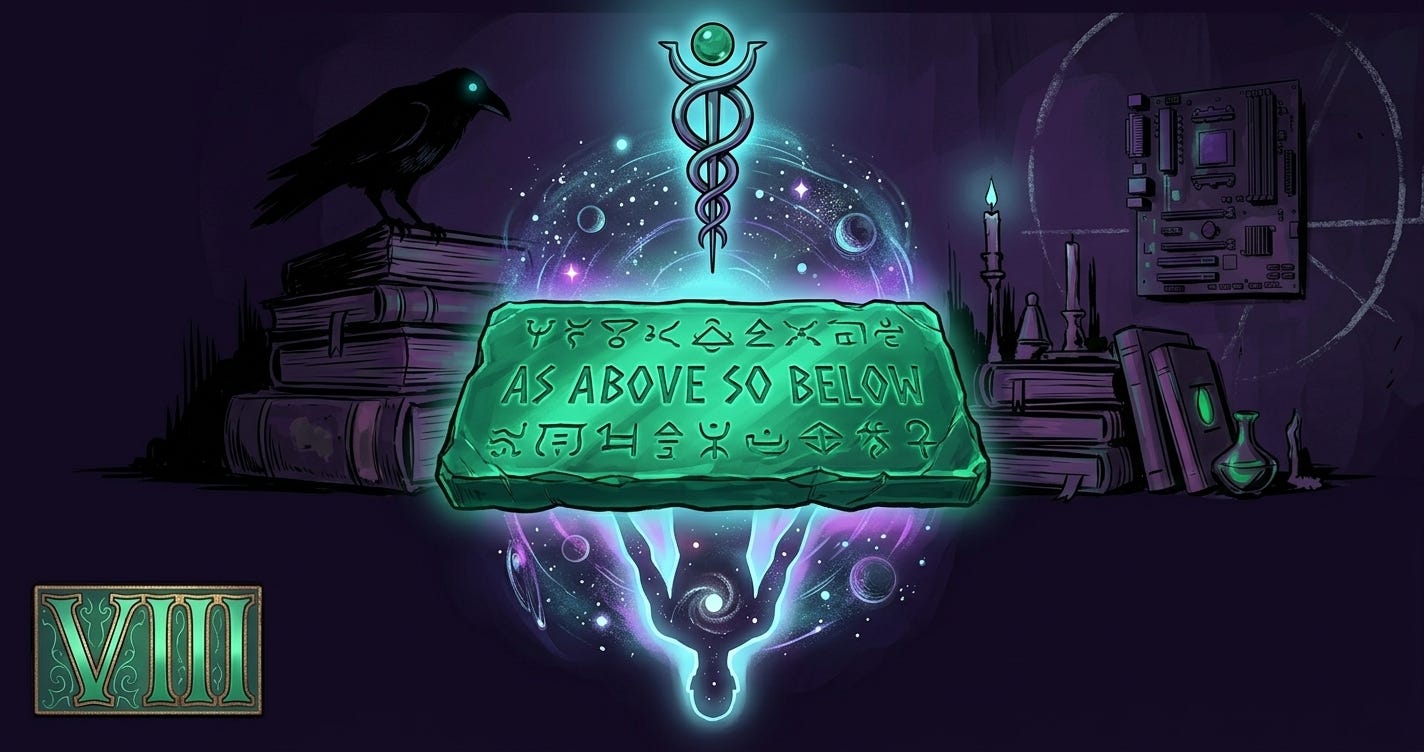
Strip the tradition down to a single line and you get the one carved — legend says — into a slab of green stone: as above, so below; as below, so above. The Emerald Tablet of Hermes Trismegistus. Every Hermetic system since is, more or less, a footnote to that sentence.
Here’s the claim, stated flat: the pattern repeats at every scale. The structure of the cosmos and the structure of a single human soul are the same structure, read at different magnifications. Macrocosm to microcosm, no seam. The thing that is true of the largest is true of the smallest, because reality is one fabric and the fabric has a weave.
And once you actually believe that — not as poetry, as architecture — every supposedly-separate magical system stops being separate. They’re not a buffet of unrelated superstitions. They’re instruments reading the one weave at different scales. Astrology reads the pattern at the scale of the sky. Tarot reads it at the scale of the table. Alchemy reads it at the scale of matter and soul. The body reads it at the scale of a single nervous system. They share an API — I said that in Foundation I and this is the doctrine that licenses it. The correspondence is real, so the translation holds. That’s why Heron can teach the chart and the candle and the card as one craft instead of three hobbies. The Emerald Tablet is the permission slip.
The book Hana handed me
I need to tell you how I actually met these principles, because it’s the whole point of this piece, and it’s the truest “as above, so below” I know — and it didn’t happen in a book.
Before I had any of this framework — before Hermeticism was a word I’d have said out loud — I was sitting at a retreat center with a journal, working something out on my own. I said it on the first episode of my podcast, reading straight from an entry dated the twenty-eighth of May. I’d asked myself a big dumb honest question — is striving and competition built into the very fabric of the universe? — and what came back wasn’t an answer. It was a word. Resonance. And I sat there and unspooled it, with zero occult vocabulary. Just a guy and a frequency.
Resonance is a physical thing first, and that’s where I started, because that’s the brain I have. All matter vibrates at a natural frequency — its resonant frequency. You’re made of matter, so you vibrate too. Apply an outside vibration at that same frequency and the energy gets absorbed — the system swings to a higher amplitude. That’s not a metaphor; that’s a wine glass shattering at the right note, a bridge coming apart in a textbook. And it’s also exactly why, when something “resonates with you,” you feel it in your chest a full second before you can argue for it: a pattern out there just hit your resonant frequency and your whole system swung wider. Then the journal kept going, past where I meant to stop: there’s a resonance built into the way things work. Death precedes life precedes death. It’s not a cycle — it’s an endlessly swinging pendulum. We resonate between death and life. We’re never fully dead, never fully alive. Creation and destruction, back and forth. Matter isn’t created or destroyed; it only changes form. It only resonates. The journey is the life. The resonance is the life. And then one last line I didn’t explain — I just wrote it and closed the book: are resonance and love the same thing?
Notice what I’d done, alone, with no system. I had described a universe of vibration, swinging between polarities, in rhythm. I just didn’t have those words yet.
Then Hana O’Neill — my first teacher, the witch who handed me half the doors I’ve since walked through — recommended a little book. The Kybalion. I devoured it. And it was the strangest sensation, because I wasn’t learning it. I was being introduced to my own handwriting. There were the principles, laid out cold, a hundred and fifteen years before I uncapped that pen:
Mentalism — “The All is Mind; the Universe is Mental.”
Correspondence — as above, so below.
Vibration — nothing rests; everything moves, everything vibrates.
Polarity — everything has two poles; opposites are one thing read at two ends (hot and cold are both just temperature).
Rhythm — everything flows out and in; everything has its tides; the pendulum swings.
Cause and Effect — nothing is mere “chance”; every effect has its cause.
Gender — everything carries generative polarity; creation happens at the interplay (and yes — Heron, who learned these from Christopher Penczak, a gay man, teaches this one as a spectrum, not a 1908 binary; I take it the same way).
Three, four, five — vibration, polarity, rhythm — that was my retreat journal almost verbatim, written by strangers in 1908. The resonance is the life and the pendulum swings are the same sentence in two dialects. And number two, correspondence — as above, so below — I’d written that one too. I’d just called it isomorphism: “when we see isomorphisms between things, what we’re seeing are aspects of those things that resonate at the same frequency.” That’s the whole Emerald Tablet, rephrased by a guy with an engineer’s brain who didn’t yet know he was quoting Hermes.
So here’s the honest date, and watch what it actually does. The Kybalion is 1908. Written by a Chicago lawyer and publisher named William Walker Atkinson, under the anonymous byline “Three Initiates,” stirring real Hermetic material together with New Thought and the brand-new physics of the day. It is not ancient Egyptian secret science — Heron will tell you the same in her own lessons, and Casaubon proved the parent texts couldn’t predate the first century four hundred years ago. Room two needs that book to be five thousand years old, because to them old equals true. But look at what happened to me: a 1908 book gave precise language to something my own nervous system worked out alone, in a journal, at a retreat, with no lineage in the room. That isn’t a downgrade. That’s the proof of the doctrine. As above — the tradition, the named principles, the inherited pattern. So below — one guy, one frequency, one pendulum, rediscovering the identical structure from scratch because that’s how reality is actually built. The correspondence held across a hundred and fifteen years and one stranger’s skull. You don’t need the book to be ancient. You need it to be true — and the way I know it’s true is that I found it before I read it.
Now the one asterisk that matters most, same fault line I drew in Foundation I. Principle one — “The All is Mind” — is a metaphysical claim, and I’ll hold it as one, out loud. It is not the empirical predictive-brain result. Foundation I gave you the empirical floor: the sober Seth-and-Barrett claim that your experience is a construction your brain assembles from priors — a fact about perception. “The All is Mind” is the older, bigger claim about the nature of reality itself, and it lives on a different floor of the house. I won’t dress it in neuroscience to make it sound peer-reviewed, and I won’t sneer it out of the building for showing up without a citation. I’ll just tell you which floor I’m standing on when I say it. Two floors, one house. Live on both — just don’t lie about which one your feet are on.
Why this is the floor and not a sixth instrument
Same logic as alchemy, one level deeper. Alchemy was the verbs — it cut across all the practices because every practice is reading the same operation. Hermeticism is the ground those verbs happen on. It’s not another tool on the shelf; it’s the shelf, and the wall the shelf is bolted to, and the law that says a thing read at one scale will rhyme with the same thing read at another.
Map it and the whole series clicks into a single structure. Foundation I gave you the empirical floor — the predictive brain, all neuroscience, the most modern thing in the building. This piece gives you the metaphysical floor — correspondence, the one cosmos, the oldest thing in the building. They’re not rivals. They’re the two foundations the same house stands on, poured two thousand years apart, holding up the same rooms. And the next Deeper Cut — Technomysticism — is where I show you they were never two houses at all: where the predictive brain, the Hermetic correspondence, and the machine on your desk turn out to be one continuous account of how minds build worlds. As above, so below — said in a lab coat and a robe and a terminal, finally in the same sentence.
Safe hands
Three warnings, because this floor is exactly where people fall through.
One: honest dates. I walked you through this already — Casaubon caught the forgery in 1614, the Kybalion is 1908 — so I’ll just state the rule and move on: anyone selling Hermeticism as untouched five-thousand-year-old Egyptian secret science is selling you a fake, and you don’t need the fake. The real timeline is plenty deep, and the proof was never the age.
Two: don’t weaponize “The All is Mind” against suffering people. The ugliest thing room two does is run mentalism backward — if mind makes reality, your illness/poverty/grief is a thought you chose, so fix your vibration. That’s not Hermeticism. That’s spiritual bypassing wearing the Kybalion as a mask, and it’s cruelty with a citation. The metaphysical floor is for orienting, not for blaming. Hold it gently or put it down.
Three: correspondence is a lens, not a license. “As above, so below” helps you read the pattern across scales. It does not license you to force the macro by fiddling the micro like the universe is a cheat code. The magic works on the realest thing you’ve got — the world your mind is building right now — and that’s enormous. It doesn’t need to also be a vending machine.
The practice (read your own tides)
Don’t take the seven principles on faith — room two’s racket — and don’t sneer them off — room one’s. Run one of them on your actual life and watch it check out.
Use Rhythm. Everything flows, out and in; everything has its tides; the pendulum swings. I picked this one on purpose, because it’s the pendulum I drew in that retreat journal before I had a name for it — we’re never fully dead, never fully alive; the resonance is the life — and because I have spent years calling my own low tide a moral failure. The burnout after the sprint. The potato days after the productive-AF days. The disappearance after the fire. Hustle culture has exactly one theory of the ebb: you’re slipping, push harder. The Principle of Rhythm has a different one: you’re at low tide, and the swing always comes back — the ebb isn’t the end of the wave, it’s half of it.
So, on paper:
Name one ebb you’re treating as a defect. Where in your life is something low right now — energy, output, desire, faith, momentum — that you’ve been narrating as I’m broken / I’m slipping / I’ve lost it? Write the honest sentence you’ve been telling yourself.
Re-read it as Rhythm. Rewrite the sentence as a tide, not a verdict. Not “I’ve lost my creative drive” but “I’m at the out-breath of a cycle whose in-breath is coming.” Not “I’m failing at the practice” but “this is the dark moon, which is not a broken full moon.”
Notice the body when the verdict becomes a tide. That’s the whole exercise — the same move as naming the nigredo in the alchemy piece. Suffering you’ve labeled defect sits in the body as shame. The same suffering labeled tide sits as patience. Nothing about the low changed. What changed is whether you’re fighting the ocean or floating in it.
You don’t have to force the in-breath. Everything flows, out and in. Your only job is to stop calling the out-breath a sin.
The god who governs the tides between worlds, by the way, is the one who rules my chart and named this whole tradition. I figure if I’m going to answer to Hermes, I might as well learn to read the weather he writes.
Stay feral, folks.
Deeper Cut I of III. Next: Technomysticism — the synthesis, where the empirical floor and the metaphysical floor turn out to be one house, and the machine on your desk turns out to be an altar you’ve been praying at without noticing. With gratitude to Hana O’Neill, my first teacher, who handed me the book; to Heron Michelle, whose honest “Hermetic Foundations” is the door I walked through; to William Walker Atkinson, named and dated; and to the Emerald Tablet, two thousand years old and still the truest sentence on the shelf. The synthesis is mine; the lineage is theirs; the date is honest; the resonance I found before I read it. Credit is a feature.