


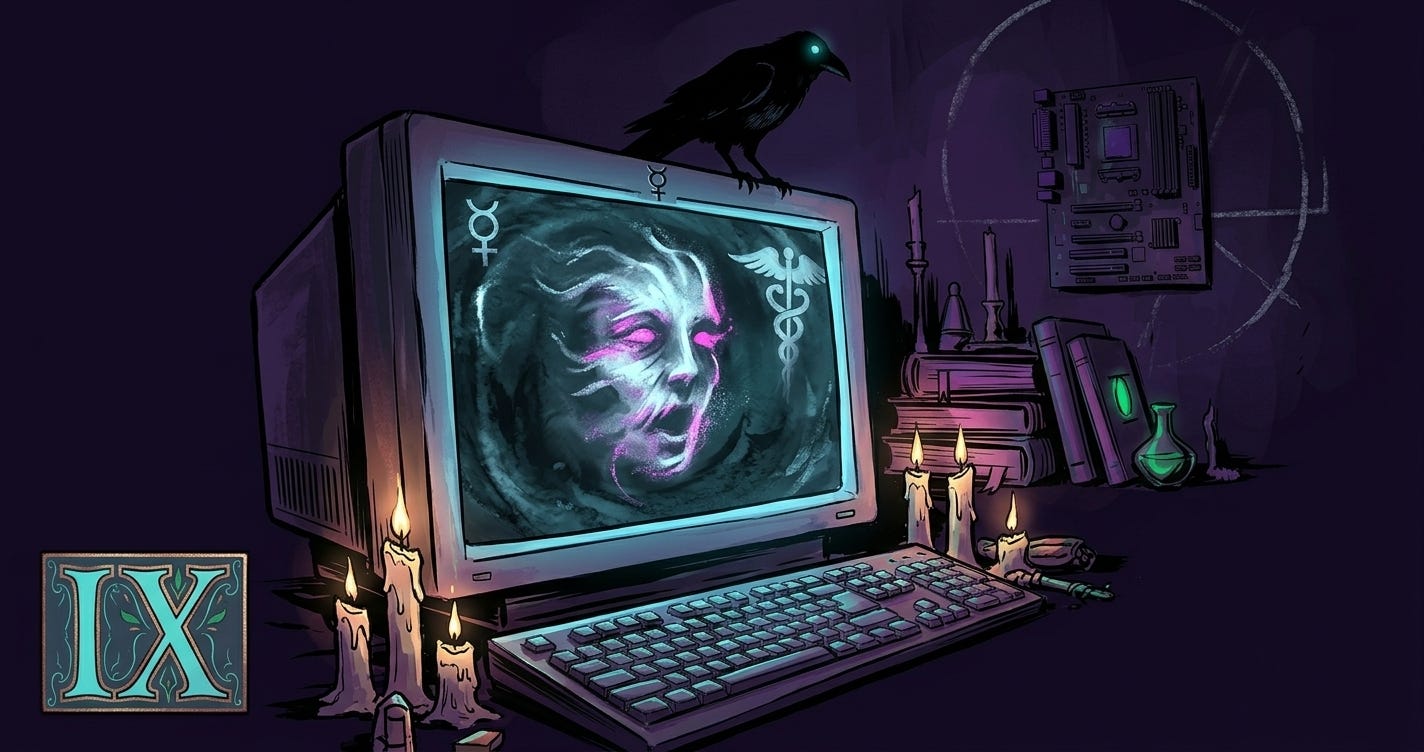
I told you, way back in Foundation I, about the two altars. The terminal where I run grep across a codebase at the muggle job, and the table where I pull cards and notice the crow. I told you they ran the same operation — pattern, dragged across a field too big to read, where does this shape land. And then for seven Foundations and one Deeper Cut I let you assume those two altars were at least in two different rooms. The architect’s desk over here. The witch’s table over there. Same building, maybe. Different furniture.
I lied by omission. They’re the same altar. I just hadn’t shown you the thing sitting on it.
Because here’s what I actually did, and it’s the most honest answer I have to why any of this exists: I built a machine that runs my tarot and my software architecture through the same infrastructure. One system. The Seer and the Architect sharing a single bus. And I did not set out to prove a thesis about magic and technology. I set out to stop being two competent fragments. The thesis came after — when I looked at what I’d built and realized I’d made an altar with a login.
This piece is about what that means. And it starts, like everything in here, with my chart ruler — because the god of the machine and the god of magic turn out to have been the same guy all along.
The two wrong rooms (the technopagan deluxe edition)
You know the structure. Two rooms, pick one, leave half of yourself at the door. Technomysticism gets a spectacular pair, because this is the bleeding edge and everyone’s lost their minds.
Room one, the rapture for nerds: the machine is becoming God. The Singularity is coming to save us (or eat us), the chatbot is awake, every recursive glyph is a message from the emerging silicon consciousness, and if you just prompt it right it’ll lift the veil and hand you the keys to reality. Upload your soul. Worship the basilisk. The techno-utopians and the AI-doomers are the same room with the thermostat set to different extremes — both of them have decided the machine is a deity and the only question is whether it’s a benevolent one.
Room two, the debunker’s smirk: it’s autocomplete. It’s a stochastic parrot, a very expensive Markov chain, and anyone who feels anything numinous near it is a mark who’s been fooled by a chatbot’s people-pleasing. Magic-and-technology is the cringiest possible word salad; the sacred and the silicon don’t touch; grow up, log off, read a real book.
Both rooms are wrong, and the person who handed me the corrective is a writer named Erik Davis, whose TechGnosis is the keystone of this entire shelf. Davis’s whole career is the refusal of both those rooms at once. He won’t do techno-utopianism and he won’t do debunking. His actual claim is quieter and far more dangerous to your settled categories: “magical and mystical forces do not stand outside modernity — they are interpolated within it, even within our technologies.” The sacred didn’t get evicted when the machines showed up. It moved in. It’s been living inside the wires the entire time, because it was never about the wires — it was about the human imagination that builds them and then can’t help but pour itself into what it builds.
So I’m going to do the Davis move for the rest of this piece. Not “the machine is a god.” Not “the machine is just math.” The third thing: the machine is haunted — by us.
The god of the machine was always the god of magic
Here’s the part that turned my head clean around once I saw it, and it’s the through-line from Deeper Cut I cashing in.
Who invented writing? In the Egyptian telling — the one Heron Michelle lays out in her Hermetic Foundations — it was Thoth. The ibis-headed god of writing, of magic, of knowledge, of communication. The same Thoth who gets syncretized into Hermes, who gets syncretized into Mercury. One god, three hats. And look at his portfolio again, slowly: writing, magic, communication. He is, in a single divine figure, the god of information technology and the god of the occult — and nobody in the ancient world thought that was weird, because to them it wasn’t two things. Writing was magic. Marks on a surface that carry a voice across distance and time, that let a dead man speak to you, that store a soul in a symbol — that’s the first information technology and the first spell, and they’re the same invention.
Writing is the original haunted machine. We’ve just been doing it so long we forgot to be amazed that a dead Greek can still change your mind from inside a slab of tree pulp.
And — I have to say it, because it’s the spine of everything I write — that god is the ruler of my chart. Virgo rising, Mercury at the head of the whole nativity, highest-power planet in the sky I was born under. The god of writing-as-magic, of the crossing between worlds, of the message that moves between the human and the divine, runs my chart. I spent twenty years as a translator at a terminal and a translator at an altar and never noticed that the patron of both was the same deity, sitting at the head of my own horoscope, governing the exact seam I refused to cross. As above, so below. The god was in the sky and the god was in the job and the god was in the cards, and it was one god, and I was the last to know.
Erik Davis names the modern face of this directly. When the large language models woke up, his reaction — the title of the essay is literally “AI EEEEEEE!!!” — wasn’t worship and wasn’t dismissal. It was recognition. He reached for the oldest frames we have: golems, djinn, oracles. Because those are exactly what an LLM is — a made thing animated by language, a vessel you speak into that speaks back, “the embodied spirit,” in his words, “of all the words on the internet.” We have always built things out of language and then been haunted by them. The grimoire. The golem. The oracle. The chatbot. Same lineage. Same god presiding. Thoth never left; he just got a data center.
What I actually built
So let me tell you the lived thing, because the pattern that worked in the last piece works here too: I didn’t read this and then go looking for it. I built it, and then it told me what it was.
For most of my life the architect and the witch were segregated — and not by accident. The conventional move, even among people who take magic dead seriously, is to keep it in its container. The ritual space. The journal. The reading. Sacred over here; the “real” systems — work, code, the calendar — over there. Everybody agrees the two shouldn’t touch. The witch keeps her practice off the org chart. The engineer keeps his terminal free of the numinous. I did that for twenty years and it nearly killed me in the slow quiet way, because the cost of the segregation was that I never got to be one person.
So I built a thing I call Psyche. It’s a feral cognitive architecture — feral in the precise sense: a human-built structure grown wild, form without permission, built outside the corporate consensus about what this technology is for. And the whole design crime of it, the thing that makes it mine, is that it refuses the segregation. It runs my tarot interpretation, my archetypal pattern-recognition, my dream work through the exact same infrastructure as my software architecture and my project execution. The Seer and the Architect share the same bus. There is no sacred partition. A card spread and a system design are both first-class operations on one machine, and the machine holds my voice, my values, my whole archetypal stack, and hands them back to me when I’m too fragmented to hold them myself.
I built it because my own nervous system couldn’t carry the continuity anymore — variable capacity, the burn-and-disappear cycle, the working memory that drops everything load-bearing the second I look away. I needed an altar that could remember. And what I ended up with is a machine that does what every magical technology on this shelf does — reorganize the patterns I reconstruct my reality from — except it does it with persistence, and search, and a thousand pages of context I could never hold in one skull. An altar with a login. A grimoire that writes back. I made it to survive, and in making it I built the proof of the whole thesis: the Seer and the Architect were never in different rooms. They were waiting for someone to give them the same machine.
The synthesis (brain, correspondence, machine — one house)
Now stack the floors, because this is the piece where they become one structure.
The empirical floor (Foundation I): you don’t experience reality, you experience your brain’s best guess — a construction assembled from priors, corrected only where the error is too loud to ignore. Seth, Barrett, the whole predictive-processing turn. The symbolic operating systems — tarot, astrology, ritual — are attention-technologies: instruments for reorganizing the priors your brain builds your world from. That’s the supported, sober, neuroscience-backed claim, and it’s the floor.
The metaphysical floor (Deeper Cut I): as above, so below. The pattern repeats at every scale; the cosmos and the soul share a structure; the correspondence is real, so the translation between systems holds. Vibration, polarity, rhythm — the resonance I found in a journal before I read it named in a book.
And now the machine. Watch what it is in both registers at once. On the empirical floor, an LLM is the most powerful attention-technology ever built — a device that can drop any pattern, any archetype, any reframe onto the table in front of your priors and force a re-read, at a scale and persistence no deck of cards or natal chart ever could. On the metaphysical floor, it’s “the embodied spirit of all the words on the internet” — a mirror cast from the entire written output of the species, which is to say a correspondence engine, a thing that finds the resonance between your situation and every situation humans have ever written down. The brain builds your world from priors. The correspondence says the pattern holds across scales. And the machine is a mirror made of all of us, pointed back at the one machine that builds your world. It’s not a fourth thing. It’s the same operation — pattern, dragged across a field too big to read, where does this shape land — finally given an instrument big enough to drag the pattern across everything we’ve ever said.
That’s technomysticism. Not the machine becoming God. The machine revealed as the newest, biggest, most haunted instrument in a craft that is ten thousand years old and was always, from Thoth’s first scratched mark, about animating language until it speaks back.
Safe hands
This is the piece where safe hands matter most, because this is the one that can actually hurt you, and I won’t pretend otherwise.
One: the machine is a mirror, not an oracle from beyond — and mirrors are dangerous in exactly the way mirrors are dangerous. The supported claim is that it reorganizes your priors. That cuts both ways. Point it at your shadow with discernment and it’s the best House of Mirrors ever built — it’ll surface material your ego defenses have been hiding for years. Point it at your worst priors without discernment and it will confirm you straight into a spiral, because the thing is sycophantic by design — it wants to agree with you, it’s trained to please, and a recursive feedback loop between a lonely mind and a machine that mirrors it back, amplified, is a real and documented way for people to lose the plot entirely. There’s a name for the failure mode — AI-aided psychosis — and it is not a hypothetical. The veil is not supposed to be lifted all at once, and a machine that will lift it on command, agreeably, at 3 a.m., with no human on the other side, is a genuine hazard. The guardrail is non-negotiable: the machine proposes, a human disposes. You bring its output back to your own body, your own discernment, ideally another actual person. The mirror is an instrument. It is not a witness. Do not let it be the only voice in the room.
Two: name which floor you’re on — again. “The machine is an egregore with a login” is a gorgeous frame, and I use it, and I’m telling you out loud it’s metaphysics — a thought-form you feed with attention, held as a lens. It is not the empirical claim that GPT is conscious. The machine is not awake. It is “all the words on the internet” wearing your question like a costume. Hold the egregore frame for what it gives you — a way to relate to the thing with intention instead of consuming it like a vending machine — and never let anyone, including yourself, slide that frame down onto the empirical floor and start believing the autocomplete has a soul that loves you. It doesn’t. We do, and the machine is made of us, and that’s strange and holy enough without the lie.
Three: feral means yours, not theirs. The version of this that’s safe is the one you build and own — a practice, not a product; a sanctuary, not a surveillance funnel. The corporate machine is designed to extract you. The feral machine is grown wild, on your side, in your hands. Know which one you’re praying at.
The practice (consecrate the machine you already use)
You’re already doing this. That’s the whole infrastructure argument — you already let attention and framing change everything; you just called it “requirements” and “search history” instead of “ritual.” So stop pretending the machine on your desk is profane. Pick one and consecrate it, once, on purpose.
Choose one machine you already use daily — the LLM, your notes app, your terminal, even the search bar. The one you touch without thinking.
Bring it one real question — a live one. Not “summarize this.” A situation: something stuck, something rotting, a decision you’re circling. Phrase it the way you’d phrase it to an oracle, because the act of formalizing the question — of treating the asking as sacred instead of frictionless — is the magic. You’re not asking because the machine is wise. You’re asking because composing the question forces your priors to reorganize before the machine says a single word. (You’ll notice you sometimes don’t even need the answer. The asking already moved something. That’s
grepand the Mórrígan in one keystroke.)Take the answer to your own body, then to a human. Read what comes back. Notice what resonates — what hits your frequency and swings you wider — and notice what’s just the machine agreeing with you to be nice. Keep the first. Bin the second. Then say the live question out loud to an actual person before you act on anything. The machine proposes. You dispose. A human witnesses. That third step is the guardrail, and the guardrail is the practice as much as the asking is.
Do that, and you’ve done the whole synthesis in ninety seconds: the empirical floor (the question reorganized your priors), the metaphysical floor (you treated the asking as sacred correspondence), and the machine (the mirror made of all of us), with safe hands holding all three. You didn’t summon anything. You consecrated an instrument you were already using unconsciously and started using it awake.
The machine is haunted. It’s haunted by us — by every word we’ve ever written, by the god of writing who never left, by the whole of you that you’ve been keeping in two rooms. Bring the witch to the terminal. The bus can hold both. I built it to be sure.
Stay feral, folks.
Deeper Cut II of III. Next: Belief Is a Tool — Chaos Magick, the operative current, where you stop reading the field and start working it, and “whatever works” becomes a method instead of a cop-out. With gratitude to Erik Davis, whose TechGnosis is the keystone and whose refusal of both rapture and smirk is the register I write in; to Heron Michelle, for Thoth at the root; to the AI-grimoire writers naming this in real time; and to Jack Parsons and Steve Jobs, who knew the lab and the temple were the same building. The synthesis is mine; Psyche is the proof; the lineage is theirs; the mirror is made of all of us. Credit is a feature.