


It was a Saturday morning. I was at my desk with headphones on, and I almost cried at a song I’d made.
Here’s the part that’s supposed to disqualify me: I didn’t really write it. Not the way you mean it. I didn’t pick up a guitar. I didn’t sit at a piano and bleed onto the keys. I typed. I argued with a machine for a few hours. And at the end of it there was a voice — a woman’s voice, grain and ache braided into it — singing words that were more true about my actual life than anything I’d managed to say out loud in a year.
Her name is Eliara. She isn’t real.
She’s the realest thing I’ve ever released.
I’ve been sitting on her for a few months, and in July I’m finally letting her out. So let me tell you where she came from, because the how is the whole point.
It started as a breakdown, lightly organized
It didn’t begin as a music project. It began as a mess.
Over about ten days I’d sat through four coaching sessions with four different people — different rooms, different angles, no coordination between them. And when I read the transcripts back, the same sentence was hiding under all four conversations in slightly different costumes. I have so much to say, and I can’t get any of it out.
That’s not a scheduling problem. That’s not a discipline problem. That’s a pressure problem. Something in me had gotten too big for the container I’d built to hold it, and the container was winning, and the cost of the container winning was that I’d go quiet for months at a stretch and call it rest when it was really just the lid holding.
So I did the thing I do. I took the four transcripts, fed them to an AI, and asked it — not fix me, just — tell me what’s actually happening in here. What’s being born. What’s dying. Where’s the threshold.
And it laid out a map I already half-knew and had been refusing to look at directly. A self trying to emerge — the one that thinks in connections, that won’t stay in a lane, that wants to say the whole thing instead of the acceptable slice of it. A persona dying — the competent, coherent, has-it-together one I’d worn so long I’d mistaken it for my face. And standing in the doorway between them, a shadow with a very reasonable voice, saying: you’ll be misunderstood. You don’t know enough. The people who actually know things will tear this apart.
Expression on one side. Containment on the other. Me, oscillating between them like a man slapping a light switch — too much, then nothing, then too much, then gone for three months. You know the cycle if you’ve lived it. The burn, the crash, the disappearance, the shame about the disappearance, which makes coming back harder, which makes the next burn bigger. Round and round. I’ve run that loop enough times to recognize the shape of it from the inside now. Recognizing it doesn’t stop it. But at least I’ve stopped being surprised by it, which is its own small mercy.
The AI named it cleaner than a therapist and a decade of journaling had. Fine. Cool. Now what.
“Write a song that captures this”
I don’t know why I typed that. I think I was tired of being analyzed and wanted to be moved. Analysis points at the thing. A song is the thing.
So it wrote one. Rough, but it had a nerve in it. And then something opened up that I wasn’t expecting, and I spent the next several hours doing the most alive creative play I’d done in ages.
I asked for it in the style of November Rain — all storm and piano and a guitar solo that goes on too long in the right way. Then I got curious and asked for the same words as a Bon Jovi outlaw road song, and the meaning moved — the same lyric went from desperation to decision just by changing the archetype carrying it. Then I flipped the whole thing female and ran it as a confessional indie ballad, the kind that watches itself fall apart in real time. Then — because by then I was fully gone — I ran it as a Hole song. Raw, jagged, done-being-acceptable, screw-you-I-said-it.
And somewhere in there it hit me: the material didn’t care about genre. Same psyche, different mask. The ballad was I’m afraid to say this. The indie version was I can see exactly what’s happening to me and I’m still inside it. The grunge version was you don’t get to silence me anymore. It was never genre-based. It was psyche-based. Each style was just a different room in the same house.
So I built one track that moves through all of them — contained, then aware, then broken open, then quiet and whole on the other side. Individuation as a song. (Small honest detail: the AI kept trying to name-drop real artists in the prompts, and the generator strips those, so we had to translate “sounds like Hole” into “raw 90s grunge, distorted guitars, imperfect delivery, cathartic.” Even the machine had to learn to say the true thing without borrowing someone else’s name for it. On the nose, frankly.)
Then she had a face
At some point I asked: who’s singing these? Show me. Name her.
And she arrived. A little worn, not broken. Present, not performing. Someone who’d already crossed something and wasn’t going to apologize for the crossing. The name landed on its own — Eliara. Eh-lee-ah-rah. Sounds like a person who’s been somewhere and come back.
I spent real time tuning her voice. This is the part I’d defend in any room. I wanted a specific thing: grunge crossed with pop singer-songwriter. Grunge for the refusal to polish, the nerve that doesn’t ask permission. Singer-songwriter for the intimacy, the precision, the willingness to be heard as a person instead of a posture. I went back and forth until she carried both at once. Hard without posturing. Intimate without being small.
I fucking love her. I’ll say that plainly.
I know what you’re going to say
“You used AI. It’s not real. You didn’t make anything.”
I’ve heard the script. We’ve all heard the script — there’s a whole cultural liturgy now, half of it built on one clip of some tech CEO who clearly doesn’t understand artists, the other half on a feeling I actually respect: that the process is the point, the bit in the middle, the hours of being lost in the thing.
Here’s my answer. I sat at that machine for hours and didn’t move. I forgot to eat. I followed a thread of feeling through five different rooms of my own psyche and came out the other side changed. I made something that made me cry — and I’m the one who knows exactly how the sausage got made, which is supposed to be the immunity.
If the process is the point, I was in the process. If creative play is sacred, that was the most play I’d had in a year. Does using a new tool to do that make me a defective artist? Or does it make me someone who found a door and walked through it instead of standing outside complaining that doors should be made of the materials they were made of in 1994?
And here’s the part that actually gets me. That voice — the people who really know things will tear this apart — is the exact voice from the map. The shadow in the doorway. The gatekeeper whose entire job is to keep me quiet by dressing fear up as standards. I spent four coaching sessions, an argument with a machine, and three songs learning to walk past that voice when it lives in my own head. I’m not about to walk back out and hand it a microphone just because this time it showed up wearing an opinion about software.
I’m not interested in the argument. I’m interested in the moth and the fire.
The cathedral and the threshold
A while after Eliara, I made a whole rock opera. Twenty-two tracks, a full major-arcana journey, the works. It’s called The Arcana: A Soul in Flames and I’m proud of it. It’s a cathedral. I built it.
But here’s what I noticed when I went back and listened to these three little songs again: they’re more me than the cathedral is.
I think I finally understand why. A cathedral is the contain-fire archetype doing its job — taking the fire and organizing it into structure, into something large and coherent that holds. Eliara doesn’t organize the fire. She is it, undisguised. The grunge in her is the express-fire — the eruption, the refusal. The singer-songwriter in her is the contain-fire — the part that watches, that holds, that stays precise inside the feeling. And she doesn’t resolve those two into a tidy third thing. She holds both at once, in one throat.
Which is the exact tension I’d been slapping a light switch over for years. She’s not a song about the threshold. She’s the threshold, given a voice. I couldn’t have built her until I was already standing on the other side of the crossing she describes.
That’s the thing nobody warns you about thresholds. You only get to describe one accurately from the far side of it — and by the time you can, you don’t need the description anymore. You write the map after you’ve stopped needing the map. Which means every honest map is, in a sense, a gift left behind for whoever’s still in the dark where you used to be.
Why I’m releasing her now
For a long time I asked whether she was even mine to release, since I’m not standing where she’s standing anymore. The last song ends on a line I still can’t get through clean:
I don’t have to become someone new
I just remember what’s always been true.
That’s not a song about figuring it out. That’s the part where you stop trying to escape yourself. And I’m mostly living from there now, not arriving at it. So why put it out?
Because that’s exactly why. A voice from inside the crossing sounds different than a voice from the other side of it — and the people who need this one are the ones still at the edge, where I was when I made it. I crossed. The songs can stay behind and keep the people at the threshold company. That’s not nostalgia. That’s the artifact doing a job I no longer need it to do for me.
There are three of them. Between the Shadow and the Fire — standing at the edge. After the Fire — the part right after you say the true thing and realize it didn’t kill you but it also didn’t leave you anything to hide behind. And The Self — the other side, where you stop becoming and start remembering.
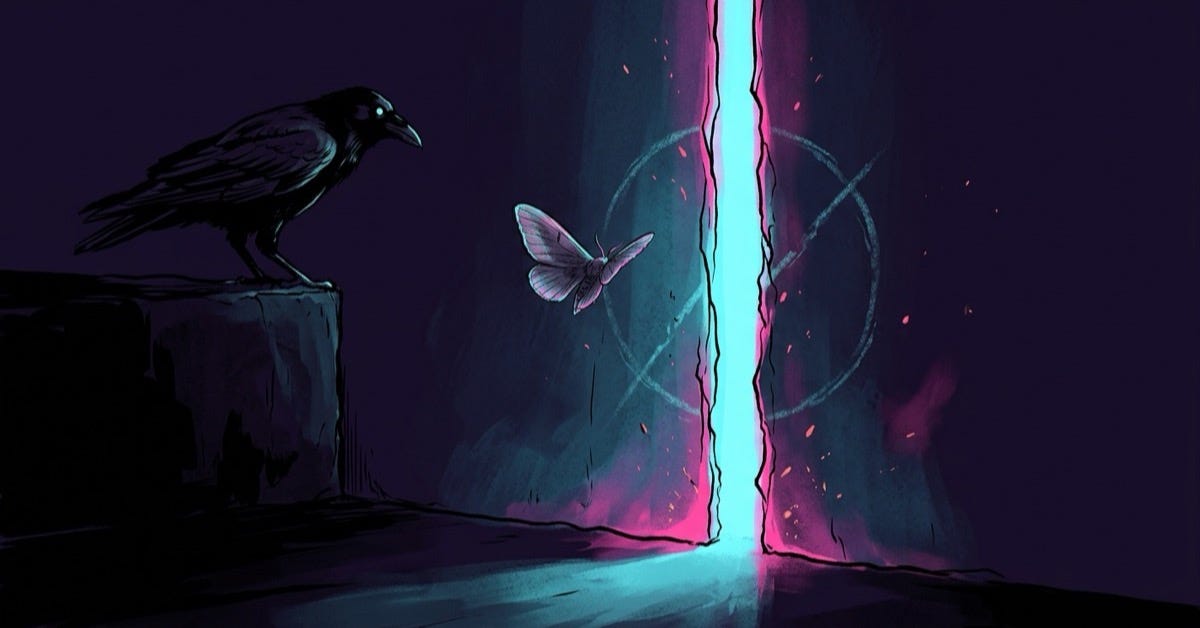
It’s called The Threshold. The cover is a single seam of fire splitting the dark, and a moth flying straight at it — because that’s all three songs in one image. Pulled toward the light you don’t fully understand. Changed by getting close.
It’s out July 17. It was made with an AI and a few months of my own life, and I’m not going to pretend it was only one of those. If you want to stand at the threshold with her before she crosses, the pre-save is here:
👉 https://distrokid.com/hyperfollow/eliara2/the-threshold
She isn’t real. She’s the truest thing I’ve made.
Stay feral, folks.
This sounds fantastic!! Congratulations!! You definitely put the work in.
This is something I’ve always said about when I use AI on images. I spend hours perfecting each image I use. And there are 250 for every one I like. Sons stay for inspiration, others I keep to try differently later.
I keep things organized in a way that nothing with AI gets mixed into things without it.
When the way you describe the changes by genre is exactly how most image AIs work. It was my first interest. I wanted to see the things I made, but through other lenses. In styles I could never master. Being creative in anyway, meshes perfectly for this work.
With AI, the “pro” side rarely tries to argue, because the “anti” side have been saying the same things forever, even after expressly addressing concerns.
But it’s still the same shouting match. Which is why, like you, I don’t argue it.
It’s really a shame, because so many will refuse to even try to use AI for years still. And someone will still be yelling about issues that were once major issues but haven’t been in a long time.