


Some weeks the whole argument lands in a single afternoon, and you don’t get to choose which two things in your life decide to collide.
On the morning in question I shipped a workbook. Fourteen pages, four exercises, built for an online summit full of multi-passionate people — the ones who do six things well and get told, over and over, to do one of them instead. I called it the Inner Spine Map. The thesis was clean and secular and I believed every word of it: your scattered interests aren’t scatter. They share a spine. Name the spine and you stop apologizing for the range. I recorded a talk to go with it. I felt good. I’d said a true thing in a way a stranger could use.
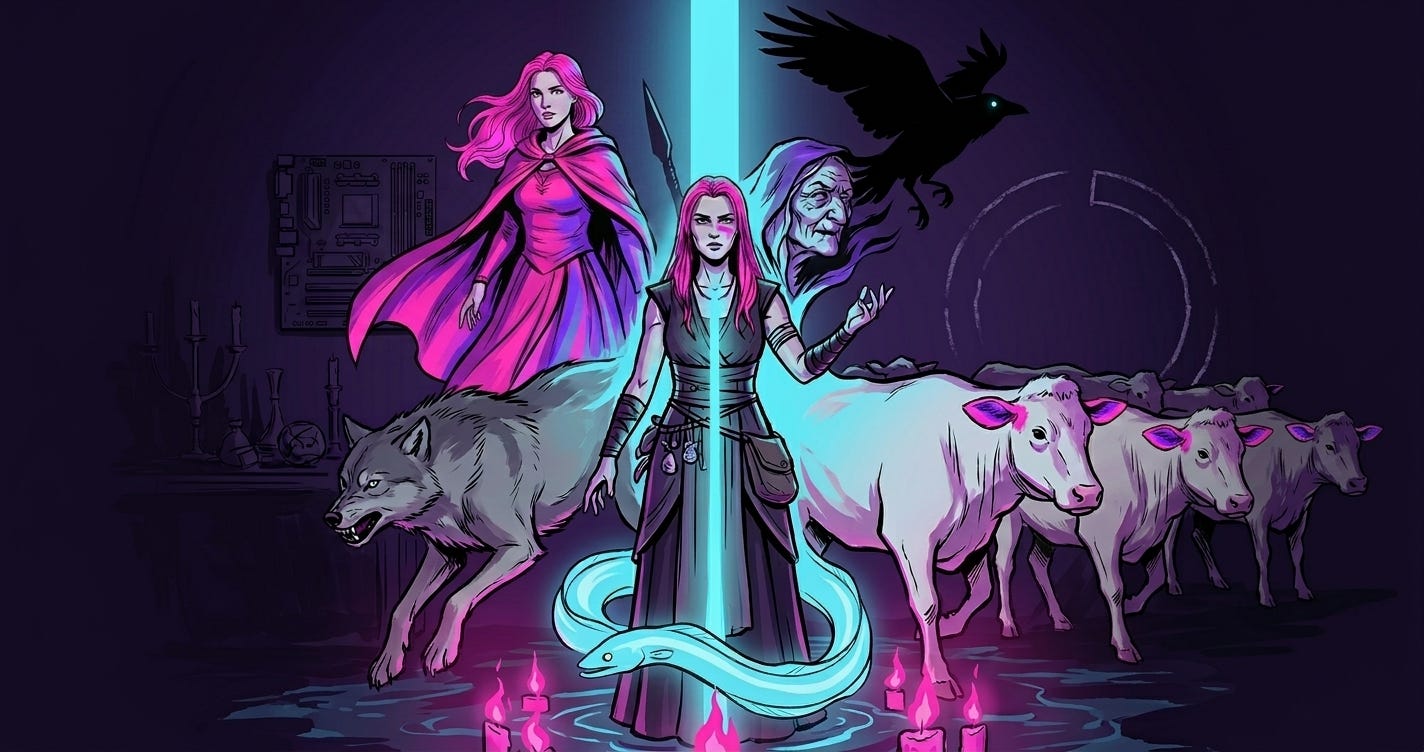
That same afternoon I sat down with the material for the intensive I’m in — a multi-year study of the Mórrígan, the Irish goddess of war, sovereignty, and prophecy — and read my teacher, Lora O’Brien, writing about Her shape-shifting. She walks through the forms the Mórrígan takes when She comes for Cú Chulainn at the ford: an eel twisting about his feet, a she-wolf tearing at his flesh, a red-eared white heifer in the herd, and in the same telling a maiden, a crone, a crow. The attack is foretold in the Táin Bó Regamna and made good in the Táin Bó Cúailnge. And then Lora lands the line that stopped me cold: her form malleable to suit her purpose and the work she does at any given time.
And I just sat there, because I’d written the secular translation of that sentence eight hours earlier and put a price of zero dollars on it.
The advice that was never about you
Here’s what I’d said in the workbook, and what I’ll say again because it’s true: when someone tells you to pick a lane, they have not, generally, been thinking about your wellbeing. They’ve been thinking about their filing system. Their org chart. Their ability to summarize you in a LinkedIn headline so they don’t have to hold the whole of you in their head for longer than a breath.
Picking a lane isn’t focus. Picking a lane is compression. And most multi-passionate people I know didn’t get more focused when they tried it — they got smaller. Quieter. Less themselves. They didn’t become the specialist they were pretending to be; they became a haunted version of the generalist they actually are, walking around with the muted ghosts of everything they put down for the sake of looking disciplined.
The workbook’s whole move is to go underneath the apparent scatter and find the structural thing that connects it. The activities are surface. The spine is the truth. Software architecture, tarot, coaching, the podcast, the writing, the ritual — to a filing clerk that’s a contradiction. To me it’s one person doing one kind of work in a lot of rooms. The forms change. The spine holds. You learn to move between expressions without losing the thread, and you learn to answer what do you do? without flinching, because the honest answer was never a list. It’s the spine.
I have written a distributed-systems design review, pulled a tarot spread over a hard decision, and drafted a verse for a twenty-two-track rock opera built on the Major Arcana — in the same week, and felt no seam between any of them. To the org chart that’s three people who need to get organized. From the inside it’s one motion — the person doing the architecture and the person reading the cards aren’t two different people taking shifts. They’re the same hand.
I stand by all of it. It’s the best vocational argument I know how to make, and I made it for people who needed exactly that and nothing heavier.
But there was a second floor to the building, and the summit wasn’t the room to open it.
What I couldn’t say in that room
The thing I left out is that I didn’t reason my way to “one spine, many expressions.” I didn’t derive it from career theory or productivity literature. I wrote down what I already knew in my body — and what my body already knew had been shaped, for a couple of years now, by apprenticeship to a goddess whose entire nature is exactly that pattern.
The Mórrígan is a shape-shifter. Not decoratively — structurally. In the tales She is an eel that wraps the hero’s legs in the ford, a grey she-wolf tearing at his flesh, a red-eared heifer driving the herd against him, a young woman, an old woman washing armor at the river, a crow on the dying warrior’s shoulder. Different forms. Same work. The forms are not indecision and they are not a costume change for its own sake — each one is the right shape for the task in front of Her. Her power is precisely the malleability with a constant purpose underneath it. She would fail every “pick a lane” performance review ever written, and the failure would be the point.
So here is the part the secular workbook structurally could not hold: a devotee of a shape-shifting goddess practicing in many forms isn’t scattered. They’re devotionally embodying their deity’s nature. When the dominant culture — Christian, post-Enlightenment, productivity-coded — tells me to specialize, it isn’t only giving me bad career advice. It’s asking me to stop doing the thing my devotion is for. I’m not too many things. I’m the right number of things for the One I serve.
That reframes the whole “pick a lane” critique. It doesn’t fail once. It fails twice. It fails vocationally — the argument I already put in the workbook. And it fails theologically — because shape-shifting deities have always existed, and they have always produced shape-shifting devotees, and telling one of them to hold still is asking them to abandon the practice. The second failure is the one I’m actually built on. The first is just its shadow on a secular wall.
The altar is the spine
I can prove this isn’t a mood, because it has a physical location. It’s the altar.
In order of arrival: the Mórrígan, Thoth, Horus, Hekate, the Dagda. Three cultural traditions, five deities, and if you read it as a tourist you’d call it a pick-and-mix — the exact deracinated buffet I refuse and that serious practitioners are right to be suspicious of. But it isn’t that, and the reason it isn’t is the whole secret. Those five share one register: dark sovereignty, threshold-guardianship, magical mastery, an utter lack of flinch. The Mórrígan and the Dagda are the Irish sovereign pair. Thoth and Horus are the Egyptian wisdom-and-kingship pair, the scribe and the falcon-eye. Hekate is the Hellenistic hinge, the goddess invoked beside Thoth-as-Hermes in the old Greek magical papyri, the one who stands in the doorway between whatever you brought and wherever you’re going.
Five deities. One register. That register is the spine. The traditions are the expressions. It’s the same architecture as the workbook — surface diversity, structural coherence — except here the spine isn’t my career. It’s a council of gods who don’t look away from the dark, and I am apprenticed to their shared disposition more than to any single national pantheon. That’s not pick-and-mix. Pick-and-mix has no spine; it grabs aesthetics. This has a spine you could hang a life on. The discipline is in the coherence, not the collection.
I have one piece of evidence I can’t argue my way out of, and it embarrasses the rational half of me. Over a year ago, on a guided journey into the Irish Otherworld — Irish specifically, Her territory, not some generic catch-all spirit-world — a figure met me. Vaguely Egyptian was all I could have told you at the time. I didn’t recognize him. What I got instead was a name, surfacing with no thread attached. Jeru. And the texture is the point: I can’t swear whether I heard it or saw it, or whether it was Jeru or Heru worn down to a hard J at the front. The memory won’t hold still that tightly. What I kept was the sound of it, and no idea what it meant. Later I typed it into a search bar the way you’d check a word half-caught on the street — and I’m fairly sure it just autocorrected my smudged spelling toward something it recognized. What it recognized was Heru. Horus. The older Egyptian name; “Horus” is only the Greek dress it got handed centuries later. A search box for a psychopomp, and a falcon-eyed sky-god on the other side of the typo — handing me his Egyptian name, not the one pop culture would have slipped me.
That’s the part I can’t file under imagination. If I’d pictured a falcon-headed figure, I’d assume my own memory dressed the set from a museum placard. But I didn’t picture Horus, and I didn’t retrieve him clean. I got a half-heard name I didn’t know — close enough to the real one that even an autocorrect could finish the guess, and just wrong enough that I clearly hadn’t pulled it off a shelf I already owned. The smudge is the evidence. A clean answer I could explain away; a near-miss I can’t. In the register frame it isn’t even strange. The Otherworld doesn’t run customs the way humans do. The gods cross the borders we police — and they seem to know the boundary between the cultural packages is the provisional thing better than the practitioners arguing about lanes ever will.
This is old
If that sounds like something I invented to make my messy altar feel intentional, I want to be honest that I didn’t invent any of it. The syncretism is older than me by an embarrassing margin.
“Hermetic,” when the coaching-and-occult marketplace says it, means Hermes Trismegistus — Thrice-Greatest Hermes — who is himself a Hellenistic Egyptian fusion of Hermes and Thoth, the named author of the Corpus Hermeticum. The thing was a merger at birth. The Irish told their own origin story for a thousand years through the Lebor Gabála Érenn, rooting the Gaels in Egypt by way of Scota, a pharaoh’s daughter — not archaeology, but a mythopoetic claim the Irish themselves chose to keep making for a millennium, which makes it load-bearing whether or not a boat ever made the trip. And a hundred and fifty years ago the Hermetic Order of the Golden Dawn — Yeats in the room, Maud Gonne, George Russell — wove Egyptian and Irish and Hermetic and Hellenistic streams together on purpose, as a deliberate working practice.
The deepest practitioners have always gathered across traditions, because the thing they were tracking was the register, not the label on the cultural package. I’m not improvising a personal religion. I’m standing in a syncretic stream that medieval monks were already pointing at eight hundred years before the Golden Dawn made it a method. The crow on the masthead and the scribe-god on the altar are not in tension. They’ve been the same current the whole time.
Both are the work
Which brings me back to the morning I shipped a secular workbook and then read a fifteen-hundred-year-old description of my own life.
The workbook can be read, now, as my first public teaching from Her — even though She is named nowhere in it. I didn’t smuggle Her in. I just wrote what I knew, and what I knew already carried Her shape: surface activity, structural truth, the spine that holds while the forms move. That’s what apprenticeship does. Your output carries the teacher’s grammar whether you credit it or not. The vocational and the devotional weren’t two pieces I bolted together. They were one thing I’d been saying in two dialects, and it took a single colliding afternoon to hear it.
It isn’t only deities I’ve gathered this way, either. Look at who I’ve apprenticed myself to — the teachers, the readers, the practitioners I keep walking toward — and the same selection runs underneath: people who carry that register, who hold the dark and the craft in the same hand and don’t flinch at either. I didn’t build a syllabus; I followed a resonance — the same one that drew the altar. It organizes not just what I do, but who I let teach me.
The altar holds the lineage. The shape-shifting is the practice. Both are the work.
So I’ll leave you with the secular door, because it opens onto real ground: the Inner Spine Map is yours — four moves to find the thing underneath your own scatter, no grade, no lane. Or, if you’d rather hear it out loud, there’s a talk. Both do honest work on their own terms.
But know what’s holding the room up underneath the workbook. You’re not scattered. You were uncatalogued — and some of us were never going to be filed under one heading, because the One we answer to wouldn’t be either. She is the eel and the wolf and the washer and the crow, and not one of those is a distraction from the others. They’re all Her, doing the work the moment requires.
Your form is malleable to suit your purpose. The spine is constant.
Stay feral, folks.
You know, young namesake, the brain has a garbage collection process. It cleans up messy models and discards some while you sleep. You cannot avoid it. The brain seeks to minimize resource usage, including energy. It is a finite cognition machine in a finite space that uses too much of the body's stuff. Compression is inevitable. Resistance is futile.
🙏