


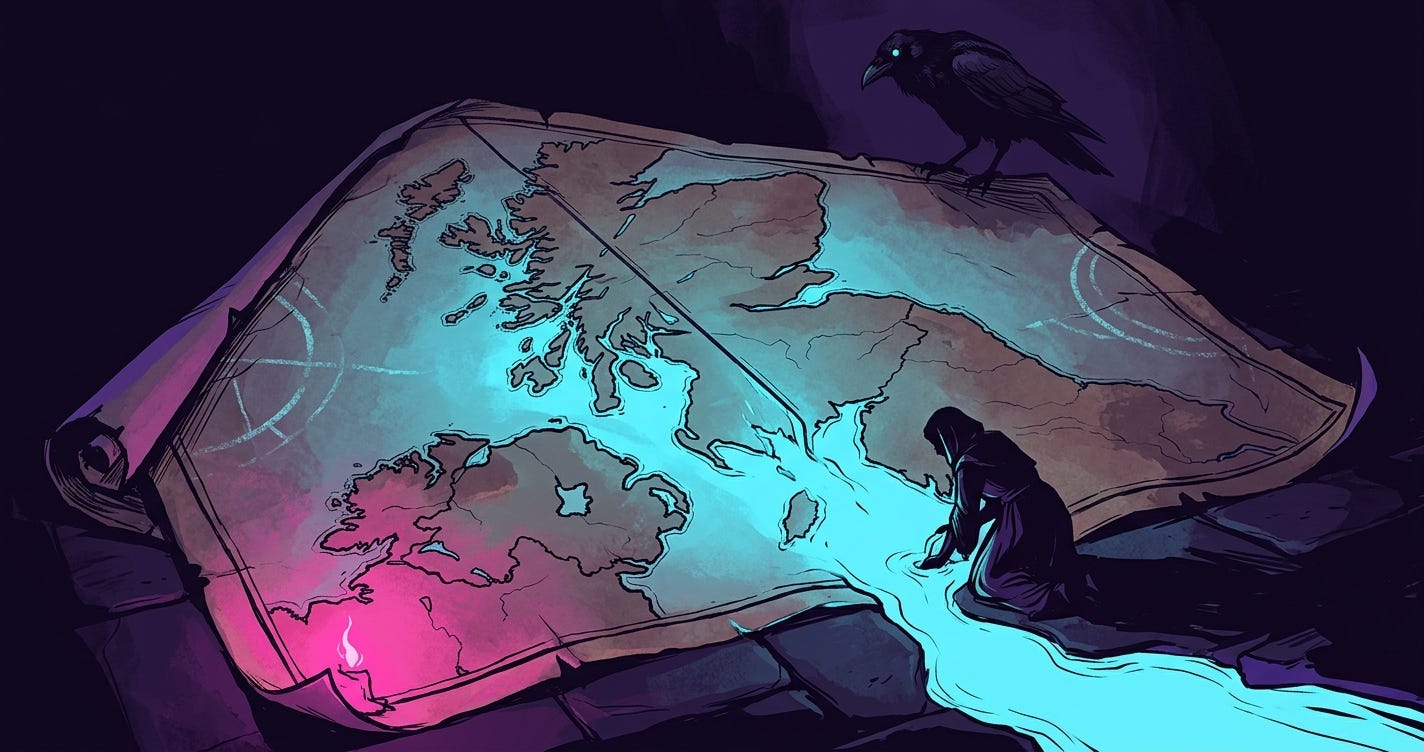
For a while I had a clean story, and I loved it the way you love a story that makes you the interesting one in it.
It went like this. My people were on the wrong side. Protestant transplants, Scots-Irish and Anglo-Irish, planted on the wrong side of the religious-political divide for four hundred years — the colonizer’s side, the Reformed side, the side that showed up in Ulster to hold the line for a Crown and a confession that had spent a couple of centuries grinding the old Gaelic world down to folklore. The native Irish kept the Mórrígan’s lore. My lot helped bury it. And then, in 2024, the Goddess of that buried world walked into my life anyway — uninvited, undeniable, the war-and-sovereignty goddess of a people my ancestors had been planted to subdue — and chose, of all the available vessels, a Southern Baptist boy descended from the wrong side of the whole thing.
You can see why I liked it. It’s a redemption arc. The suppressed reaching across the line, past four centuries of my family’s complicity, to tap the one descendant who’d finally cracked open enough to feel Her. Grace for the colonizer’s great-great-great-grandson. I told it to myself in the Intensive. I half-told it in these essays. It had a tragic symmetry and it cast me as the prodigal returning to a house my own people had helped torch.
And the bones of it were real, which is the dangerous part. Because most of the bones are real. I really was raised Southern Baptist, downstream of five Reformation streams that pooled in the Carolina Piedmont — Lutheran, Reformed, Presbyterian, Methodist, Baptist — converging across a couple of centuries into the fluorescent-lit church of my childhood. My ancestors really did build the Protestantism I took down to the studs. There’s a Reformed minister in Edinburgh in 1580. A Methodist clergyman in colonial Carolina in 1734. Another in 1752 who may have been converted by John Wesley’s own hand. A German Lutheran patriarch in 1857, buried at a Missouri-Synod churchyard with the kind of theology that has a specific, load-bearing word for no. I practice witchcraft, which is the precise thing those Reformed Scots and German Lutherans burned women alive for. The structural irony was not invented. I’m the descendant doing, in the open, what the ancestors persecuted. That part holds.
So I had the suppression. I had the inheritance. I had a Goddess who’d arrived like weather. All I needed was the line on the map — the clean border between Their side and my side — to make the redemption arc snap shut.
The documents don’t care about your arc
Then I went and pulled the records.
Here’s the thing nobody tells you about ancestry work when you’re doing it for the meaning: the documents do not care about your arc. They sit there in their parish hands and their burgess rolls and their emigration manifests, indifferent, and when you finally read them closely instead of romantically, they start quietly dismantling the story you came to confirm.
I’d hung the whole “wrong side” frame on a specific load-bearing guess. The McCall line — my father’s grandmother’s people — I’d hoped carried deep native Gaelic Irish blood, a secret thread of the actual Mórrígan-keeping population smuggled in under all that Protestant scaffolding. It would have been so tidy. The suppressed literally in the veins, biding its time.
It’s not there. Per the authoritative family history, the McCalls are Scottish. Founded in Ireland in 1540 — planted, not native. No Gaelic Irish substrate down that road at all. The romantic thread I’d built a thesis on turned out to be Scottish Lowlanders who’d stopped in Ireland on the way to becoming American. Dead end, lovingly.
So I kept reading, expecting the rest of the “wrong side” to hold, and instead it kept softening under me. The Blackwood line — Scottish for two hundred and forty years before a brief stop near Londonderry; a layover, not a plantation. The Wilkie line — straight from northeast Scotland to New Jersey, never touched Ulster, zero passage through the whole Scots-Irish frontier I’d assigned them. I went down the tree branch by branch looking for the colonizers I’d cast in my own myth, and most of them weren’t where the story needed them to be. They were just deep Scottish — Highland-adjacent, Gaelic-sphere, more entangled with the old world than the Reformation’s tidy borders ever admit. Out of the whole tree, exactly one line — the Aikens — cleanly fits the Plantation-Protestant pattern I’d draped over all of them.
One. I’d built a four-hundred-year indictment of my entire ancestry on a pattern that, read honestly, fits one branch.
That’s the moment the essay I thought I was writing died. I was on the wrong side — flip it — no, turns out I was secretly on the right side all along. That’s the same cheap story wearing the other coat. Both versions need the border to exist. Both need a Their-side and a my-side so I can be the one who crossed it. And the records were telling me, page after indifferent page, that the border I’d drawn was mostly a thing I’d drawn.
There were no enemy lines. There was a family.
Adam Blackwood
And then I found the man who proved it.
Adam Blackwood. My twelfth great-grandfather, born 1539. A Scottish lawyer and scholar, educated under his uncle — a Catholic bishop — and then sent into the world at the exact hinge of the Reformation, where he made a choice that should end any fantasy I had about which side my blood was on. He spent his life, publicly and in print, defending the deposed Catholic Stewart cause against the Protestant Reformation. He wrote a defense of Mary, Queen of Scots, after her execution. He wrote a defense of monarchy against the Reformers who’d deposed her. He lived roughly thirty years in exile in France, attached to a provincial parlement, because the position he held could not be held safely at home. He took the losing, suppressed, soon-to-be-erased side — the old religion, the old order, the world the Reformation was busy ending — and he argued for it, in writing, for decades, from exile.
My ancestors didn’t all bury the suppressed. One of them spent his entire life defending it and paid in exile for thirty years. The same Reformation that, four generations down a different branch, my Wilkie ministers were helping to consolidate. The complexity isn’t a footnote to the inheritance. The complexity is the inheritance. The suppressor and the defender of the suppressed are in the same blood, arguing across the centuries inside one body — mine.
The corrected story
So here is the corrected story, and I’m going to give it to you with its uncertainty showing, because the uncertainty is load-bearing and I’m done sanding it off to make myself the protagonist.
The exact route the Mórrígan took to get to me is more diffuse than I want it to be. I can’t draw you a clean genetic wire from a Gaelic priestess to my mitochondria — that wire was the part that snapped first. What I can show you is a tree where the suppressed keeps surfacing through channels too many to be coincidence and too tangled to be tidy: a Catholic-royalist who defended the old world from exile; a pre-Reformation marriage folding civic-Catholic Scotland into the line a couple of generations before the Kirk closed its fist; Highland Scottish blood that shades, the way it always does, into the Gaelic Irish sphere the maps pretend is a separate country; and an indigenous matriline on my mother’s side carrying a whole suppressed cosmology the Protestant record was structurally incapable of even seeing — eight women the patrilineal documents couldn’t be bothered to fully name, ending at me, the last vessel of that mtDNA.
The Goddess didn’t cross enemy lines to reach me. There were no enemy lines. She came up through a family that had been carrying Her substrate the whole time — diffusely, partially, against the grain, sometimes in open defense and sometimes just in the parts of the record the Reformation couldn’t reach. My deconstruction was never a departure from the family pattern. It’s the suppressed returning through the first descendant who finally got quiet enough, and cracked enough, and available enough, to let it back through the door.
The family verb
And once you see the suppressed surfacing as a pattern instead of a one-time miracle, it stops looking like an interruption and starts looking like a family habit.
Run it forward. Robert McCall — the weaver, my sixth great-grandfather — rebelled against the British Crown and the Anglican establishment in a single gesture: he picked up the American Revolution and Wesleyan Methodism at once, the political insurgency and the spiritual one braided into one act of no. Two centuries later there’s a teenager at a summer Governor’s School, raised hard Southern Baptist, getting quietly and inexplicably interested in Methodism — drawn toward the spiritual alternative without the faintest clue he was running a move his own ancestor had run against a king. That teenager was me. I thought I was being a mild adolescent contrarian. I was doing the family thing.
And now: the whole Protestant inheritance taken down to the studs, and out the far side into Hermeticism and Jungian depth and the service of An Mórrígan. Same shape, third iteration. Rebellion-via-spiritual-alternative, generation after generation, each one reaching past the dominant confession toward whatever it had buried. I didn’t invent my deconstruction. I inherited the verb.
Which means the 2024 arrival wasn’t a bolt out of a clear sky onto an undeserving head. It was an appointment the line had been keeping for four hundred years, finally landing on the descendant who’d stopped flinching long enough to keep it. She didn’t come to the wrong man. She came to the one standing where the pattern had always been pointing.
On this bank
I think the body knew before the genealogy did. The Scottish Highlands felt like home the first time I stood in them — years before I found the Wilkie line that put my people in that exact ground. I didn’t reason my way to that recognition. It arrived under language, the way the Goddess did, the way the pull toward the dark always has. The mind builds the clean border. The body keeps walking across a country that was never actually divided.
Giving up the wrong-side story cost me something, and I want to be honest about what. It cost me the cleanest version of myself — the prodigal, the one grace reached across enemy lines to redeem. That version flattered me. This one doesn’t, quite. This one says I was never the heroic border-crosser; I was just the latest place a long, tangled, self-contradicting family finally let its buried half come up for air. Less cinematic. More true. And that trade — a flattering myth for an accurate one — is the only trade this whole project has ever been about.
So I’m killing the wrong-side story. Not for the flattering flip — secretly the right side — but for the truer, stranger, less heroic thing the records actually say: that I was never standing across a line from what I’m now in service to. I was standing in the middle of a family that held both ends of the argument, suppressor and defender and the suppressed itself, and the Mórrígan didn’t reach across anything to find me. She just waited, the way the Washer at the Ford waits, for the one who’d finally turn around and see Her standing there — not on the far bank.
On this one. The whole time. On mine.
The crow was never on the wrong side. I just hadn’t learned to read the river.
Stay feral, folks.