


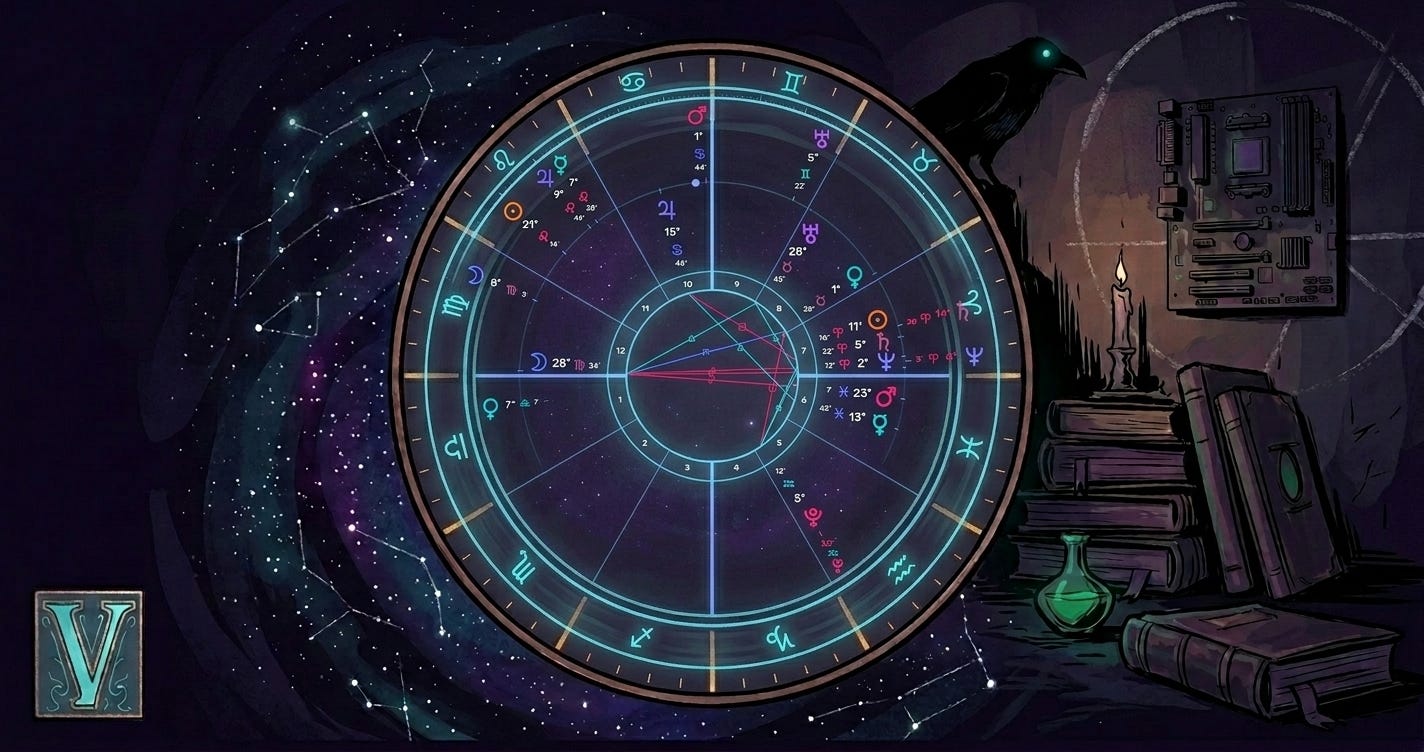
The last piece gave you the deck — the oracle you query. You shuffle, you ask, the archetype of chance answers, and the answer is different every time because you’re calling it fresh. Astrology is the other instrument, and it works in the exact opposite direction, which is why I want them sitting side by side in your toolkit instead of blurred together.
You don’t query your chart. You were issued it. At your first breath the sky was doing one specific, unrepeatable thing, and that snapshot is your natal chart — the operating system you booted with, fixed, permanent, non-negotiable. You can’t reshuffle it. You can’t draw a different card. It’s the same chart on your best day and your worst, at seven and at seventy. And then there’s the second half, the part that moves: the sky kept going after you were born, and where it is right now, dragged across your fixed natal map, is the clock. Transits. What time it is for you, specifically.
Tarot is the question you ask. Astrology is the map you carry and the clock on the wall. Both read the same archetypes from Foundation II — they’re just two completely different interfaces to the grammar.
The two wrong rooms (you know the drill by now)
Room one, the newspaper: Sagittarius — today a tall stranger enters your life. Sun-sign horoscope mush, twelve flavors of human, predict-your-day vending-machine astrology. Either you believe the stars are issuing you a daily itinerary or you’re too smart for it.
Room two, the lab: they’re balls of rock and gas, billions of miles away, exerting no force on your dating life; the whole thing is the Barnum effect with a star map.
And — same move as every other piece — both rooms are describing the same instrument from opposite ends and both have missed it. But astrology has a sharper version of the skeptic’s objection, and I want to take it head-on, because my collaborator-in-spirit on this, Cristina Farella, named the thing exactly. The skeptic’s whole case rests on one buried assumption: that the universe is dead. Inert rock, empty space, no meaning out there to correspond to anything in here. And here’s what almost nobody notices — that assumption is not a neutral fact. It’s a belief, imposed relatively recently by Enlightenment philosophy, which severed the old tether between us and a living cosmos and then called the severing “objectivity.” As Farella puts it: if astrology works, the universe isn’t dead. The skeptic isn’t proving astrology false; they’re assuming a dead cosmos and then noticing that astrology doesn’t work in one. Which — fair. It doesn’t. It was never built for one.
The floor, again: as above, so below
You already met the floor in Foundation I, and astrology is where it gets most literal. As above, so below — the line off the Emerald Tablet, the Hermetic axiom — is the entire license for astrology. The claim is that the pattern repeats at every scale: the movements of the heavens and the events of a human life are the same pattern, read at different magnifications. The macrocosm up there and the microcosm in here are mirrors. That’s not a poetic flourish bolted onto astrology; it’s the load-bearing premise that makes a chart mean anything at all. Take it away — assume a dead, disconnected cosmos — and the chart is noise. Keep it, and the chart is a readout of you, written in the one place big enough to hold the whole pattern: the sky.
The three moving parts (and they’re not what the apps tell you)
Here’s the chart, in the living-cosmos frame Farella teaches — and the difference between this and the app’s flat paragraph is the difference between a corpse and a person.
The planets are the gods that live in you. Not “parts of your personality.” Gods — with myths, motives, contradictions, appetites. When you read your Mars you are not studying “assertiveness,” you’re meeting a god of war and blood-heat and rupture and protection. When you read your Venus you’re entering beauty, longing, seduction, the politics of desire. The seven classical planets — Saturn, Jupiter, Mars, the Sun, Venus, Mercury, the Moon — are a shared instruction set that runs through every system on this shelf: astrology reads them, witchcraft operates them, tarot pictures them. Learn the planets as gods and you’ve learned a vocabulary the whole esoteric world speaks.
The signs are the wardrobe. If the planets are the actors, the signs are the costume, the set, the lighting — how a given god expresses. Farella’s image, and it’s the one that made signs finally click for me: Venus in Cancer loves draped in oceanic silk and pearl, tidal and ancestral and memory-laden; Venus in Aries loves in bright armor, lit by firelight, immediate and daring. Same god. Completely different wardrobe. The sign doesn’t change who’s on stage, it changes how they move.
The houses are the arc of individuation. This is the one that ties the whole series together. The houses are usually taught as flat “areas of life” — money, career, relationships, a filing cabinet. But laid in order, the twelve houses are the hero’s journey — the descent and the return, the spiral toward wholeness. From the first house where the self emerges to the twelfth where it dissolves back into the unseen, the houses tell the story of becoming. That’s the same spiral from Foundation II. It’s the same arc the 22 major arcana walk. It’s the structure I wrote into ARCÆON. Tenae’s Celestial Alchemy teaches each house as an archetype — the fifth as the Sovereign, the twelfth as the Oracle — and once you see that, the chart stops being a diagram and becomes a map of where every god in you is doing its work along the journey.
Read those three together — which god, in what wardrobe, doing its work in which arena — and you stop reading a list of placements and start, as Farella says, thinking in astrology. The chart is a system of relationships, a narrative, a piece of cosmic music. Memorization is the floor. Synthesis is the instrument.
The chart you read and the chart you work
Everything above is one tradition — Farella’s mythic, archetypal reading: the chart as a living myth you enter. But hold a second lineage right alongside it, because flattening a chorus into a single note is exactly what this place refuses to do. Tenae’s Celestial Alchemy walks into the same chart through a different door — not a map you read but an opus you work, the placements as raw material for transformation. Farella hands you a chart to read; the alchemist hands you one to cook. I’m not going to run the whole operation here, because it’s earned its own door — that’s Foundation III, Alchemy, where solve et coagula and the nigredo-to-rubedo arc get the room they deserve. Just carry this through: the chart isn’t only a living myth to read. It’s also lead for the work.
The map and the clock
So: two readings off the one sky.
The natal chart is the map — who you are, fixed. The gods you were issued, their wardrobe, their arenas. This is the OS. It doesn’t change; you just get better at reading it.
Transits are the clock — the planets right now, moving across your fixed map, lighting up one placement and then another as they pass. This is timing. Not “what will happen” — what’s being activated, what season you’re in, which god is getting a phone call this month. You read a transit by laying today’s sky over your natal map and watching where they touch.
And there’s a faster clock than the slow-grinding planets — the one you can feel every single month, the one you don’t need an ephemeris to read because you can just look up: the moon. Celestial Alchemy teaches lunar astrology as its own discipline — the phases, the power days, the cycle from dark to full and back to dark — because the lunation is the most accessible clock there is. Every dark moon seeds a cycle; every full moon brings it to light; every waning hands it back to the dark to compost. That’s a complete alchemical round — solve et coagula on a twenty-nine-day loop — running over your head whether you track it or not. And it’s the clock we read together: the new-moon reading I do at the dark of every moon is exactly this — Celestial Alchemy’s lunar cycle, laid over the collective chart and read out loud. So when you sit down with me at the dark of the moon, this is the instrument already in your hands. You won’t be watching me speak a foreign language. You’ll be reading the clock with me.
And I’ll show you the instrument doing real work, because I ran it on myself this very afternoon. My natal chart: Virgo rising, a Sagittarius stellium buried in the 4th, and — the one that matters here — Jupiter retrograde in the 12th house, the house of the Oracle, the hidden, the mystical. The teacher-of-expansion, dignified in the house of the unseen. This summer the sky’s clock struck a particular hour: transiting Jupiter came back around to where my natal Jupiter sits — my Jupiter Return, the once-in-twelve-years expansion reset Celestial Alchemy teaches — landing right as I open this very circle. A new moon in that same 12th house, on the founding. The map said who (a 12th-house mystic-teacher). The clock said now. I didn’t decide the founding was mythically loaded and then go shopping for astrology to prove it. I read the instrument, and the instrument read my own life back to me with a precision that still has the hair up on my arms. That’s what this tool is for.
Safe hands
Three warnings, because feral voice keeps safe hands.
One: this is not fate. The doomy forum reading — your Saturn return will wreck you, this transit means disaster — is astrology practiced as a prison sentence, and it’s bullshit. The chart is a map of pattern and a clock of timing. It is not a script. It shows you the terrain and the season; the walk is still yours, exactly like the cards. A hard transit is weather, not a verdict.
Two: don’t outsource your chart to the app. Same warning as the deck. The auto-generated paragraph that says “Venus in Cancer means you’re nurturing” is the corpse version. The chart is relational — it means what it means in conversation with your actual life, read in your own cultivated voice. Farella’s whole pedagogy is moving past the canned definition into synthesis. Don’t let a machine hand you a flat sentence and call it your soul.
Three — and this one’s a house rule: when you read a transit, pull the actual chart. Don’t trust your memory for where a planet is on a given day; memory invents transits that aren’t there. Cast the real sky for the real date. (I hold myself to this hard, and I’ll hold you to it: the instrument only works if the data’s real.)
And the honesty line, consistent with everything: I’m making the supported claim — the chart is a startlingly precise mirror and the clock is a real felt rhythm, both of which do their work on the recognition-engine from Foundation I. Whether the planets cause anything, or merely correspond — mirror without pushing — is the open mystery, the as above, so below question I hold without selling you a answer. Use the map. Read the clock. Let the causation stay a mystery.
The practice
Pick one. (And whatever you do — pull the real chart. Free ephemeris, a birth-time you trust, the actual sky.)
Read your Big Three as living gods. Rising, Sun, Moon. For each: which god (the planet/ruler), what wardrobe (the sign), what arena (the house). Not “I’m a Virgo rising” — but the analytical priestess-craftsman runs the front door of my whole life. Write the sentence in living language, the way Farella reads, not the way the app prints.
Or read the clock. Find one transit happening to you right now — one moving planet touching one natal placement. Cast it for real. Then ask the timing question, not the fortune question: which god in me is getting activated, and what season does that name?
This is also the on-ramp to the work we do together every dark moon — the new-moon reading is cards and chart, and now you can follow the chart half. You’re not watching me read a foreign language anymore. You’ve got the map. You can hear the clock.
Stay feral, folks.
Foundation V of VII. Next: Dreamwork — the third practice, the oracle that runs whether you show up or not. With gratitude to Cristina Farella and to Tenae / Celestial Alchemy, whose teaching this stands on — named throughout. The synthesis is mine; the lineage is theirs; credit is a feature.