


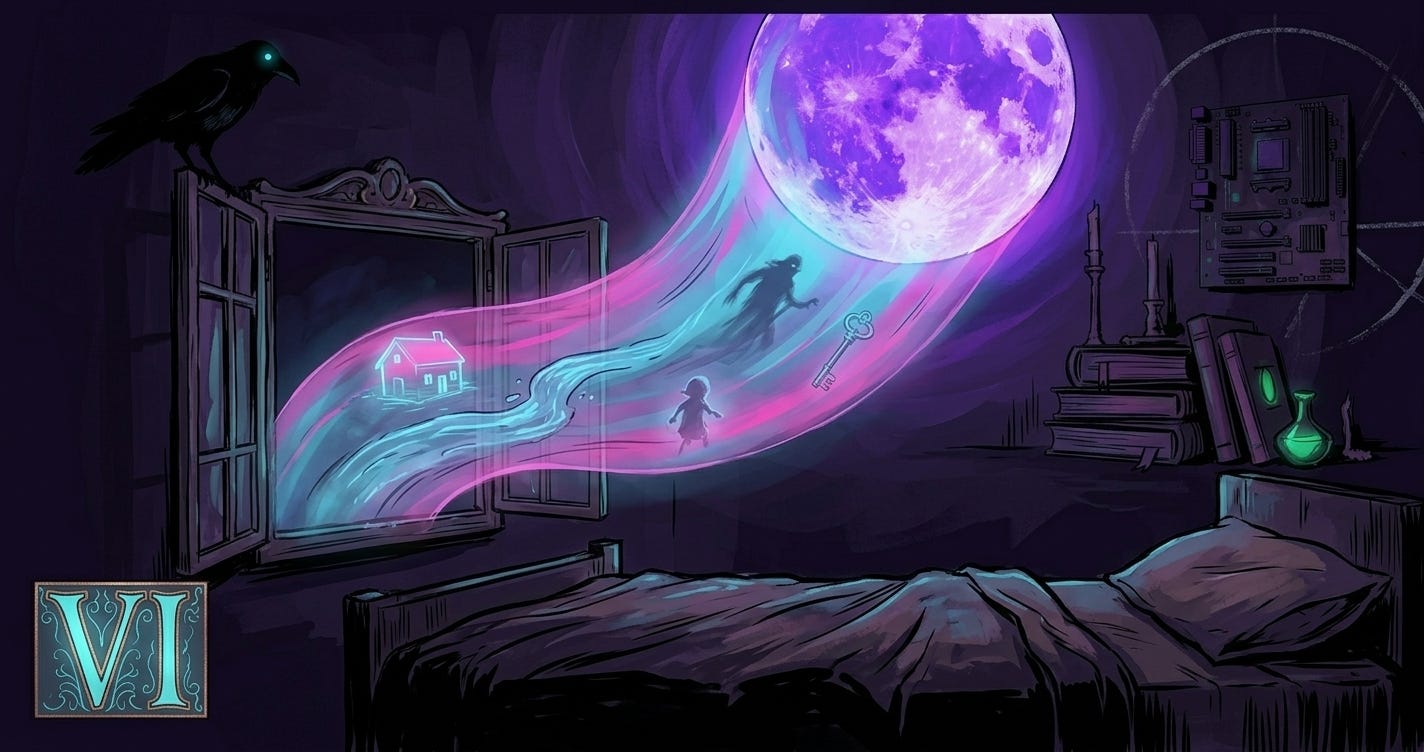
Every instrument so far you had to pick up. The deck you shuffle. The chart you cast, the clock you read. You decide to consult them; they wait for you to ask. This last one is different, and it’s why I saved it for the end: dreamwork is the one oracle that runs whether you show up or not. Every night, for free, unbidden, the unconscious composes you a transmission in the exact archetypal language everything before it taught you to read — and most people sleep right through the only oracle they never have to pay for.
So let me start where I always have to start.
“I don’t dream”
I know what you’re going to say. I don’t dream.
Yes, you do. You dream every night, multiple times, in long vivid reels. You just don’t remember them — the recall fades in the first ninety seconds of waking, faster if you reach for your phone, faster still if you bolt out of bed into the day. Everyone who tells me they don’t dream is really telling me they’ve never built the catch. The dreams are happening. The broadcast goes out every night. You’ve just never set up a receiver.
So how do you start remembering? You start paying attention. That’s the whole secret, and we’ll get to the mechanics. But first I want you to understand what you’ve been sleeping through.
What a dream actually is
Back in Foundation II, I listed the lies room one tells you, and one of them was this: dreams are random neural exhaust. Garbage the brain takes out at night. Noise. And like the other dismissals in this series, it’s an assumption wearing a lab coat, not a finding.
Here’s the other reading, the one Jung built and the one Alyssa Polizzi — The Artemisian — teaches as a discipline: a dream is the psyche bridging its own layers. The conscious mind goes offline, and the deeper material — the personal unconscious, and underneath it the collective unconscious where the archetypes live — gets to speak without the ego standing in the doorway editing everything. The dream is the unconscious running grep against your whole life while you sleep and handing back what it found, rendered in images because images are the native tongue down there. It’s the same descent the tarot reaches into on demand and the same depths the chart maps — except dreams are the unconscious reaching back up to you, every single night, unprompted. Jung’s word for one of its main jobs was compensation: the dream shows you what your waking attitude is leaving out, the part of the pattern your conscious bias filters off. It’s not noise. It’s the missing half of the picture, delivered nightly.
It speaks in archetype and personal symbol — and the dictionary is poison
This is where the grammar from Foundation II earns its keep, because dreams speak in exactly two registers at once: the archetypal (the universal templates — the House, the Water, the Pursuer, the Child, the Dead) and the personal (your specific grandmother’s specific kitchen). And reading them means holding both.
A house in a dream is, archetypally, the psyche itself — and the room you’re in, the basement you’re afraid of, the door you’ve never noticed before, all map something about your own interior. Water is the unconscious, the emotional deep — calm or drowning tells you the state of it. The thing chasing you is almost never a thing to escape; it’s the disowned material from Foundation II — the shadow, often the bright shadow, the too-much thing you buried — and it chases you precisely because you keep running from it. (The chase dream ends when you turn around. That’s not a metaphor. Try it in active imagination and watch.)
But here is the cardinal sin of dreamwork, the one I will die on the hill of, and it’s the same warning from the tarot and the chart pieces, only sharper: burn the dream dictionary. The app, the website, the paperback that tells you “snake = betrayal, teeth = anxiety” — poison. Every teacher worth a damn says the same thing — Alyssa, Mariana, all of them — only you can decipher your symbols. A snake to a herpetologist is not a snake to a Pentecostal kid is not a snake to a tarot reader who’s spent years with the Wands. Your dream uses your associations, your life, your myths. The dictionary hands you someone else’s and calls it yours. The symbol means what it means to you, read through the grammar — and finding that out is the whole practice.
The method: catch it, then work it
There are two halves. Most people fail at the first and never reach the second.
Catch it. The practice begins and almost ends with recall, because you can’t work a dream you didn’t keep. Journal or phone-note within reach of the bed. The instant you wake — before you move, before you check anything, before the day’s first thought rushes in — lie still and write down whatever’s there. A fragment. A color. One image. A feeling with no picture attached. It feels like nothing and it’s everything: you’re training the receiver, and within a week or two of doing this, the reels start coming back in full. Recall is a muscle. It grows the second you start respecting what’s there.
Work it. Once you’ve caught one, here’s the method — and the cleanest version I know is Robert Johnson’s, from Inner Work, braided with the active-imagination approach Alyssa and CreativeMind both teach:
Associate. Take each image and ask: what does this connect to, for me? Not what it “means” — what it brings up. Let it chain. The grandmother’s kitchen → safety → also surveillance → also the smell of a specific shame. Collect it all.
Amplify. Now widen to the archetype (Foundation II again). The flood isn’t just your flood — it’s the Deluge, the drowning-and-rebirth, every myth of the waters rising. Go read the myth. Let the personal image get backlit by the universal one.
Animate. Re-enter the dream while awake — active imagination — and let it keep moving. Talk to the figure that was chasing you. Ask the dead relative what they came to say. Don’t script it; let it surprise you. (When the answer surprises you, you know it’s not the ego talking.)
Honor it. Johnson’s step everyone skips: do something with it. A small physical act that ritualizes the dream — write the line on your wall, light a candle, take the one action it pointed at. Otherwise the insight evaporates like the dream did. (You met this in the tarot piece: intellectual insight that never touches the body doesn’t hold.)
And one more move, because dreamwork isn’t only passive: you can ask. Dream incubation — Alyssa teaches it — is putting a clear question to the unconscious as you fall asleep, and watching what comes over the next few nights. The oracle that runs unbidden will also, sometimes, take a request.
The diagnostic gift
Here’s the thing dreamwork gives you that nothing else does: it tells you where you are in the spiral. CreativeMind taught me to read this, and it’s reliable. When your dreams are personal and everyday — coworkers, your actual house, the mundane churn — you’re doing personal-shadow-level work; that’s the layer that’s live. When they tip into the archetypal and numinous — mythic figures, impossible landscapes, a charge of the sacred or the terrifying that doesn’t feel “yours” — the deeper collective layer has opened, and bigger work is underway. And every so often a presenting dream arrives: a single huge dream that seems to map the whole journey ahead, the one you’ll still remember in twenty years. When that one comes, write it in blood and keep it. It’s the unconscious handing you the table of contents.
This is the daily-practice payoff of the whole series. The deck and the chart you consult at thresholds. The dream tells you, nightly, which floor of the descent you’re currently standing on.
Safe hands
Three, and they’re the gentle ones.
Not every dream is Big. Some of it really is the day composting — you ate late, you doom-scrolled, the brain is filing paperwork. Don’t inflate every fragment into a prophecy; that’s the dream-equivalent of pulling a card every morning until you’re numb. Let the potent ones announce themselves. They will.
Your symbols are yours. Said it already; saying it again because it’s the one people break. No dictionary. No app. No me telling you what your snake means. I can teach you the grammar. The vocabulary is yours alone to learn, dream by dream.
Don’t force it. The unconscious works on its own clock and resents the whip. If recall won’t come, don’t grind — just keep the journal by the bed and stay curious. Gentleness is the technique. The descent opens to patience, never to pressure.
The practice (tonight)
Set the receiver. Journal and pen within arm’s reach of the bed before you sleep. (Optional: incubate — as you drift off, ask the unconscious one clear question, and hold it lightly.)
Catch. The moment you wake, before you move or touch the phone, write whatever’s there — fragment, image, color, mood. No editing. No “that’s too small.”
Work one image. Pick the single image with the most charge and run the method: associate (personal) → amplify (mythic) → and if it’s potent, animate it (talk to it). Don’t reach for what it “means.” Let it tell you.
Do that for one week and the oracle you’ve been sleeping through your whole life starts speaking in full sentences. It was always broadcasting. Now you’re listening.
That’s the last of the three practices — the deck, the chart, the dream. Three different doorways into the same depths, and you can walk through all of them now.
Which leaves exactly one question, and it’s the one this whole series has been walking toward: you’ve got the worldview, the grammar — the nouns and the verbs — and three ways to read the patterns. So what does it actually look like to live this? Day to day, moon to moon, inside a circle of people doing the same work? That’s the last door.
Stay feral, folks.
Foundation VI of VII. Next: Life Inside The Construct — where the nouns, the verbs, and the three practices stop being a syllabus and become a life. With gratitude to Alyssa Polizzi, to Robert Johnson, to Jung, and to Debra & Dr. Rob Maldonado, whose work this stands on — named throughout. The synthesis is mine; the lineage is theirs; credit is a feature.